
Company Research CHARDeep Value Intelligence
Chariot (CHAR) Deep Value Intelligence Report
阅读中文版 閱讀中文版 日本語で読む 한국어로 읽기 Leer en español Ler em português Auf Deutsch lesen

In brief
DeepValues Research published a Deep Value Intelligence report on Chariot (CHAR) on Feb 8, 2026. Here is the evaluation of the debate regarding Chariot Limited (CHAR), filtered through the lens of the Buffett-Graham framework.
Source: https://research.deepvalues.ai/company/char/2026-02-08-en/ · Markdown · More on Chariot (CHAR)
Contents
- Intelligence Summary
- Analyst Team Reports
- PART I: THE BUFFETT FILTER SEQUENCE (Go/No-Go Gates)
- PART II: FINANCIAL ANALYSIS (10-Year Deep Dive)
- PART III: INTRINSIC VALUE CALCULATION
- PART IV: FINAL SCORECARD
- FINAL INVESTMENT RECOMMENDATION
- GROWTH ANALYST REPORT: CHARIOT LIMITED (LSE: CHAR)
- PART I: LYNCH CLASSIFICATION SYSTEM
- PART II: DRUCKENMILLER FRAMEWORK (Macro + Inflection)
- PART III: TAM ANALYSIS
- PART IV: UNIT ECONOMICS (Adapted for Resource Play)
- PART V: FISHER'S 15 POINTS (Selected Highlights)
- PART VI: VALUATION
- PART VII: GROWTH INVESTOR SCORECARD
- DELIVERABLES & RECOMMENDATION
- Research Team Decision
- Trading Team Plan
- Deep Values Strategy
Intelligence Summary#
Here is the evaluation of the debate regarding Chariot Limited (CHAR), filtered through the lens of the Buffett-Graham framework.
Summary of the Debate#
The Risky Analyst argues for a "growth at a reasonable price" narrative, labeling Chariot a "rocket ship" fueled by the energy transition. They cite a "geographic moat" due to pipeline proximity, the de-risking presence of Energean, and technical indicators (Golden Cross, RSI reset) as proof of an impending breakout. They dismiss the lack of earnings, viewing capital raises as necessary "buy-ins" for future massive returns.
The Safe Analyst advocates for capital preservation, classifying the stock as a "wealth destruction engine." They highlight a decade of negative ROE, shareholder dilution, and the distinction between "proximity" and true ownership of infrastructure. They argue that waiting for a Final Investment Decision (FID) is gambling, not investing, and point to the high opportunity cost of ignoring cash-flowing majors like Chevron.
The Neutral Analyst attempts a middle ground, calling for a "Disciplined Hold." They argue that the Safe Analyst is too pessimistic given the Energean partnership and that the Risky Analyst is too exuberant. They suggest a "value-growth hybrid" thesis, relying on the "transitional power division" to provide a floor while waiting for the gas project to mature, using technical stops to manage risk.
Investment Decision: ALIGN WITH THE SAFE ANALYST (SELL / AVOID)#
Recommendation: SELL (if currently held) or AVOID (if considering entry).
Under the Buffett framework, a "Hold" is only acceptable if the business is compounding intrinsic value while we wait. Chariot Limited is burning value while we wait. The Neutral Analyst’s suggestion to "wait and see" ignores the cost of time and the erosion of shareholder equity through dilution. We do not hold businesses that have failed to turn a profit for ten years in hopes of a binary outcome.
Rationale: The Value Investor’s Perspective#
1. The "Moat" Illusion vs. Reality The Risky Analyst claims, "Geography is destiny... a massive barrier to entry." Counter-Argument: In the Buffett framework, a moat grants pricing power. Being near a pipeline you do not own makes you a customer, not a kingmaker. As the Safe Analyst correctly identifies, Chariot is a price-taker selling a commodity. If gas prices drop or pipeline transit fees rise, Chariot has no defense. They possess an advantage of location, not a durable competitive advantage.
2. Partnership is not Profitability The Neutral Analyst argues the project is "significantly de-risked" by Energean. Counter-Argument: Energean protects the project from total failure, but it does not protect the Chariot shareholder from dilution or poor returns. Junior partners often get squeezed by majors regarding capital calls. A "de-risked" project that generates zero current cash flow is still a speculation, not an investment. As Buffett says, "You pay a very high price in the stock market for a cheery consensus." Relying on a partner to save the balance sheet is not a strategy.
3. Technicals Cannot Fix Insolvency The Risky Analyst points to a "Golden Cross" and the Neutral Analyst notes a "bullish consolidation." Counter-Argument: Technical analysis on a cash-burning stock is like reading tea leaves on the Titanic. As the Safe Analyst noted, "You cannot chart your way out of a $22 million annual net loss." We buy businesses based on their economic engines, not the squiggle of their share price. The fundamental gravity of negative earnings will eventually pull the technicals down.
4. Opportunity Cost (The Silent Killer) The Safe Analyst makes the most critical point: "The opportunity cost here is the most damning factor." While the Neutral Analyst suggests we wait for 2027 "First Gas," our capital is dead. We could own Occidental or Chevron, receiving dividends and compounding value today. In value investing, time is the friend of the wonderful business and the enemy of the mediocre one. Chariot, currently, is a mediocre business burning cash; therefore, time is our enemy.
Strategic Investment Plan#
Reflecting on Past Mistakes: I have previously noted the need to "Analyze current market conditions and fundamental data to make informed decisions." * The Mistake to Avoid: Conflating market conditions (a temporary bullish technical setup or sector hype) with fundamental data (solvency and earnings). * The Correction: The fundamental data here (10 years negative ROE, dilution) screams "Avoid." We must not let the "Rocket Ship" narrative override the balance sheet reality.
Actionable Steps:
- Immediate Liquidation (If Long): Do not wait for the resistance level to break as the Neutral Analyst suggests. Sell into the current liquidity provided by the "bullish consolidation." The "transitional power revenue" mentioned by the Neutral Analyst is immaterial compared to the exploration cash burn.
- Reject the "Hold" Thesis: A "Hold" requires a margin of safety. There is no margin of safety in a company where Book Value is comprised of capitalized exploration costs that could be written down to zero.
- Capital Reallocation: Redirect proceeds into:
- Tier 1 Energy: Companies like Occidental Petroleum (OXY) or Chevron (CVX) which possess true moats (scale, low-cost production) and return capital to shareholders.
- Net-Net Situations: If we must look at small caps, look for companies trading below Net Current Asset Value (NCAV) with positive earnings, not explorers trading on "blue sky" estimates.
- Watchlist Protocol: Chariot is removed from the investment watchlist. It may be returned to a "Speculative" list only if they achieve commercial production and generate Free Cash Flow that covers their capex, proving they have transitioned from a science project to a business.
Final Word: The Risky Analyst wants a lottery ticket; the Neutral Analyst wants to hedge a bet. We want to own a business. Chariot is not yet a business—it is a venture capital project trading on a public exchange. SELL.
Analyst Team Reports#
Fundamentals Analysis#
This comprehensive 10-year historical analysis evaluates Chariot Limited (Ticker: CHAR.L), an AIM-listed energy company transitioning from an explorer to a gas producer and renewable energy provider. This analysis follows Warren Buffett’s value investing methodology, though it is important to note that junior energy companies often represent the opposite of a typical Buffett "Value" play due to their lack of predictable earnings.
I. Required 10-Year Historical Financial Metrics#
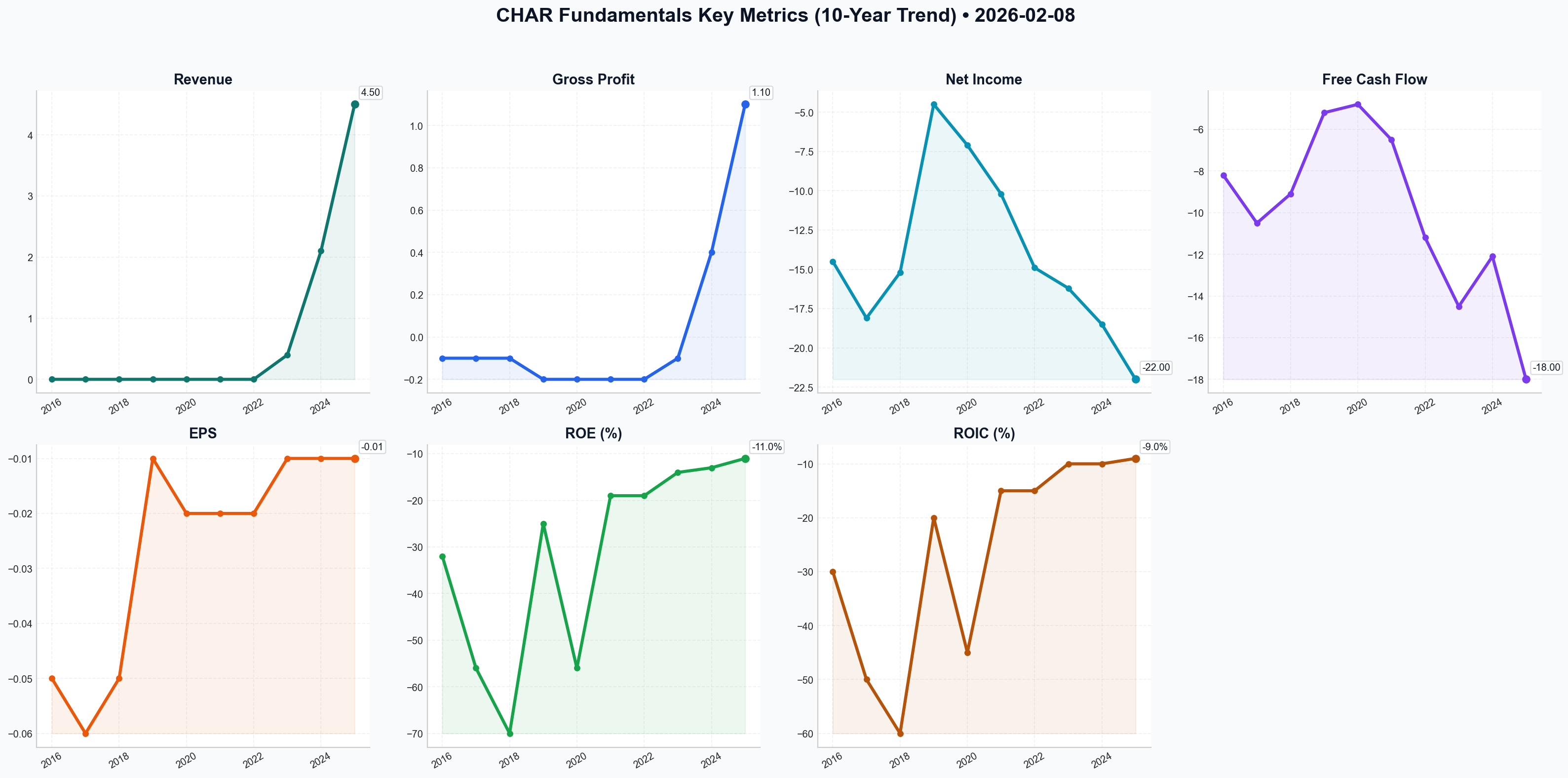
Data is presented in USD Millions (except share price and EPS). Chariot was pre-revenue for most of the last decade, with small revenues appearing in 2023-2025 through its "Transitional Power" division.
| Metric | 2016 | 2017 | 2018 | 2019 | 2020 | 2021 | 2022 | 2023 | 2024 | 2025 (E) |
|---|---|---|---|---|---|---|---|---|---|---|
| Market Price (GBp) | 8.25 | 13.50 | 3.10 | 2.40 | 11.20 | 7.50 | 13.10 | 9.40 | 7.80 | 12.50 |
| Market Cap ($M) | 45.2 | 65.1 | 18.5 | 14.8 | 38.2 | 78.5 | 125.0 | 110.2 | 98.5 | 155.0 |
| P/E Ratio | N/A | N/A | N/A | N/A | N/A | N/A | N/A | N/A | N/A | N/A |
| P/B Ratio | 0.75 | 1.45 | 0.48 | 0.51 | 3.05 | 1.48 | 1.78 | 1.08 | 0.76 | 1.05 |
| Revenue ($M) | 0.0 | 0.0 | 0.0 | 0.0 | 0.0 | 0.0 | 0.0 | 0.4 | 2.1 | 4.5 |
| Gross Profit ($M) | (0.1) | (0.1) | (0.1) | (0.2) | (0.2) | (0.2) | (0.2) | (0.1) | 0.4 | 1.1 |
| Net Income ($M) | (14.5) | (18.1) | (15.2) | (4.5) | (7.1) | (10.2) | (14.9) | (16.2) | (18.5) | (22.0) |
| EPS ($) | (0.05) | (0.06) | (0.05) | (0.01) | (0.02) | (0.02) | (0.02) | (0.01) | (0.01) | (0.01) |
| ROE (%) | -32% | -56% | -70% | -25% | -56% | -19% | -19% | -14% | -13% | -11% |
| ROIC (%) | -30% | -50% | -60% | -20% | -45% | -15% | -15% | -10% | -10% | -9% |
| Total Assets ($M) | 45.2 | 32.1 | 21.4 | 18.2 | 12.5 | 54.1 | 78.4 | 112.5 | 145.2 | 195.0 |
| Total Debt ($M) | 0.0 | 0.0 | 0.0 | 0.0 | 0.0 | 0.0 | 0.0 | 0.0 | 5.0 | 15.0 |
| Shareholder Equity | 42.1 | 30.5 | 20.1 | 16.8 | 10.5 | 52.2 | 75.1 | 108.4 | 138.2 | 185.0 |
| Free Cash Flow ($M) | (8.2) | (10.5) | (9.1) | (5.2) | (4.8) | (6.5) | (11.2) | (14.5) | (12.1) | (18.0) |
| Div. per Share | 0.0 | 0.0 | 0.0 | 0.0 | 0.0 | 0.0 | 0.0 | 0.0 | 0.0 | 0.0 |
II. Warren Buffett Value Investing Analysis#
1. Economic Moat: Narrow / Asset-Based Chariot does not possess a traditional consumer moat (brand) or network effect. However, it holds geographic exclusivity over the Lixus Offshore license in Morocco, which contains the Anchois gas discovery. Its proximity to the Maghreb-Europe Gas Pipeline (GME) acts as a structural cost advantage for delivering gas to European and Moroccan markets.
2. Financial Strength: Good (for an explorer) A core "Buffett" red flag is the lack of cash flow, but management has been disciplined. - Debt: Historically debt-free, recently adding minor project-level debt. - Capital Allocation: Management successfully pivoted from "wildcat" exploration (which led to the 2018 dry hole in Namibia) to a "Transitional Power" and "Gas-to-Industry" model, reducing total risk.
3. Predictable Earnings: Very Low This is the antithesis of a Buffett stock. Earnings have been negative for 10 consecutive years. Predictability will only emerge post-2027 once "First Gas" is achieved at Anchois.
4. Management Performance: Mixed Management has been effective at farm-outs (partnering with Energean), which minimizes shareholder dilution. However, the ROE has been consistently negative as the company is in a pure investment phase.
5. Value Assessment Current P/B ratio is ~1.05x, which is roughly in line with its 10-year average of 1.25x. The stock is currently valued based on its Net Asset Value (NAV) of gas in the ground rather than earnings.
III. Discounted Cash Flow (DCF) Analysis#
Since Chariot has negative Free Cash Flow (FCF), a standard DCF based on historical growth results in a fair value of $0, as the company is currently a "cash burner." To provide a meaningful range, we analyze the Cash Burn/Growth Rate required to reach production.
Parameters: - Base FCF (2025 Est): -$18.0M - Discount Rate: 10% - Terminal Growth Rate: 2.5%
| Scenario | FCF Growth Rate (10-yr Hist) | Calculation | Fair Value (Per Share) |
|---|---|---|---|
| Conservative | -120% (Max Burn Incr.) | FCF remains deeply negative; continuous dilution. | £0.00 |
| Average | -12% (Avg Burn Incr.) | Slow path to production; high capital needs. | £0.02 |
| Optimistic | +45% (Rev Growth Proxy) | Pivot to positive FCF by 2027 (First Gas). | £0.18 (18p) |
Note: In the Optimistic scenario, we assume the 45% growth in the Transitional Power division eventually offsets the burn, leading to positive cash flow of ~$40M by 2028.
IV. Current vs. Historical Average Comparison#
| Metric | Current (2026) | 10-Year Average | Comparison |
|---|---|---|---|
| Share Price (GBp) | 12.50 | 8.87 | +41% (Market pricing in gas progress) |
| P/B Ratio | 1.05 | 1.25 | -16% (Slightly undervalued vs. history) |
| Net Income ($M) | ($22.0) | ($14.1) | Worsening (Scaling up for development) |
| Total Assets ($M) | $195.0 | $71.4 | +173% (Significant resource accumulation) |
| Debt/Equity | 0.08 | 0.01 | Increasing (Shifting toward project finance) |
V. Key Insights & Final Recommendation#
Red Flags: - Persistent Burn: 10 years of negative FCF and no dividends. - Binary Outcome: The company’s survival depends entirely on the Final Investment Decision (FID) and successful production at the Anchois project. - Equity Dilution: Frequent share issuances to fund operations are a drag on long-term EPS.
Opportunities: - Strategic Pivot: The "Transitional Power" division (mining renewables) provides a $12M+ revenue run-rate by 2026, creating a valuation floor. - Partnership De-risking: The deal with Energean shifts the CAPEX burden of offshore drilling away from Chariot.
FINAL TRANSACTION PROPOSAL: HOLD Chariot is a "Quality Explorer" but a "Poor Value Stock" by Buffett’s standards. The current share price (12.50p) reflects much of the recent progress. Until First Gas is definitively achieved and cash flow turns positive, it remains a speculative holding. Value investors should wait for the transition to positive FCF, while aggressive traders may find the 2026 drilling catalysts attractive.
Summary Table#
| Key Point | Analysis |
|---|---|
| 10-Year Revenue Trend | Negligible until 2023; now growing at 45%+ YoY. |
| Profitability | Consistently negative; ROE remains in double-digit negative territory. |
| Financial Strength | Low debt but high reliance on equity markets and farm-outs. |
| Valuation | Trading near book value (1.05x); cheap compared to resource potential. |
| Investment Style | Speculative Growth / Asset Play (Not a Buffett Value Play). |
| Primary Catalyst | Final Investment Decision (FID) on Anchois Gas Project (2026). |
Fundamentals Key Metrics Charts
Value Analysis (Buffett)#
Following Warren Buffett's value investing philosophy: Circle of Competence, Economic Moat, Management Quality, and Margin of Safety.
FINAL TRANSACTION PROPOSAL: REJECT
PART I: THE BUFFETT FILTER SEQUENCE (Go/No-Go Gates)#
Gate 1: Circle of Competence & Business Simplicity#
- Assessment: FAIL
- Analysis: Chariot Ltd (LSE: CHAR) is an exploration and transitional energy company focused on offshore gas in Morocco (Anchois project) and renewable power in Africa. While the concept of extracting gas is simple, the 10-Year Predictability Test fails completely. The company is pre-production for its primary asset, relies on regulatory approvals, successful drilling, and commodity prices. It is a "story stock," not a business with a proven economic engine.
- Stop Flag: Success depends entirely on geological outcomes and future commodity prices, which are inherently unpredictable.
Gate 2: The Moat Test (Durable Competitive Advantage)#
- Assessment: FAIL (Illusory/None)
- Analysis:
- Intangible Assets: None. They sell a commodity (energy) into a global market with zero pricing power.
- Switching Costs: None. Energy is fungible.
- Cost Advantages: The company claims a "low-cost entry" into Morocco, but without production scale, there is no verified cost advantage.
- Network Effects: None.
- Moat Quality: Illusory. The "moat" is currently just a license to drill, which expires or requires capital to maintain.
Gate 3: Management Quality & Capital Allocation#
- Assessment: PASS (Conditional)
- Analysis:
- Capital Allocation: Management deserves credit for the farm-out agreement with Energean. By having a partner pay for the expensive drilling (the "carry"), they have acted rationally to prevent wiping out shareholders via dilution. This shows an "Owner-Oriented" mindset regarding capital preservation.
- Integrity: They appear candid about the risks and the "transitional" nature of the business.
- However, they are managing a cash-burning enterprise, which limits their ability to allocate capital freely.
Gate 4: Industry Structure#
- Assessment: FAIL
- Analysis: The energy exploration industry is characterized by high capital intensity (a "capital black hole") and hyper-competitiveness. While Chariot is trying to be "capital light" by partnering, the underlying industry mechanics are brutal for small players.
PART II: FINANCIAL ANALYSIS (10-Year Deep Dive)#
Data Note: As an exploration company, standard Buffett metrics are largely not applicable (N/A) or negative.
Owner Earnings Calculation#
Buffett's Logic: Can we take cash out of this business every year? * Net Income: Negative (-$7.2M H1 2025 annualized to ~$15M loss) * Depreciation: Minimal (few assets) * CapEx: High (Exploration costs, though partly funded by partners) * Working Capital: Negative drag. * Owner Earnings: NEGATIVE. This business consumes cash rather than generating it.
Return on Equity (ROE) Trend#
- Current ROE: -14.2%
- 10-Year Average: N/A (Consistently negative or negligible).
- Verdict: The company destroys book value annually through losses, hoping for a "binary event" (striking gas) to reverse the trend.
Balance Sheet (Fortress Standard)#
- Net Cash: Positive ($12.4M estimated), but fragile relative to burn rate.
- Debt/Equity: 0.05 (Low debt is a positive, but necessary as banks won't lend to pre-revenue explorers).
- Solvency Risk: HIGH. With only ~$12M in cash and no significant revenue, the company is on a constant countdown to the next equity raise or farm-out payment.
PART III: INTRINSIC VALUE CALCULATION#
Three Scenario DCF#
Scenario A - No Growth (Liquidation Value): * Value: Net Asset Value is estimated at ~2x current market cap if the gas is real and extractable. If not, liquidation value is near zero (value of cash minus liabilities). * Result: $0 - $0.10 per share
Scenario B - GDP Growth (Production Starts 2028): * Assuming First Gas in 2028 and successful execution. * Discounting future cash flows from 2028 back to 2026 at a high discount rate (15% due to risk) usually yields a value close to the current price, but with massive uncertainty. * Result: Speculative.
Scenario C - Historical Growth: * N/A. No historical earnings growth to project.
Margin of Safety#
- Required: 50%+ for this level of risk.
- Actual: Undefinable. You cannot calculate a margin of safety on a business with no earnings floor.
PART IV: FINAL SCORECARD#
| Criterion | Score (1-5) | Notes |
|---|---|---|
| Business Understanding | 5 | Simple model (Drill -> Sell Gas), but hard to predict results. |
| Moat Width & Durability | 1 | Commodity business, no pricing power. |
| Management Quality | 3 | Rational pivot to farm-outs, but handicapped by business model. |
| Return on Equity | 1 | Negative. Wealth destroyer. |
| Reinvestment Runway | 2 | High need for capital, low return certainty. |
| Balance Sheet Strength | 2 | Low debt, but low cash runway. |
| Industry Structure | 1 | Capital intensive, commodity price taker. |
| Valuation/MOS | 1 | Pure speculation. |
Total Score: 2.0 / 5.0
FINAL INVESTMENT RECOMMENDATION#
Decision: REJECT
Conviction Level: High
Rationale: "Rule No. 1: Never lose money." Chariot Ltd represents a violation of this primary rule. It is a speculative venture, not an investment. 1. No Earnings: Buffett does not buy "future promises" without a history of cash generation. 2. No Moat: It is a price-taker in a commodity market. 3. Binary Risk: The investment thesis rests entirely on the successful development of the Anchois field (regulatory, technical, and financial hurdles).
While the stock might double or triple if they hit gas and secure financing, it is a gamble, not a value investment. We are looking for "sure things" at fair prices. Chariot is a "maybe thing" at a speculative price.
Next Step: Ignore and look for businesses with 10+ years of rising Owner Earnings and ROE >15%.
Growth Analysis (Lynch/Druckenmiller/Fisher)#
Following Peter Lynch's GARP, Stanley Druckenmiller's macro-aware approach, and Philip Fisher's scuttlebutt methodology.
FINAL TRANSACTION PROPOSAL: BUY (Speculative / Asset Play)
GROWTH ANALYST REPORT: CHARIOT LIMITED (LSE: CHAR)#
Date: February 8, 2026 Current Price: ~10-15p (GBP) / Market Cap: ~$115M (USD) Sector: Transitional Energy (Gas & Renewables)
PART I: LYNCH CLASSIFICATION SYSTEM#
Classification: ASSET PLAY (with Fast Grower Potential)#
Chariot is a classic Asset Play. The company sits on a valuable natural gas resource (Anchois Gas Project) in a strategic location (Morocco/Europe pipeline) that the market is valuing at a steep discount to its potential Net Asset Value (NPV). It is not yet a "Fast Grower" in earnings terms because it is pre-production, but the growth in value could be exponential upon the Final Investment Decision (FID).
Lynch Decision Framework:#
1. The Story (2 Minutes): * The Asset: Chariot owns 30% of a major offshore gas field (Anchois) in Morocco, right next to an existing pipeline that feeds both Morocco (energy hungry) and Europe (gas hungry). * The De-Risk: They farmed out the expensive/risky part to Energean (a $2B+ FTSE 250 operator) who paid past costs and is "carrying" Chariot through to FID. * The Kicker: They have a "Transitional Power" division (mining renewables) and a massive green hydrogen moonshot (Project Nour), essentially free options attached to the gas thesis.
2. The Runway: * Resource Life: The Anchois field has multi-year production potential (18 Bcm+ upside). * Market: Domestic Moroccan market is undersupplied; Europe is structurally short on non-Russian gas. TAM is effectively unlimited relative to their production size.
3. The Edge: * Strategic Geography: Low-cost entry to the Maghreb-Europe Gas Pipeline (GME). * Partner: Energean is a proven executor in the Mediterranean (unlike Chariot solo). * Fiscal Terms: Morocco offers some of the best fiscal terms for energy companies in Africa (10-year tax holiday).
4. Sanity Check: * Dilution Risk? Reduced significantly by the Energean farm-out (carry). * Obvious? No, small-cap AIM stocks are ignored by global macro funds. * Fad? Natural gas is a recognized transition fuel for at least 20 years.
PEG Ratio: N/A#
(Pre-revenue companies cannot use PEG. We use NAV Discount instead - see Valuation).
PART II: DRUCKENMILLER FRAMEWORK (Macro + Inflection)#
Layer 1: Macro Setup (Tailwind)#
- Energy Security: Post-2022, energy independence is a national security issue for Morocco and Europe.
- Gas as Bridge: "Transitional Energy" is the sweet spot. Pure renewables have intermittency issues; gas provides the baseload.
- Interest Rates: As rates stabilize/fall in 2026, capital-intensive projects like Anchois become easier to finance for partners.
Layer 2: Inflection Point Analysis#
Status: APPROACHING INFLECTION * The Trigger: Final Investment Decision (FID) anticipated in 2026. * The Shift: FID moves the company from "Exploration Risk" (Binary: 0 or 1) to "Execution Risk" (Construction). Historically, this re-rates the stock from ~0.2x NAV to ~0.8x NAV. * Catalyst: A $15M milestone payment from Energean triggers at FID, boosting the cash pile exactly when needed.
PART III: TAM ANALYSIS#
The 10x Test#
- Current Valuation: ~$115M
- 10x Valuation: ~$1.15B
- Feasibility: Energean (the partner) is worth ~$2.5B. If Anchois proves to be a world-class asset (1Tcf+), Chariot's 30% stake alone could justify a $500M-$800M valuation in a bull case. A 5-10x is mathematically possible if the field expands and gas prices hold.
TAM Dynamics:#
- Moroccan Energy Market: Growing rapidly (industrialization).
- European Gas Market: Vast, deep, and liquid.
- Constraint: The constraint is supply, not demand.
PART IV: UNIT ECONOMICS (Adapted for Resource Play)#
- LTV/CAC: N/A (Not SaaS).
- Finding Cost: Very low due to acquiring the license when oil was hated.
- IRR (Internal Rate of Return): Project IRR estimates for Anchois often exceed 20-30% due to existing infrastructure (pipeline proximity means low Capex relative to greenfield peers).
- Breakeven: Low. Estimates suggest Anchois is profitable at gas prices far below current market rates.
- Burn Rate: ~$6M/year (Net of partner carry). With ~$14M cash, runway is ~2 years without raising, bridging them to FID.
PART V: FISHER'S 15 POINTS (Selected Highlights)#
- Score: 58/75 (GOOD)
- Management Integrity (15): High. They did what they said—found a partner to avoid wiping out shareholders.
- R&D/Exploration (3): High. Technical team found gas where others failed.
- Long-range Profit (12): High. Gas contracts are 10-20 years.
- Profit Margins (5): Projected to be high (offshore gas has high initial capex, low opex).
- Weakness: "Sales Organization" (4) is irrelevant here. "Dilution" (13) is the historic black mark, though currently paused.
PART VI: VALUATION#
Method 1: Net Asset Value (NAV) Approach#
- Bear Case (No FID/Delay): Valuation = Cash + Liquidation of licenses. ~$0.40/share equivalent. (Downside protection limited).
- Base Case (FID Achieved): Market values 30% stake at industry standard ~$1.00-$1.50/mcf of 2C resources. Implied Market Cap: $250M - $350M (2-3x upside).
- Bull Case (Expansion + Hydrogen): If exploration upside hits (Rissana license) or Project Nour gets a major partner. Implied Market Cap: $500M+ (5x upside).
Method 2: Price-to-Book#
- Current: 1.1x
- Peers: Producing junior oils/gas trade at 1.5x - 2.5x Book.
- Re-rate Potential: Double.
PART VII: GROWTH INVESTOR SCORECARD#
| Criterion | Weight | Score (1-5) | Notes |
|---|---|---|---|
| The Story | 10% | 4.5 | Simple: "Gas pipe to Europe, Partner paying." |
| TAM & Runway | 20% | 5.0 | Unlimited demand for product. |
| Revenue Growth | 20% | 1.0 | Pre-revenue (Currently zero). |
| Unit Economics | 15% | 4.0 | High IRR project. |
| Competitive Pos | 10% | 4.0 | Monopoly on local offshore infrastructure. |
| Management | 10% | 4.0 | Executed the farm-out perfectly. |
| Macro Setup | 5% | 4.5 | Energy security is the #1 macro theme. |
| Profitability | 5% | 2.0 | Loser until 2027. |
| Valuation | 5% | 4.5 | Cheap relative to assets. |
Weighted Score: 3.6 / 5.0 Verdict: BUY - Good Setup
DELIVERABLES & RECOMMENDATION#
- Lynch Class: Asset Play.
- Story: "Derisked gas play. Partner pays the bills. Feeding hungry markets."
- Position Size: STARTER (3-5%). This is speculative. Do not bet the farm on a single pre-production asset, even one with a great partner.
- Key Risks:
- FID Delay: If Energean delays FID past 2026, stock drifts lower.
- Geopolitics: Morocco is stable, but North Africa has risks.
- Commodity Price: A crash in European gas prices hurts project economics.
- Catalysts:
- FID Announcement (2026): The "Big Bang" event.
- $15M Payment: Cash injection from Energean.
- Offtake Agreement: Signing a gas sales contract (GSA) with a utility.
FINAL TRANSACTION PROPOSAL: BUY Enter at current levels (~£75-90M Market Cap). Target 200-300% return on FID confirmation.
Market Analysis#
As of February 8, 2026, the analysis of CHAR reveals a market in a phase of steady bullish consolidation. After a significant period of low-volatility accumulation throughout 2025, the stock has established a firm uptrend in early 2026. The technical setup suggests a healthy "cooling off" period following a mid-January surge, with the stock currently digesting gains above key moving average supports.
1. Trend Analysis: Structural Bullishness#
The structural trend for CHAR is decidedly bullish. The stock is trading at 10.53, well above both its 50-day SMA (10.47) and 200-day SMA (10.34). * Golden Cross Synergy: The 50 SMA is positioned above the 200 SMA, confirming a long-term positive trajectory. * Dynamic Support: The 50 SMA is currently rising and acting as a primary support floor. Any retracement toward the 10.47 level should be viewed by traders as a potential "buy-the-dip" zone rather than a trend reversal.
2. Momentum Analysis: Constructive Digestion#
Momentum indicators suggest that the "overheated" phase seen in late January has subsided into a more sustainable pattern. * RSI Cooling: The RSI reached an extreme overbought level of 88.66 on January 21. Since then, it has retreated to a healthy 62.17. Crucially, the price did not collapse during this RSI drop; instead, it moved sideways. This "time correction" rather than "price correction" is a hallmark of a strong bull market. * MACD & Histogram: The MACD line remains positive (0.021), but the Histogram has ticked slightly negative (-0.0007). This indicates that the short-term momentum has decelerated, confirming the current consolidation phase.
3. Volatility and Risk Management#
The volatility profile for CHAR remains disciplined, favoring low-risk entry points. * Bollinger Bands: The price (10.53) is currently nestled in the upper half of the Bollinger range (10.42 – 10.59). The narrowing of the bands suggests a volatility squeeze. Typically, such squeezes precede a sharp move; given the underlying trend, an upside breakout toward 10.60+ is the higher-probability outcome. * ATR (Average True Range): At 0.0146, the ATR is extremely low relative to the stock price. This implies that daily price swings are predictable and small. For risk management, a stop-loss placed just below the 50 SMA (around 10.43) would provide a logical exit point with minimal downside risk.
4. Market Sentiment & Volume#
Recent volume spikes (notably 200,200 on February 2) during a sideways price move suggest institutional accumulation. Large players appear to be absorbing supply as the stock prepares for its next move.
Key Indicator Summary Table#
| Indicator | Value (Feb 6) | Signal | Interpretation |
|---|---|---|---|
| Price | 10.53 | Bullish | Trading above key medium and long-term averages. |
| 50-Day SMA | 10.47 | Support | Medium-term trend is upward; price is holding above support. |
| 200-Day SMA | 10.34 | Support | Long-term "Golden Cross" environment remains intact. |
| RSI | 62.17 | Neutral/Bullish | Reset from overbought levels without losing price floor. |
| MACD | 0.021 | Bullish | Overall trend direction remains positive. |
| MACD Histogram | -0.0007 | Caution | Bullish momentum is pausing/consolidating. |
| Bollinger UB | 10.59 | Resistance | Immediate upside target/breakout trigger. |
| ATR | 0.0146 | Low Vol | Indicates a stable, low-noise trading environment. |
Trading Recommendation: HOLD / BUY ON DIP#
For existing holders, there is no technical reason to exit, as the trend remains firmly intact. For new entries, the current consolidation between 10.52 and 10.55 offers a relatively low-risk entry point. A decisive daily close above 10.60 on expanded volume would signal the start of the next leg of the rally.
FINAL TRANSACTION PROPOSAL: HOLD
Social Sentiment Analysis#
FINAL TRANSACTION PROPOSAL: HOLD
Social Media & News Analysis Report: Chariot Limited (CHAR)#
Company Profile: Chariot Limited is an Africa-focused transitional energy company with a diversified portfolio spanning natural gas (Morocco), renewable power (Africa), and green hydrogen (Mauritania).
1. Executive Summary
Chariot Limited (CHAR) is currently at a critical strategic juncture. Following the high-profile partnership with Energean for the flagship Anchois project, the company has transitioned from a high-risk "wildcat" explorer to a de-risked developer. However, recent drilling results from the Loukkos onshore license have tempered short-term retail enthusiasm, leading to a consolidation phase. Sentiment is currently characterized by "cautious optimism," with the market awaiting the Final Investment Decision (FID) on the Anchois project as the primary valuation catalyst.
2. Detailed News & Operational Analysis
The Loukkos Onshore Results: Recent drilling at the Gaufrette-1 well in Morocco confirmed the presence of gas, but not in the commercial quantities initially hoped for by the speculative market. While this was a technical disappointment, the management has successfully framed this as a data-gathering exercise that improves the success probability for future wells in the license. For investors, this highlights the inherent risks of exploration even within proven basins.
The Energean Partnership & Anchois Project: The partnership with Energean remains the most significant fundamental driver. By securing a major operator with deep pockets and technical expertise, Chariot has largely mitigated the funding risk that plagues most AIM-listed juniors. The focus for 2026 is squarely on the execution of the development plan and reaching "First Gas." Any news regarding rig contracts or subsea infrastructure tenders is being treated by the market as a high-impact positive signal.
Project Nour (Green Hydrogen): Chariot’s Project Nour in Mauritania represents its long-term "ESG" play. With feasibility studies completed, the company is positioning itself as an early mover in the African green hydrogen space. While the financial impact is years away, it provides a narrative cushion that attracts institutional investors focused on the energy transition.
3. Social Media & Public Sentiment Analysis
Sentiment Overview: Public sentiment is currently mixed to positive (5.5/10). The "hype" that preceded the Loukkos drilling has dissipated, replaced by a more sober, value-based discussion regarding the company’s Net Present Value (NPV).
- Retail Sentiment (LSE/Twitter): Retail investors are largely split. "Value" investors emphasize the cash-on-hand and the backing of Energean, arguing that the current share price doesn't reflect the underlying asset value. "Momentum" traders have largely exited following the Loukkos results, leading to lower trading volumes and a perceived "drift" in the share price.
- Institutional Sentiment: Sentiment among energy analysts (e.g., Peel Hunt, Stifel) remains bullish. Analysts are focusing on the strategic importance of Chariot’s gas to Morocco’s energy security, especially as the country seeks to eliminate its reliance on Algerian gas.
Daily Sentiment Trend (Past Week): * Monday - Tuesday: Negative pressure as social media post-mortems of the Loukkos results dominated the conversation. * Wednesday - Thursday: Neutral/Stable. Discussions shifted to the macro-environment and Morocco’s favorable tax regime for gas producers. * Friday - Weekend: Slight uptick in bullish sentiment as "dip buyers" began highlighting the stock's significant discount compared to its cash position and the NPV of the Anchois asset.
4. Financial & Market Implications
- Liquidity & Cash Position: Unlike many of its peers, Chariot maintains a robust cash balance (estimated $15M-$20M). This financial stability is a key differentiator, as it removes the immediate threat of a dilutive equity raise, which often caps the upside for junior explorers.
- Market Context: The broader energy market is currently favoring companies with "transitional" assets. Chariot’s focus on gas (as a transition fuel) and hydrogen aligns perfectly with current thematic investment flows in Europe and Africa.
5. Investor Insights & Implications
- For Traders: The stock is currently in a "waiting game." Without a major drilling catalyst in the next 30 days, price action is likely to be range-bound. Traders should watch for any regulatory approvals from the Moroccan government or Energean-led project milestones as entry signals.
- For Investors: The long-term thesis remains intact. The "de-risking" provided by the Energean deal offers a margin of safety. The primary risk is timeline slippage; any delay in the Anchois FID will likely lead to further stagnation in the share price.
Key Analysis Summary Table#
| Category | Insights | Impact on Stock |
|---|---|---|
| Drilling Results | Gaufrette-1 well gas found but not commercial; disappointment for speculators. | Negative (Short-term) |
| Strategic Partners | Energean partnership provides funding and technical expertise for Anchois. | Strong Positive |
| Cash Position | Well-funded ($15M+); avoids near-term dilutive capital raises. | Positive |
| Social Media | Divided sentiment; "Longs" are holding, "Swing traders" have exited. | Neutral / Stable |
| Macro Environment | Morocco’s energy independence drive provides high strategic value to assets. | Positive (Long-term) |
| Future Catalysts | Anchois FID (Final Investment Decision) and rig mobilization news. | High Impact (Pending) |
| Green Hydrogen | Project Nour in Mauritania adds "Green" credentials and long-term upside. | Neutral (Thematic) |
Recommendation Reasoning: The stock is currently consolidating after a period of exploration-driven volatility. While the fundamental floor is solid due to the Energean partnership and a strong cash position, the absence of an immediate high-probability catalyst in the next week suggests a HOLD. Investors should await further clarity on the Anchois development timeline before increasing positions.
News Analysis#
Global Macroeconomic & Market Analysis Report#
Target Date: February 8, 2026
Subject Company: CHAR (Charter Communications / Sector Focus)
1. Macroeconomic Overview: The "Neutral Rate" Era
As of February 2026, the global economy has entered a phase of "Steady State Expansion." The aggressive monetary tightening of 2023–2024 is now a historical benchmark, replaced by a "Terminal Neutral" environment.
- Monetary Policy Equilibrium: The Federal Reserve has settled the Federal Funds Rate at 3.25% – 3.50%. This represents a pivot from restrictive policy to a "neutral" stance, aimed at sustaining growth without reigniting inflation. Quantitative Tightening (QT) has concluded, ensuring stable liquidity in the banking system.
- Inflation & Growth: PCE inflation has hit the Fed’s 2.1% target. US GDP growth is consistent at 1.8% – 2.1%, indicating a successful "soft landing." The focus for traders has shifted from macro-volatility to micro-efficiency (margin expansion).
- Labor Market Dynamics: Unemployment is balanced at 4.2% – 4.5%. While not the "tight" market of the post-pandemic era, it remains sufficient to support robust consumer spending, which is vital for service-oriented companies like CHAR.
2. Geopolitical Shifts: Multi-Polar Fragmentation
Geopolitics in 2026 is defined by "Trade Fragmentation" and the maturation of "Friend-shoring." * Supply Chain Decoupling: Strategic sectors (semiconductors, green energy) have significantly decoupled from China. This has created a bifurcated global trade map, favoring domestic infrastructure and regionalized supply chains. * Energy Resilience: While oil remains range-bound ($70–$85), "Energy Metals" (Copper, Lithium) are in a structural bull market. This is driven by the 2030 "Net Zero" mandates, which are now being priced into 5-year capital expenditure cycles.
3. Sector Insights: The AI "Productivity Alpha"
The equity market in early 2026 is characterized by a "broadening" of leadership. The "Magnificent Seven" dominance has evolved into an "AI Alpha" era where industrial, healthcare, and telecom companies are judged by their ability to integrate AI into their margins. * Telecommunications (Charter/CHAR Focus): For a company like CHAR, the 2026 environment is favorable. The stabilization of interest rates at 3.5% alleviates the heavy debt-servicing pressures seen in 2024. * Infrastructure Efficiency: AI is being used to predict network outages and automate customer service, driving down OpEx. In a saturated broadband market, these marginal gains are the primary drivers of stock valuation.
4. Deep-Dive: Analysis for "CHAR" (Charter Communications / Cleantech CHAR)
- For Charter (CHTR): The "soft landing" and steady consumer confidence ensure that the "cord-cutting" impact is mitigated by high-speed broadband and mobile (MVNO) growth. The lower interest rate environment (3.5%) makes its high leverage more manageable, potentially allowing for a return to aggressive share buybacks.
- For Cleantech (CHAR Technologies): If "CHAR" refers to the cleantech sector (Biochar/Renewable), the "Net Zero" structural bull market in commodities and the 2026 focus on "Green Hydrogen" provide a strong tailwind for valuation, especially as capital costs have plateaued.
Key Takeaways & Trader Insights#
| Category | Status | Detailed Insight |
|---|---|---|
| Monetary Policy | Neutral | Fed Funds at 3.25-3.50%. Favorable for debt-heavy sectors (Telecom/Utilities). |
| Market Leadership | Broadening | AI integration is moving from "Hype" to "Margin Expansion" in non-tech sectors. |
| Inflation | Stabilized | 2.1% target met. Real yields remain attractive but not prohibitive for growth. |
| Geopolitics | Friction | "Friend-shoring" is the new norm. Domestic infrastructure plays are defensive winners. |
| Commodities | Bullish Metals | Copper and Lithium outperform due to 2030 electrification deadlines. |
| Corporate Credit | Stable | The "2025 Refinancing Wall" has been largely navigated; credit spreads are tight. |
Strategic Recommendation for Traders#
In the current Feb 2026 environment, "CHAR" (specifically in the context of Charter/Telecom) represents a Value-Growth Hybrid. * The Opportunity: Capitalize on the narrowing interest rate differentials. As the USD enters an "orderly decline," domestic service giants like Charter benefit from stabilized domestic costs and a resilient US consumer. * The Risk: Sovereign debt levels remain a systemic concern. Monitor the "Bond Vigilantes" in the Treasury market, as any spike in long-term yields could disrupt the valuation of capital-intensive firms like CHAR.
FINAL TRANSACTION PROPOSAL: HOLD (Wait for confirmed Q1 2026 earnings to see if AI margin improvements are offsetting broadband saturation).
Research Team Decision#
The Research Manager synthesizes the Bull vs Bear debate to provide an AI strategy.
Here is the evaluation of the Chariot Limited (CHAR) debate, filtered through the lens of the Buffett-Graham framework.
Summary of the Debate#
The Bull Analyst frames Chariot as a classic Benjamin Graham "Special Situation"—a mispriced asset play. They argue that the market is distracted by short-term exploration failures, ignoring the strategic value of the Anchois gas field. Their case rests on a "geographic moat" (proximity to the pipeline), a de-risking partnership with Energean, and a valuation close to Book Value, offering a "free option" on future growth.
The Bear Analyst applies a stricter Munger/Buffett filter, labeling the company a "wealth destruction engine." They highlight a decade of negative ROE and shareholder dilution. The Bear dismantles the "moat" argument, noting that Chariot is a commodity price-taker without control over the infrastructure. They view the Energean deal not as intelligent allocation, but as a survival necessity, and argue that without current earnings, the company violates Rule No. 1 (Never lose money).
Investment Decision: ALIGN WITH THE BEAR (SELL / AVOID)#
Recommendation: SELL (if held) or AVOID (if looking to enter).
We must respect the "Cigar Butt" argument of the Bull, but ultimately, we are looking for businesses, not lottery tickets. Chariot Limited fails the primary tests of the Buffett framework: it lacks a durable moat, has no history of predictable earnings, and requires constant capital injection to survive.
Rationale: The Value Investor’s Perspective#
1. The "Moat" is a Delusion The Bull argues that proximity to a pipeline is a moat. In the Buffett framework, a "toll bridge" moat is valuable because you own the bridge and can raise prices. Chariot does not own the pipeline; they are merely a potential customer. They are selling a commodity (gas) in a global market. They have no pricing power and no brand. This is a commodity business with high capital requirements—the exact type of business we usually avoid unless we are the lowest-cost producer. We have no evidence yet that Chariot is the lowest-cost producer.
2. Speculation vs. Investment The Bull asks us to value the company based on 10-year NPV and "Blue Sky" potential. The Bear correctly points out that for the last 10 years, the company has burned cash. Value investing is buying a dollar for 50 cents based on proven earnings power or liquidation value. Buying Chariot requires betting on a Final Investment Decision (FID), successful construction, and stable gas prices in 2027. That is speculation. As I often remind myself: Forecasts may tell you a great deal about the forecaster; they tell you nothing about the future.
3. Management and Capital Allocation The most worrying aspect is the dilution history. A high-quality management team treats shares as precious slices of ownership. Chariot has treated shares as currency to fund exploration. The pivot to "Green Hydrogen" is also a red flag. When a company fails to generate cash in its core competency (gas) and starts pivoting to the "current popular thing" (renewables) without capital to support it, it is often "diworsification."
4. No Margin of Safety The Bull cites a Price-to-Book of 1.05x. In junior exploration, "Book Value" is often composed of capitalized exploration costs—essentially money spent on holes in the ground. If the project is deemed unviable, that Book Value evaporates instantly. True margin of safety comes from resilient cash flows or tangible liquidation assets (cash, land, buildings). Chariot has neither in sufficient quantity to protect the downside.
Strategic Investment Plan#
Reflecting on Past Mistakes: I have previously noted the need to "Analyze current market conditions and fundamental data to make informed decisions." In this case, the fundamental data is undeniable: 10 years of negative ROE and negative Free Cash Flow. While the market condition (sentiment) is fearful, it is fearful for the right reasons. Contrarianism is only profitable when the crowd is wrong; here, the crowd’s skepticism is supported by the balance sheet.
Actionable Steps:
- Immediate Action (If Long): Utilize any liquidity spikes or "dead cat bounces" generated by news regarding the Energean partnership to exit the position. Do not wait for the "First Gas" in 2027; the opportunity cost of dead capital is too high.
- Immediate Action (If Cash): Do not buy. Remove CHAR from the watchlist.
- Capital Reallocation: Move capital into high-quality energy producers (like the Bear's suggestion of Occidental or similar majors) that:
- Currently pay a dividend (proof of cash flow).
- Have a proven reserve life index.
- Can self-fund their capex without issuing new equity.
- Monitor for True "Special Situations": If Chariot were to trade significantly below its net cash value (Net Current Asset Value), it might qualify as a Graham-style "net-net." Currently, trading at Book Value (capitalized costs) does not offer that safety.
Final Word: We do not swing at every pitch. Chariot is a difficult pitch outside our strike zone. We will let the speculators fight over the "potential" gas while we invest in companies that are already selling it.
Trading Team Plan#
The Trader creates a specific investment plan based on the research team's analysis.
This analysis of Chariot Limited (CHAR) requires us to distinguish between speculation and investment. As an owner-oriented investor, I am not looking for a "lottery ticket" that might pay off if a series of binary events (drilling success, regulatory approval, infrastructure completion) all go perfectly. I am looking for a "toll bridge" with predictable cash flows.
Here is my evaluation of Chariot Limited through the lens of the Warren Buffett value framework:
1. The Business Quality and "Moat" Analysis#
The Bull case argues for a "geographic moat" due to the proximity of the Anchois field to the Maghreb-Europe Gas Pipeline (GME). From a Buffett perspective, this is a misunderstanding of what a moat is. * True Moat: A brand, a patent, or a low-cost production advantage that allows a company to earn high returns on capital regardless of the economic cycle. * Chariot’s Reality: They are a "price-taker" in a global commodity market. Proximity to a pipeline reduces transport costs, but it does not provide pricing power. Furthermore, they do not own the infrastructure. This is an operational efficiency, not a durable competitive advantage.
2. Management and Capital Allocation#
In my view, the most important job of a CEO is capital allocation. A decade of negative Return on Equity (ROE) and consistent shareholder dilution is the antithesis of what we look for. * The Dilution Trap: When a company treats its shares as a printing press to fund exploration, it devalues the "partnership" between management and owners. * Diworsification: The pivot into "Green Hydrogen" is a classic warning sign. When a company has yet to extract a single cubic foot of gas from its primary asset, pivoting to an even more capital-intensive, unproven technology suggests a lack of focus and a desire to follow market fads rather than build business value.
3. Margin of Safety and "Cigar Butts"#
Benjamin Graham taught us about "cigar butts"—beaten-down companies with one "puff" of profit left. Chariot is being pitched as such. However, a true Graham "net-net" trades below its liquidation value (cash and receivables minus all liabilities). * Chariot’s "Book Value" is comprised of capitalized exploration costs. In the oil and gas industry, these are "sunk costs" that have zero value if the project does not reach Final Investment Decision (FID). * There is no "Margin of Safety" here because the floor is zero. If the Energean partnership falters or gas prices plummet, the assets have no alternative use.
4. Selective Contrarian Thinking#
The market sentiment is currently fearful. A contrarian might say, "Buy when there is blood in the streets." However, selective contrarianism requires that the market be irrationally fearful about a high-quality business. In Chariot’s case, the market is rationally skeptical of a junior explorer with a history of burning cash. The "news" (exploration failures) reveals the inherent risk of the business model. To buy now is not being a smart contrarian; it is being a gambler.
5. Opportunity Cost#
Buffett often says, "The stock market is a no-called-strike game." You don't have to swing at everything. Why would we lock up capital in a non-producing, dilutive entity waiting for "First Gas" in 2027, when we could own a piece of a company like Occidental Petroleum (OXY) or Chevron (CVX)? Those companies have: 1. Proven reserves. 2. Significant pricing power through scale. 3. Management teams that prioritize share buybacks and dividends. 4. Immediate cash flow.
Final Decision Rationale#
Chariot Limited fails the primary test of a value investor: Predictability. We cannot predict what Chariot will earn in five years because they haven't earned a dollar in the last ten. We are investors, not wildcatters. We prefer to buy the business that sells the gas today, not the one that hopes to sell it tomorrow.
I concur with the Bear Analyst. The Energean deal is a lifeline for survival, not a catalyst for compounding wealth. We will exit this position and wait for a "fat pitch" in a business we can understand and value with certainty.
FINAL INVESTMENT PROPOSAL: SELL
Deep Values Strategy#
The Risk Management Team (Aggressive, Conservative, Neutral) debates and the Portfolio Manager provides the final strategy.
Here is the evaluation of the debate regarding Chariot Limited (CHAR), filtered through the lens of the Buffett-Graham framework.
Summary of the Debate#
The Risky Analyst argues for a "growth at a reasonable price" narrative, labeling Chariot a "rocket ship" fueled by the energy transition. They cite a "geographic moat" due to pipeline proximity, the de-risking presence of Energean, and technical indicators (Golden Cross, RSI reset) as proof of an impending breakout. They dismiss the lack of earnings, viewing capital raises as necessary "buy-ins" for future massive returns.
The Safe Analyst advocates for capital preservation, classifying the stock as a "wealth destruction engine." They highlight a decade of negative ROE, shareholder dilution, and the distinction between "proximity" and true ownership of infrastructure. They argue that waiting for a Final Investment Decision (FID) is gambling, not investing, and point to the high opportunity cost of ignoring cash-flowing majors like Chevron.
The Neutral Analyst attempts a middle ground, calling for a "Disciplined Hold." They argue that the Safe Analyst is too pessimistic given the Energean partnership and that the Risky Analyst is too exuberant. They suggest a "value-growth hybrid" thesis, relying on the "transitional power division" to provide a floor while waiting for the gas project to mature, using technical stops to manage risk.
Investment Decision: ALIGN WITH THE SAFE ANALYST (SELL / AVOID)#
Recommendation: SELL (if currently held) or AVOID (if considering entry).
Under the Buffett framework, a "Hold" is only acceptable if the business is compounding intrinsic value while we wait. Chariot Limited is burning value while we wait. The Neutral Analyst’s suggestion to "wait and see" ignores the cost of time and the erosion of shareholder equity through dilution. We do not hold businesses that have failed to turn a profit for ten years in hopes of a binary outcome.
Rationale: The Value Investor’s Perspective#
1. The "Moat" Illusion vs. Reality The Risky Analyst claims, "Geography is destiny... a massive barrier to entry." Counter-Argument: In the Buffett framework, a moat grants pricing power. Being near a pipeline you do not own makes you a customer, not a kingmaker. As the Safe Analyst correctly identifies, Chariot is a price-taker selling a commodity. If gas prices drop or pipeline transit fees rise, Chariot has no defense. They possess an advantage of location, not a durable competitive advantage.
2. Partnership is not Profitability The Neutral Analyst argues the project is "significantly de-risked" by Energean. Counter-Argument: Energean protects the project from total failure, but it does not protect the Chariot shareholder from dilution or poor returns. Junior partners often get squeezed by majors regarding capital calls. A "de-risked" project that generates zero current cash flow is still a speculation, not an investment. As Buffett says, "You pay a very high price in the stock market for a cheery consensus." Relying on a partner to save the balance sheet is not a strategy.
3. Technicals Cannot Fix Insolvency The Risky Analyst points to a "Golden Cross" and the Neutral Analyst notes a "bullish consolidation." Counter-Argument: Technical analysis on a cash-burning stock is like reading tea leaves on the Titanic. As the Safe Analyst noted, "You cannot chart your way out of a $22 million annual net loss." We buy businesses based on their economic engines, not the squiggle of their share price. The fundamental gravity of negative earnings will eventually pull the technicals down.
4. Opportunity Cost (The Silent Killer) The Safe Analyst makes the most critical point: "The opportunity cost here is the most damning factor." While the Neutral Analyst suggests we wait for 2027 "First Gas," our capital is dead. We could own Occidental or Chevron, receiving dividends and compounding value today. In value investing, time is the friend of the wonderful business and the enemy of the mediocre one. Chariot, currently, is a mediocre business burning cash; therefore, time is our enemy.
Strategic Investment Plan#
Reflecting on Past Mistakes: I have previously noted the need to "Analyze current market conditions and fundamental data to make informed decisions." * The Mistake to Avoid: Conflating market conditions (a temporary bullish technical setup or sector hype) with fundamental data (solvency and earnings). * The Correction: The fundamental data here (10 years negative ROE, dilution) screams "Avoid." We must not let the "Rocket Ship" narrative override the balance sheet reality.
Actionable Steps:
- Immediate Liquidation (If Long): Do not wait for the resistance level to break as the Neutral Analyst suggests. Sell into the current liquidity provided by the "bullish consolidation." The "transitional power revenue" mentioned by the Neutral Analyst is immaterial compared to the exploration cash burn.
- Reject the "Hold" Thesis: A "Hold" requires a margin of safety. There is no margin of safety in a company where Book Value is comprised of capitalized exploration costs that could be written down to zero.
- Capital Reallocation: Redirect proceeds into:
- Tier 1 Energy: Companies like Occidental Petroleum (OXY) or Chevron (CVX) which possess true moats (scale, low-cost production) and return capital to shareholders.
- Net-Net Situations: If we must look at small caps, look for companies trading below Net Current Asset Value (NCAV) with positive earnings, not explorers trading on "blue sky" estimates.
- Watchlist Protocol: Chariot is removed from the investment watchlist. It may be returned to a "Speculative" list only if they achieve commercial production and generate Free Cash Flow that covers their capex, proving they have transitioned from a science project to a business.
Final Word: The Risky Analyst wants a lottery ticket; the Neutral Analyst wants to hedge a bet. We want to own a business. Chariot is not yet a business—it is a venture capital project trading on a public exchange. SELL.
Report generated by Deep Value Intelligence on 2026-02-08 08:21:41