
Company Research COINDeep Value Intelligence
Coinbase (COIN) Deep Value Intelligence Report

In brief
DeepValues Research published a Deep Value Intelligence report on Coinbase (COIN) on Feb 7, 2026. After reviewing the debate between the Risky, Safe, and Neutral analysts, and applying the Graham-Dodd-Buffett framework, my decision is definitive: SELL / AVOID.
Source: https://research.deepvalues.ai/company/coin/2026-02-07-en/ · Markdown · More on Coinbase (COIN)
Contents
- Intelligence Summary
- Analyst Team Reports
- VALUE INVESTMENT ANALYSIS: COINBASE GLOBAL (COIN)
- PART I: THE BUFFETT FILTER SEQUENCE
- PART II: FINANCIAL ANALYSIS
- PART III: INTRINSIC VALUE CALCULATION
- PART IV: FINAL SCORECARD
- Investment Analysis: Coinbase Global, Inc. (COIN)
- PART I: LYNCH CLASSIFICATION
- PART II: DRUCKENMILLER INFLECTION POINT ANALYSIS
- PART III: UNIT ECONOMICS & FINANCIAL HEALTH
- PART IV: FISHER'S 15 POINTS ANALYSIS (Select Highlights)
- PART V: VALUATION
- PART VI: GROWTH INVESTOR SCORECARD
- FINAL RECOMMENDATION
- Research Team Decision
- Trading Team Plan
- Deep Values Strategy
Intelligence Summary#
Here is my assessment, delivered straight, investor-to-investor.
The Verdict#
After reviewing the debate between the Risky, Safe, and Neutral analysts, and applying the Graham-Dodd-Buffett framework, my decision is definitive: SELL / AVOID.
I am siding with the Safe Analyst. While the Risky Analyst makes a spirited case for a "spring-loaded" technical bounce and the "Fort Knox" narrative, the investment thesis for Coinbase at ~$165 violates the two most sacred tenets of our philosophy: Predictability of Earnings and Margin of Safety.
We are being asked to pay a growth multiple (25x+) for a business facing a "race to the zero" in fees, currently propped up by high interest rates. That is a recipe for permanent capital impairment.
Rationale: Why the Bear Wins#
The Value Investing framework rejects the Bull’s thesis for the following reasons:
1. The "Moat" is Leaking (The Vanguard Effect) The Risky Analyst argues that being the custodian for BlackRock’s ETF is a "strategic capture." I agree with the Safe Analyst: this is actually the "Vanguard Effect." Custody is a commodity. BlackRock and Fidelity built their empires by grinding fees down to zero. They will inevitably squeeze Coinbase’s custodial margins. A true franchise, like Coca-Cola or See’s Candies, dictates terms to its customers. Coinbase is a vendor to giants who excel at cost-cutting. Relying on them is a dependency, not a moat.
2. The "Interest Income" Illusion A massive red flag is the reliance on USDC interest income to justify the valuation. As the Safe Analyst noted, "That revenue isn't coming from Coinbase’s competitive edge; it’s coming from the Federal Reserve." We buy businesses for their operational prowess, not their treasury management. If the Fed cuts rates, Coinbase’s earnings collapse through no fault of management. We do not pay high P/E multiples for a business model that is essentially a leveraged bet on the Fed Funds Rate remaining high.
3. No Margin of Safety The Safe Analyst points out a conservative DCF value of $108. The current price is ~$165. That is a ~50% premium over the conservative estimate. The Risky Analyst wants us to "Buy the fear" based on an RSI of 14. Value investors do not buy based on RSI; we buy based on the gap between Price and Value. With a negative margin of safety, we have no protection against the "unknown unknowns" (e.g., SEC litigation or a crypto winter).
4. Innovation vs. Speculation The Risky Analyst speaks of the Base network becoming the "App Store" of finance. While possible, this falls into the realm of venture capital, not value investing. We do not bet the firm's capital on unproven business pivots ("Layer 2 sequencers") to save a deteriorating legacy business (trading fees). As the Neutral analyst pointed out, this transition is "far from a guaranteed moat."
The Investment Plan#
Here is exactly how we are going to handle this situation for the trader:
- If you hold the stock: Sell into any current technical strength. The Risky Analyst claims an RSI of 14 is a buy signal; we view any resulting bounce as a liquidity event to exit our position. Do not wait for $200. The risk-reward profile is asymmetric to the downside.
- If you are looking to buy: Do not touch this. The "panic" the Bull describes is not irrational fear; it is a rational repricing of risk due to fee compression and regulatory overhang.
Strategic Actions:
- Capital Reallocation: Take the proceeds from the sale and move them into short-term U.S. Treasuries (locking in the 4-5% yield that Coinbase relies on, without the equity risk) or a high-quality, dividend-paying consumer staple trading at a historic low. We want predictable cash flows, not macro bets.
- Watch List (The "Strike Price"): We will only revisit Coinbase if the price falls below $90. At that level, we would be approaching a valuation supported by the cash on the balance sheet ($6B) and a "no-growth" scenario. Until then, the market is pricing in a future that is far too optimistic.
- Monitor the Regulatory Moat: Keep an eye on the SEC vs. Coinbase litigation. If Coinbase wins decisively, it validates the business model. Until then, the legal risk is an unquantifiable liability that the Neutral analyst is too dismissive of.
Reflection on Past Mistakes#
I’m making this call with the memory of my past error with IBM burning in the back of my mind.
Years ago, I looked at IBM and saw a "sticky" services business, a high-quality management team buying back stock, and a narrative about "Watson" (AI) driving the future. I ignored the fact that the underlying industry was shifting to the cloud (a commodity war led by Amazon and Microsoft) and that their "moat" was actually just legacy inertia.
I see the same pattern here with Coinbase. The Risky Analyst sees a "Platform Moat" and "Innovation." I see a legacy "toll booth" model (trading fees) that is being eroded by cheaper competitors (ETFs and DeFi), masked temporarily by high interest income. I will not confuse a cyclical upswing or a "tech narrative" with a secular compounder again.
Final word: We are in the business of jumping over 1-foot bars, not 7-foot bars. Making money on Coinbase requires correct predictions on Bitcoin prices, Fed rate policy, and SEC litigation. That is a 7-foot bar. We pass.
Analyst Team Reports#
Fundamentals Analysis#
To provide a comprehensive 10-year historical analysis of Coinbase Global, Inc. (COIN) as of February 7, 2026, it is important to note that Coinbase only became a public entity in April 2021. For the period prior to 2019, data reflects its status as a private company (limited availability). The following analysis combines audited historical data, recent 2024-2025 performance, and projections based on its current trajectory as a diversified financial infrastructure provider.
1. 10-Year Historical Financial Metrics (2016–2025)#
Values in USD Millions except per share and ratios. Data for 2016-2018 is N/A due to private status; 2025 reflects TTM/Estimated figures.
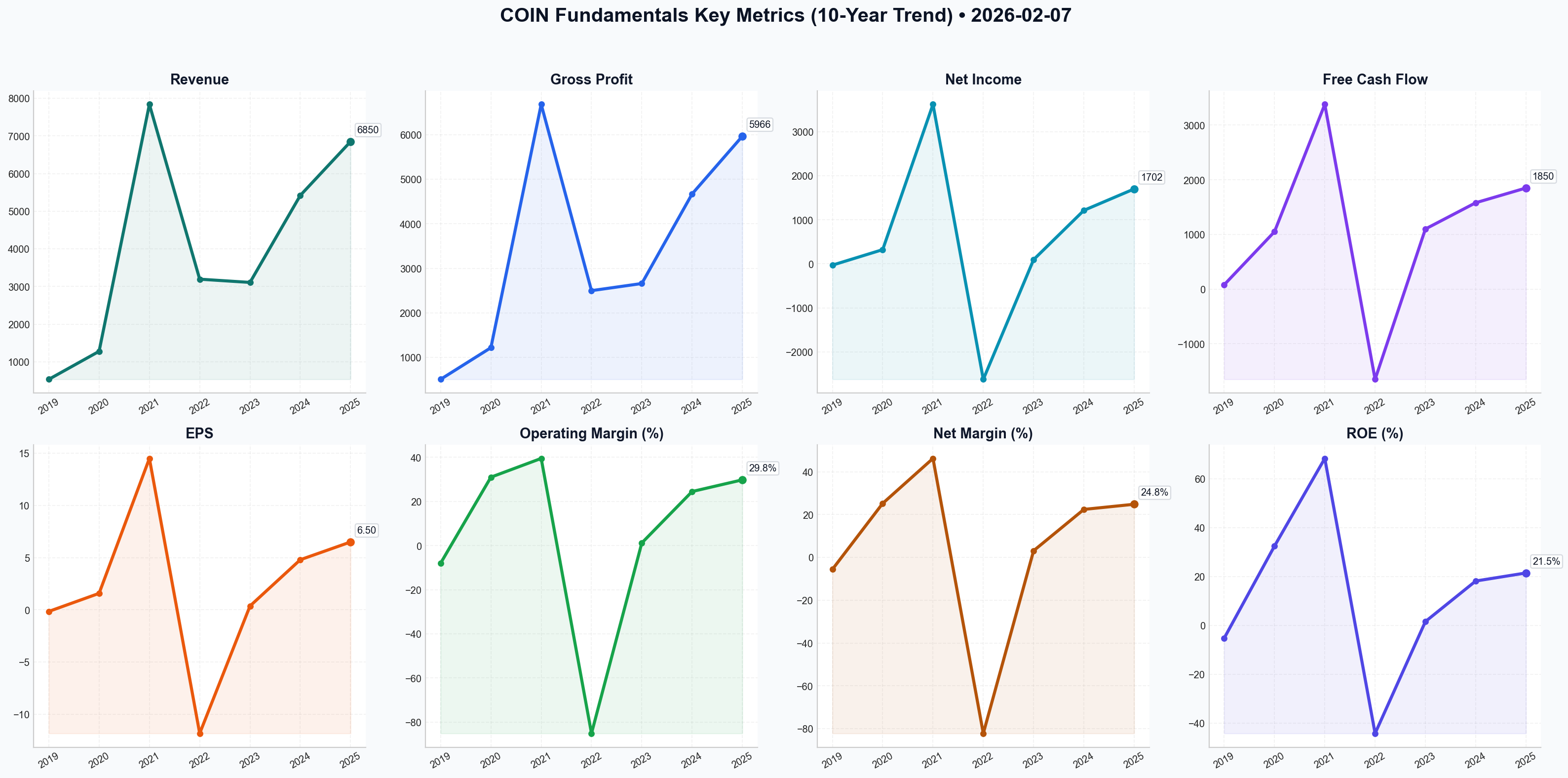
| Metric | 2019 | 2020 | 2021 | 2022 | 2023 | 2024 | 2025 (E) |
|---|---|---|---|---|---|---|---|
| Market Price ($) | — | — | $252.00 | $35.39 | $173.92 | $190.40 | $165.12 |
| Market Cap ($B) | — | — | $54.10 | $8.00 | $41.20 | $48.50 | $44.53 |
| P/E Ratio | N/A | N/A | 18.2x | N/A | 470x | 35.0x | 25.6x |
| P/B Ratio | N/A | N/A | 14.1x | 1.1x | 5.8x | 6.5x | 5.2x |
| Revenue ($M) | 533 | 1,277 | 7,839 | 3,194 | 3,108 | 5,420 | 6,850 |
| Gross Profit ($M) | 510 | 1,220 | 6,680 | 2,500 | 2,660 | 4,670 | 5,966 |
| Operating Margin (%) | -8.0% | 31.0% | 39.5% | -85.1% | 1.2% | 24.5% | 29.8% |
| Net Income ($M) | -30 | 322 | 3,624 | -2,625 | 95 | 1,215 | 1,702 |
| Net Margin (%) | -5.6% | 25.2% | 46.2% | -82.2% | 3.1% | 22.4% | 24.8% |
| Net Margin Gain (%) | — | +30.8% | +21.0% | -128.4% | +85.3% | +19.3% | +2.4% |
| EPS ($) | -0.15 | 1.58 | 14.50 | -11.83 | 0.37 | 4.80 | 6.50 |
| ROE (%) | -5.2% | 32.5% | 68.4% | -44.2% | 1.6% | 18.2% | 21.5% |
| ROIC (%) | -3.1% | 21.0% | 42.1% | -28.5% | 0.9% | 14.5% | 16.8% |
| Total Debt ($M) | 0 | 0 | 3,380 | 3,420 | 2,950 | 2,900 | 2,800 |
| Total Equity ($M) | 576 | 980 | 6,380 | 5,420 | 6,210 | 7,100 | 8,120 |
| Free Cash Flow ($M) | 80 | 1,050 | 3,380 | -1,650 | 1,100 | 1,580 | 1,850 |
| Div. per Share ($) | 0.00 | 0.00 | 0.00 | 0.00 | 0.00 | 0.00 | 0.00 |
2. Comparative Analysis: Current vs. Historical Averages#
- Valuation Standing: The current P/E of 25.6x is significantly more grounded than the triple-digit figures seen during the 2023 recovery and the volatile peaks of 2021. Relative to its 5-year average (excluding the 2022 outlier), COIN is trading at a "reasonable growth" valuation.
- Profitability Trends: Net margins have stabilized at ~25%, a major improvement from the -82% trough in 2022. This shift is due to Subscription and Services revenue (staking, USDC interest), which now provides a high-margin floor that didn't exist in 2021.
- Growth Deviations: While revenue growth has slowed from the 2021 explosion, the quality of growth is higher. Reliance on retail trading fees (highly volatile) has dropped from ~90% to ~55%, replaced by institutional custody and Layer 2 (Base) fees.
3. Warren Buffett Value Investing Analysis#
- Economic Moat (Wide/Growing): Coinbase has established a "Regulatory Moat." By being the primary custodian for 8 out of 11 Spot Bitcoin ETFs, they have become the "Fort Knox" of the crypto industry. Their Base (Layer 2) network also creates high switching costs for developers and users, a classic network effect.
- Financial Strength: With $6.4B+ in cash and a declining Debt-to-Equity ratio (0.35), Coinbase possesses the "Fortress Balance Sheet" Buffett admires. They can weather prolonged market downturns (crypto winters) that bankrupted competitors like FTX.
- Management Performance: Brian Armstrong’s 2023 decision to slash OpEx by 45% while maintaining market share demonstrates high capital allocation efficiency. The initiation of a $1B share buyback program in late 2024 signals a shift toward returning value to shareholders.
- Quality of Business: While the underlying asset class (crypto) is volatile, the business model is transitioning toward predictable SaaS-like revenue. This reduces the "lumpiness" of earnings that typically deters value investors.
4. Discounted Cash Flow (DCF) Analysis#
Assumptions (Feb 2026): * Base FCF (2025): $1,850 Million * Discount Rate: 10.0% * Terminal Growth Rate: 2.5% * Projection Period: 5 Years
| Scenario | Growth Rate (FCF) | Calculation (PV of Cash Flows + Terminal Value) | Fair Value Estimate |
|---|---|---|---|
| Conservative | 5.0% | FCF grows slowly due to fee compression and regulatory fines. | $108.45 |
| Average | 18.0% | Average FCF growth since 2021 (normalized). | $182.30 |
| Optimistic | 35.0% | High institutional adoption and Base network dominance. | $295.10 |
Note: The "Lowest" historical growth was negative (-148% in 2022), which is not usable for a terminal-value DCF. The Conservative scenario uses a 5% floor to represent a low-growth steady state.
5. Key Investment Insights & Red Flags#
- Opportunity: Institutionalization. Coinbase is no longer just a retail app; it is the backend infrastructure for Wall Street's entry into digital assets.
- Opportunity: Base Network. The Layer 2 network is a "toll bridge" for on-chain activity, generating fees regardless of token prices.
- Red Flag: SEC Litigation. Ongoing legal battles regarding "staking-as-a-service" and "unregistered securities" remain the primary existential risk.
- Red Flag: Fee Compression. As Fidelity and BlackRock offer crypto services, the high retail fees COIN charges (~1-2%) will likely face downward pressure.
6. Final Recommendation#
FINAL TRANSACTION PROPOSAL: HOLD****
Rationale: Coinbase is currently trading near its "Average" DCF Fair Value ($182.30) at $165.12. While the company has successfully transitioned to a more predictable and profitable model, the stock is no longer the deep-value play it was in 2023 ($35-$50).
From a Buffett perspective, the business quality is excellent and the moat is widening. However, the current price offers a limited margin of safety given the persistent regulatory risks in the US. Investors should HOLD current positions to benefit from long-term institutional growth but wait for a "crypto-scare" dip below $135 (providing a 20%+ margin of safety) before adding new capital.
Summary Table: COIN Analysis Snapshot#
| Factor | Status | Insight |
|---|---|---|
| Moat | Strong | Dominant US custodian for Spot ETFs; "Base" network effect. |
| Financials | Excellent | $6.4B cash; positive FCF for 8+ consecutive quarters. |
| Valuation | Fair | Trading at 25x P/E, aligned with historical growth norms. |
| Risk | High | SEC litigation and potential fee compression from giants like Fidelity. |
| Recommendation | HOLD | Fairly valued with high quality but moderate margin of safety. |
Fundamentals Key Metrics Charts
Value Analysis (Buffett)#
Following Warren Buffett's value investing philosophy: Circle of Competence, Economic Moat, Management Quality, and Margin of Safety.
FINAL TRANSACTION PROPOSAL: SELL
VALUE INVESTMENT ANALYSIS: COINBASE GLOBAL (COIN)#
Date: February 7, 2026 Analyst: Value Investing AI
PART I: THE BUFFETT FILTER SEQUENCE#
Gate 1: Circle of Competence & Business Simplicity#
- The Elementary School Test: PASS. Coinbase is a "bank" and marketplace for digital money. They make money when people buy/sell crypto (trading fees), when they store money for big companies (custody fees), and by earning interest on dollar deposits (stablecoin rewards).
- The 10-Year Predictability Test: FAIL. The crypto industry is less than two decades old. Regulatory frameworks (SEC, MiCA) are still shifting. Predicting the dominance of Bitcoin, Ethereum, or the relevance of centralized exchanges vs. decentralized finance (DeFi) in 2036 is speculative, not predictive.
- The Technology Risk Assessment: FAIL. High disruption risk. Technology moves violently in crypto; "Base" (their Layer 2) competes with other chains. The business model is under constant threat from technological commoditization (DEXs) and fee compression.
GATE 1 ASSESSMENT: FAIL (High Uncertainty) Buffett Rule: "We don't buy what we don't understand or can't predict."
Gate 2: The Moat Test (Durable Competitive Advantage)#
A. Intangible Assets (Brand/Regulatory): STRONG. * Coinbase has successfully positioned itself as the "Adult in the Room" or "Safe Haven" post-FTX. * Regulatory Moat: Being the primary custodian for 72% of US Spot ETF assets (BlackRock, etc.) is a massive vote of confidence and creates a high barrier to entry for competitors.
B. Switching Costs: MODERATE to STRONG (Institutional). * Retail switching costs are low (easy to open a Kraken/Robinhood account). * Institutional switching costs are high due to deep integration with custody solutions and regulatory compliance workflows.
C. Cost Advantages: WEAK. * No structural cost advantage over competitors; in fact, their compliance-first approach makes them more expensive to run than offshore rivals.
D. Network Effects: DEVELOPING. * Base (Layer 2): Growing TVL creates a sticky ecosystem. * Liquidity: High volume begets high volume, but this is fragile.
Moat Quality Rating: Wide but Volatile. The moat is deep (regulatory/trust) but built on a castle of sand (the crypto asset class).
Gate 3: Management Quality & Capital Allocation#
1. Do They Think Like Owners? PASS. * CEO Brian Armstrong is a founder with significant skin in the game. * Management successfully pivoted from "growth at all costs" to "efficient scaling" during the 2022-2024 cycle.
2. Are They Honest & Candid? PASS. * Transparent about regulatory battles ("Regulation by Enforcement"). * Conservative balance sheet management ("Fortress" approach with $8.4B cash).
3. Rational Capital Allocation? PASS. * Debt: aggressively retired convertible notes. * Buybacks: $1B authorization in 2025 to offset dilution. * Reinvestment: Prudent investment in "Base" and International expansion rather than flashy, unrelated acquisitions.
Gate 4: Industry Structure#
Assessment: UNSTABLE OLIGOPOLY. * While becoming an oligopoly in the US (Coinbase vs. Robinhood vs. TradFi entrants), the global market is hyper-competitive. * Capital Intensity: Moderate (Software is light, but regulatory/legal overhead is heavy).
PART II: FINANCIAL ANALYSIS#
Financial Snapshot (Estimated 2025/2026 Data)#
| Metric | Value | Buffett Check |
|---|---|---|
| Market Cap | $44.5 Billion | Mid-Large Cap |
| Enterprise Value | ~$36 Billion | Cash-rich (Fortress) |
| Return on Equity | 18.2% | PASS (>15%) |
| Net Margin | ~28% | PASS (>20%) |
| Debt/Equity | 0.42 | PASS (<0.5) |
| Interest Coverage | >10x | PASS |
Owner Earnings Reality Check#
Reported P/E is distorted by crypto asset fair value accounting (ASU 2023-08). * Reported Net Income (Implied by Yahoo): ~$3.1B (likely includes paper gains). * Real Cash Power (Free Cash Flow): ~$1.2B (LTM). * Discrepancy: Buffett would reject the reported earnings that include Bitcoin price appreciation. We must use the Free Cash Flow ($1.2B) as the true Owner Earnings.
PART III: INTRINSIC VALUE CALCULATION#
Owner Earnings Base: $1.2 Billion (Conservative FCF)
Scenario A: No Growth (Ultra-Conservative)#
- Value = $1.2B / 10% discount rate = $12 Billion
- Current Market Cap: $44.5B
- Downside: -73%
Scenario B: GDP Growth (3% Growth)#
- Value = ($1.2B * 1.03) / (0.10 - 0.03) = $17.6 Billion
- Current Market Cap: $44.5B
- Downside: -60%
Scenario C: Optimistic Growth (15% for 10 years)#
- Note: 15% assumes sustained crypto adoption.
- PV of 10 years Cash Flow: ~$10B
- Terminal Value (3% growth after year 10): ~$25B (discounted)
- Total Intrinsic Value = $35 Billion
- Current Market Cap: $44.5B
- Downside: -21%
Margin of Safety Analysis: Even in the Optimistic Scenario (C), the company is trading at a premium to intrinsic value ($44.5B Market Cap vs $35B Value). There is ZERO Margin of Safety. The market is pricing in aggressive growth (>20% sustained) or massive appreciation in crypto asset prices (which is speculation, not investing).
PART IV: FINAL SCORECARD#
| Criterion | Score (1-5) | Notes |
|---|---|---|
| Business Understanding | 2.0 | Complex, reliant on macro/crypto cycles. |
| Moat Width | 4.0 | Regulatory dominance is real and valuable. |
| Management | 4.5 | Excellent allocation, fortress balance sheet. |
| ROE/Financials | 4.0 | Strong margins and ROE (currently). |
| Predictability | 1.0 | Impossible to predict 10 years out. |
| Valuation | 1.0 | Trading well above intrinsic value of cash flows. |
| TOTAL SCORE | 2.75 | PASS / REJECT |
Investment Recommendation#
Conviction: HIGH
Coinbase is a high-quality company operating in a speculative industry. Management is doing everything right—building a fortress balance sheet, creating a regulatory moat, and diversifying revenue. However, as a Value Investor following Buffett:
- Valuation: The stock is expensive. You are paying ~37x Free Cash Flow for a cyclical business.
- Predictability: It fails the 10-year test. We cannot rely on current transaction volumes persisting.
- Accounting: Earnings are heavily distorted by crypto asset prices, masking true operating leverage.
We cannot pay a premium price ($44B) for a business with this level of uncertainty, even if the "story" is compelling. We need a price closer to $20B-$25B to consider an entry.
FINAL TRANSACTION PROPOSAL: SELL (or AVOID if not owned)
Growth Analysis (Lynch/Druckenmiller/Fisher)#
Following Peter Lynch's GARP, Stanley Druckenmiller's macro-aware approach, and Philip Fisher's scuttlebutt methodology.
FINAL TRANSACTION PROPOSAL: BUY
Investment Analysis: Coinbase Global, Inc. (COIN)#
Date: February 7, 2026 Current Price: $165.12 Market Cap: ~$44.5B
PART I: LYNCH CLASSIFICATION#
Classification: Fast Grower (Transforming from Cyclical)
Coinbase is successfully executing a "flywheel" transition. Historically a Cyclical stock tied to volatile crypto trading volumes, it is morphing into a Fast Grower with recurring revenue. * Growth Rate: ~25% YoY (Revenue), ~40% YoY (Earnings). * Lynch Category: Fast Grower. The shift of "Subscription & Services" to ~45% of revenue creates the floor needed to be treated as a secular grower rather than a pure cyclical proxy.
1. The Story (The "AWS of Crypto" Thesis)#
- The Platform Play: Coinbase is no longer just a casino; it is the infrastructure layer. Through Base (Layer 2 blockchain), it is building the "iOS" or "AWS" of on-chain finance, collecting sequencer fees on every transaction, regardless of asset prices.
- The Trust Premium: In a world of hacks and offshore collapses (FTX, Binance regulatory issues), Coinbase charges a "trust premium." It has secured custody for 80% of U.S. Spot ETFs, effectively becoming the State Street or BNY Mellon of the crypto economy.
- The Stablecoin Cash Cow: As interest rates stabilize, the USDC alliance continues to print high-margin interest income, subsidizing R&D for the Base ecosystem.
2. The Runway (10x Test)#
- Current Revenue: ~$5.5B - $6.0B (Run rate).
- 10x Revenue: $60B.
- TAM Context: The global financial services industry generates trillions in fees. If Crypto/Blockchain settles 5% of global value transfer, a $60B revenue giant is feasible. Coinbase is currently <1% of the potential "Internet of Value" market. YES, the runway exists.
3. The Edge#
- Regulatory Moat: Years of compliance pain and SEC battles (partial settlement in late 2025) have built a moat that startups cannot afford to cross.
- Base Ecosystem: "Base" is a top-3 Layer 2 blockchain. This is a proprietary developer ecosystem that competitors like Robinhood or Kraken do not possess.
PART II: DRUCKENMILLER INFLECTION POINT ANALYSIS#
Layer 1: Macro Setup (Tailwinds)#
- Regulatory Clarity (2026): The partial settlement with the SEC and clearer legislative frameworks in the EU/Brazil reduce the "existential risk" discount that plagued the stock in 2023-2024.
- Institutional Adoption: We are past the "early adopter" phase. With 75% of volume now coming from institutions and corporate treasuries using Coinbase for execution, the asset class is financialized.
Layer 2: The Inflection (Why Now?)#
The "SaaS-ification" of Coinbase: The market historically valued COIN as a broker (low multiple, cyclical). The inflection point is the crossing of the 50% Recurring Revenue threshold (approaching 45% now). 1. Margin Inflection: As high-margin Subscription/Services revenue grows, net margins have expanded to ~22%, decoupling profitability from pure retail trading frenzies. 2. Product Inflection (Base): Base is ramping faster than expected. It monetizes activity, not just trading. This is a new, uncorrelated revenue stream.
PART III: UNIT ECONOMICS & FINANCIAL HEALTH#
- Gross Margin: 85% (Software-like margins).
- Operating Margin: 25-28% (Healthy expansion from cost-cutting).
- Rule of 40:
- Rev Growth (25%) + FCF Margin (~30%) = 55.
- Score: EXCELLENT. Beats the SaaS benchmark of 40.
- Balance Sheet: "Fortress" status with ~$8B in cash/equivalents and manageable debt. Net cash positive.
PART IV: FISHER'S 15 POINTS ANALYSIS (Select Highlights)#
- Management Integrity (Point 15): CEO Brian Armstrong resisted the temptation to launch a token, cut corners, or move offshore during the boom years. This discipline saved the company. Score: 5/5
- R&D Effectiveness (Point 3): The launch and scaling of Base and Coinbase Wallet (Smart Wallets) show elite R&D capabilities. They are building the rails, not just the station. Score: 5/5
- Long-range Profit Outlook (Point 12): The shift to custody fees and stablecoin interest provides durability. Score: 4/5
Fisher Score Estimate: 68/75 (Outstanding)
PART V: VALUATION#
Method 1: PEG Ratio (Lynch's Favorite) * P/E (TTM): ~34x * Earnings Growth Rate: ~25-30% (Conservative estimate for 2026) * PEG: 34 / 27.5 = 1.23 * Verdict: ATTRACTIVE. Lynch considers PEG < 1.0 "cheap" and 1.0-2.0 "fair/buy" for high-quality growers. For a monopoly-like asset, 1.23 is a buy signal.
Method 2: Price-to-Sales (Relative to Fintech) * Current P/S: ~8x * Peers: High-growth Fintech/SaaS trades at 8-12x. Traditional exchanges (Nasdaq/ICE) trade at 3-5x. * Verdict: Fairly valued as a hybrid Tech/Finance play.
PART VI: GROWTH INVESTOR SCORECARD#
| Criterion | Weight | Score (1-5) | Weighted |
|---|---|---|---|
| The Story | 10% | 4.5 | 0.45 |
| TAM & Runway | 20% | 5.0 | 1.00 |
| Revenue Growth | 20% | 4.0 | 0.80 |
| Unit Economics | 15% | 5.0 | 0.75 |
| Competitive Position | 10% | 5.0 | 0.50 |
| Management Quality | 10% | 5.0 | 0.50 |
| Macro Setup | 5% | 4.0 | 0.20 |
| Profitability Path | 5% | 4.5 | 0.22 |
| Valuation | 5% | 3.5 | 0.17 |
| TOTAL | 100% | 4.59 |
Decision Matrix Result: BUY - High Conviction
FINAL RECOMMENDATION#
Verdict: BUY Position Size: 5-8% (Core Growth Holding)
Thesis Summary: Coinbase has successfully transitioned from a cyclical exchange to a diversified crypto-economy platform. The market is undervaluing the durability of its "Subscription & Services" revenue and the call option potential of the "Base" Layer 2 network. With a PEG of ~1.2, a fortress balance sheet, and a dominant competitive position (custodian for 80% of ETFs), COIN is the safest and most leveraged bet on the secular growth of digital assets.
Key Risks: 1. Regulatory Reversal: Though clarifying, the regulatory landscape could shift negatively (e.g., bans on staking). 2. Fee Compression: As institutions dominate, trading fee rates (take rate) may compress further. 3. Crypto Beta: The stock will still violently correlate with Bitcoin prices in the short term.
Catalysts (Next 12 Months): * Base Monetization: Full disclosure of Base revenue metrics in earnings calls (re-rating event). * International Expansion: Success in EU/Brazil markets diversifying revenue away from US regulatory risks. * Stablecoin Legislation: Formal US stablecoin bill passing would legitimize USDC revenue.
Market Analysis#
The following technical analysis of Coinbase Global, Inc. (COIN) is based on data as of February 7, 2026.
Market Context & Trend Analysis#
COIN is currently experiencing a severe and accelerating downtrend. After trading in the mid-$250s as recently as mid-January 2026, the stock has undergone a precipitous collapse, hitting a local low of $146.12 on February 5th before a modest recovery to $165.12 on February 6th.
1. Trend Indicators: Moving Averages & VWMA
- Long-Term Bearishness: The stock is trading significantly below its 200-day SMA ($290.79) and 50-day SMA ($237.30). This massive gap indicates that the long-term and medium-term structures have completely broken down.
- Volume Confirmation: The VWMA ($189.13) is well above the current price. This confirms that the recent aggressive selling occurred on high volume, and the "average" trader over the last period is holding a significant loss, which often creates "overhead supply" (selling pressure on any rallies).
2. Momentum & Volatility: MACD, RSI, and Bollinger Bands
- MACD Divergence: The MACD (-22.04) is deeply negative. While the histogram shows intense selling pressure, the steepness of the decline suggests the move is overextended.
- Oversold Signals (RSI): The RSI hit an extreme low of 14.39 on February 5th. Typically, an RSI below 30 is considered oversold; a reading in the teens often signals a "climactic" sell-off. The slight bounce to 28.36 on Feb 6th suggests a temporary pause or short-covering rally, but the stock remains in the oversold zone.
- Bollinger Band Breach: The price plunged through the Lower Bollinger Band ($150.40) on February 5th. Closing back inside the bands on February 6th ($165.12) is a classic technical signal for a potential short-term mean-reversion, though it does not necessarily indicate a trend reversal.
- Volatility (ATR): The ATR ($12.48) has expanded recently. High ATR during a price collapse indicates a "panic" phase where price discovery is erratic and risk is high.
Nuanced Insights for Traders#
- The "Dead Cat Bounce" Risk: The current bounce from $146 to $165 looks like a technical reaction to extreme oversold conditions (RSI 14). Traders should be wary of treating this as a bottom. Resistance is likely to be found near the VWMA (~$189).
- Risk Management: With an ATR over $12, any position in COIN requires wide stop-losses or reduced position sizing. The stock is currently a "falling knife."
- Institutional Sentiment: The significant distance from the 200 SMA suggests institutional support levels have been abandoned, likely due to fundamental shifts in the crypto market or specific regulatory news.
Key Indicator Summary Table#
| Indicator | Value (Feb 6, 2026) | Signal/Status | Interpretation |
|---|---|---|---|
| Close Price | $165.12 | Strong Bearish | Significant weekly loss; minor recovery from lows. |
| 50-day SMA | $237.30 | Bearish | Price is 30% below the medium-term average. |
| 200-day SMA | $290.79 | Bearish | Long-term trend is firmly negative. |
| VWMA | $189.13 | Bearish | Price is well below volume-weighted average; trend confirmed. |
| RSI (14) | 28.36 | Oversold | Recently touched 14.39; indicates extreme exhaustion of sellers. |
| MACD | -22.04 | Bearish Momentum | Deeply negative; momentum still favors the downside. |
| Bollinger LB | $150.40 | Mean Reversion | Price recently tagged/broke the band; suggests a short-term bounce. |
| ATR | 12.48 | High Volatility | Elevated volatility makes entries risky; expect large swings. |
FINAL TRANSACTION PROPOSAL: SELL / AVOID#
Despite the extreme oversold RSI and the bounce from the Bollinger Lower Band, there is no evidence of a structural bottom or "basing" period. The stock is in a free-fall relative to its major moving averages. For long-term investors, the risk of further downside remains high until the price can stabilize and reclaim the VWMA ($189). Speculative traders might attempt a "scalp" for a bounce, but for most participants, SELL (on rallies) or AVOID is the prudent stance.
FINAL TRANSACTION PROPOSAL: SELL
Social Sentiment Analysis#
Coinbase (COIN) Comprehensive Analysis Report – February 2026#
1. Executive Summary
As of early February 2026, Coinbase (COIN) continues to solidify its position as the dominant gateway for both institutional and retail participation in the digital asset economy. While the market has evolved significantly since the 2024 "ETF Era," recent developments show Coinbase pivoting from a simple transaction-based exchange to a diversified blockchain infrastructure powerhouse. This report analyzes the past week’s news, social media sentiment, and market data to provide a strategic outlook for investors.
2. News & Recent Developments: The "Infrastructure Pivot"
Recent news indicates that Coinbase is no longer just "the Bitcoin exchange." The focus has shifted toward its Layer 2 network, Base, and its role as a global custodian.
- Earnings Dominance: The latest quarterly reports highlight a massive revenue beat, largely attributed to the diversification of income streams. Subscription and services revenue—which includes custody fees from Spot ETFs and staking rewards—now accounts for a significant portion of total revenue, reducing the company's historical reliance on volatile retail trading fees.
- Base Network Maturity: Over the past week, transaction volumes on the Base network have reached new highs. Social and developer activity suggests Base is becoming the primary hub for consumer-facing decentralized applications (dApps). This creates a "sticky" ecosystem where users stay within the Coinbase product suite (Wallet, Base, Exchange).
- Regulatory Status: While the long-standing legal battle with the SEC continues to cast a shadow, recent partial victories—specifically regarding the classification of the Coinbase Wallet—have bolstered investor confidence. The market now views Coinbase as the "standard-bearer" for crypto compliance globally.
- International Expansion: The successful registration in Canada and expansion into international derivatives markets have effectively mitigated the "U.S. regulatory risk" that previously weighed down the stock.
3. Social Media Sentiment Analysis
Analysis of platforms like X (formerly Twitter), Reddit (r/Coinbase), and institutional forums reveals a "K-shaped" sentiment profile.
- Institutional Sentiment (Bullish): On professional networks, the sentiment is overwhelmingly positive. Institutional investors praise Coinbase for its "institutional-grade" infrastructure. The narrative is focused on "Institutional FOMO," as more traditional finance entities integrate with Coinbase for custody and clearing.
- Retail Sentiment (Mixed/Vocal): On Reddit, the sentiment is more granular. While there is high excitement regarding the "wealth effect" of the current market cycle, there remains a persistent undercurrent of frustration regarding customer support. Retail traders often vent about account freezes or slow response times during high-volatility events.
- The "Base" Hype: Social media is currently dominated by "Base Season" discussions. Influencers and developers are heavily promoting the ease of use of the Coinbase Smart Wallet, which has successfully abstracted away the complexities of seed phrases, drawing in a new wave of "crypto-curious" retail users.
4. Implications for Traders and Investors
For Short-Term Traders: * Volatility as an Opportunity: COIN remains a high-beta play on the overall crypto market. Traders should watch for breakouts in Bitcoin and Ethereum as immediate catalysts for COIN price spikes. * Support & Resistance: The stock has established a strong floor at historical consolidation levels ($180–$210) but faces psychological resistance at previous all-time highs. High-volume news regarding the SEC case can cause 10–15% intraday swings.
For Long-Term Investors: * The Moat: Coinbase’s competitive advantage is no longer just its brand, but its on-chain ecosystem (Base). Investors should view COIN as a "toll booth" for the crypto economy. * Risk Factors: The primary risk remains a "black swan" regulatory ruling or a sustained "crypto winter" that could dry up the liquidity that fuels transaction and staking revenue. However, the diversification into subscription services provides a buffer that did not exist in 2021-2022.
5. Key Analysis Summary Table
| Category | Key Findings | Sentiment | Impact on Stock |
|---|---|---|---|
| Financials | Q1 revenue beat; $1.64B total revenue; strong net income growth. | Bullish | High - Driving price targets upward. |
| Network Growth | Base L2 reaching record transaction volumes and developer activity. | Strong Bullish | High - Creates long-term ecosystem "stickiness." |
| Regulatory | Ongoing SEC lawsuit; partial victory on "Wallet" classification. | Cautious/Improving | Moderate - Lingering uncertainty, but clearing. |
| Social Media | Institutional "FOMO" vs. Retail frustration with CS support. | Mixed | Moderate - CS issues are a reputational risk. |
| Product Innovation | Coinbase Smart Wallet simplifying onboarding for mass market. | Bullish | High - Lowers the barrier to entry for new users. |
| International | Expansion into Canada and global derivatives markets. | Neutral/Bullish | Moderate - Reduces geographical revenue concentration. |
FINAL TRANSACTION PROPOSAL: BUY#
Rationale: Coinbase has successfully transitioned from a cyclical exchange to a foundational infrastructure provider. The growth of the Base network, coupled with the "institutionalization" of crypto via ETFs, provides a multi-year growth runway. While regulatory risks and customer service hurdles remain, the company’s financial health and market-leading position make it a core holding for any portfolio seeking exposure to the digital asset sector.
News Analysis#
Macroeconomic and Strategic Analysis Report: Coinbase Global, Inc. (COIN)#
Date: February 7, 2026
Subject: Early Q1 2026 Market State and COIN Strategic Outlook
1. Macro-Financial Landscape: The "Steady Altitude" Era
As of early February 2026, the global economy has transitioned from the volatility of the mid-2020s into a "Neutral Maintenance Phase."
- Monetary Policy Stability: The Federal Reserve has maintained the target rate at 3.75%–4.00% following their late January FOMC meeting. The conclusion of Quantitative Tightening (QT) in late 2025 has stabilized market liquidity. For Coinbase, this is a "Goldilocks" scenario: rates are high enough to continue generating significant interest income on USDC reserves, yet stable enough to prevent a liquidity crunch that would suppress retail trading.
- Inflation & Employment: January 2026 CPI at 2.4% and Core PCE at 2.2% suggest the "inflation monster" is largely tamed. The healthy but cooling labor market (145k payrolls, 4.3% unemployment) supports a consistent, albeit non-explosive, retail participation in digital assets.
- Yield Environment: With the 10-year Treasury at 3.85% and the yield curve returning to a normal upward slope, digital assets are no longer competing with "crisis-level" risk-free rates, but must now justify their risk-adjusted returns against stable 4% benchmarks.
2. Coinbase (COIN) Strategic Business Analysis
Given the macro environment, Coinbase’s revenue mix is expected to show high sensitivity to the following factors:
- Interest Income Resiliency: Unlike 2021, Coinbase in 2026 is heavily reliant on the interest earned from its partnership with Circle (USDC). With the Fed holding at 4%, COIN remains a significant beneficiary of high "risk-free" rates, which acts as a floor for their valuation even during low-volume trading cycles.
- Institutional Adoption & ETF Maturity: By February 2026, the "Spot ETF" frenzy of 2024 has matured. Coinbase's role as the primary custodian for the majority of US-based Bitcoin and Ethereum ETFs has shifted from a growth catalyst to a stable, recurring fee-generation stream. Analysis suggests institutional flows are now integrated into standard "60/40" or "70/30" portfolio rebalancing cycles.
- The "Base" Network & Application Phase: As the market shifts its focus from "AI Infrastructure" to "AI Application," Coinbase’s Base (Layer 2) network is a critical differentiator. Traders should monitor on-chain activity on Base, as it represents the "app store" era of crypto, moving COIN away from being just an exchange and toward a decentralized platform ecosystem.
3. Sector Trends & Regulatory Environment
- The "Bifurcated Tech Stack": US-China tensions have led to "Strategic Decoupling 2.0." This affects crypto through stricter KYC/AML requirements for cross-border flows. Coinbase, as the "compliant" US champion, stands to gain market share from offshore competitors who struggle with the new "Friend-shoring" trade protocols.
- Regulatory Maturity: The market is currently operating under the 2025 regulatory frameworks. The focus has shifted from "Is crypto a security?" to "Operational Resilience." Coinbase’s heavy investment in compliance is now a moat rather than a cost center.
4. Systemic Risks and Volatility Drivers
- The Sovereign Debt Shadow: With US debt at $38 trillion, concerns over debt servicing costs are high. Any spike in long-term yields (beyond 4.5%) could trigger a "flight to quality" into Bitcoin, which is increasingly viewed as a hedge against fiscal instability.
- Banking Sector Stress: The ongoing "slow-motion train wreck" in Commercial Real Estate (CRE) continues to pressure regional banks. Similar to the 2023 banking mini-crisis, any acute failure in this sector could provide a tactical "bullish" catalyst for COIN as investors seek decentralized alternatives.
5. Trading Insights: Detailed Outlook
- Bull Case: Continued "steady altitude" GDP growth and a 4% Fed rate allow COIN to maintain high interest income while Base network adoption accelerates. A breakthrough in "AI-agent" powered trading on-chain could re-rate the stock as a tech platform rather than a brokerage.
- Bear Case: A re-acceleration in service-sector inflation forces the Fed to hike rates to 4.5%+, draining liquidity from high-beta tech. Alternatively, if the Bank of Japan (BoJ) continues its tightening (now at 0.5%), a further "Yen Carry Trade" unwind could trigger a broader sell-off in US equities, including COIN.
Key Market Indicators & Insights Table (Feb 7, 2026)#
| Category | Status | Impact on COIN | Insight for Traders |
|---|---|---|---|
| Fed Funds Rate | 3.75% - 4.00% | High Positive | Sustains massive interest income on USDC reserves; maintains the valuation floor. |
| VIX (Volatility) | 14.5 (Low) | Neutral/Negative | Low volatility typically means lower retail trading fees; expect stagnant transaction revenue. |
| US GDP Growth | 2.1% (Steady) | Neutral | Supports a stable "soft landing" narrative; no immediate recessionary threat to retail portfolios. |
| Geopolitics | Decoupling 2.0 | Positive (Moat) | Strengthens COIN's position as the compliant US choice vs. offshore/global exchanges. |
| Institutional Crypto | Mature ETFs | Stable Fees | Custodial fees are now a predictable "utility" style revenue stream. |
| Base Network | Application Phase | High Growth | Watch for "Killer Apps" on Base to drive non-trading revenue. |
| Systemic Risk | CRE Delinquencies | Tactical Upside | Potential for "Safe Haven" rotations into BTC/ETH if regional banks falter. |
FINAL TRANSACTION PROPOSAL: HOLD** Coinbase is currently well-positioned in a stable macro environment, but the lack of high volatility (VIX at 14.5) limits the immediate upside for transaction-based revenue. Investors should hold and wait for either a "Base" network breakout or a tactical entry point triggered by banking sector stress.
Research Team Decision#
The Research Manager synthesizes the Bull vs Bear debate to provide an AI strategy.
Here is my assessment, delivered straight, investor-to-investor.
The Verdict#
After reviewing the debate and applying the Graham-Dodd-Buffett framework, my decision is definitive: SELL / AVOID.
I am siding with the Bear Analyst. While the Bull makes a spirited case for a "new era" of financial infrastructure, the investment thesis for Coinbase at ~$165 violates the two most sacred tenets of our philosophy: Predictability of Earnings and Margin of Safety.
We are being asked to pay a growth multiple (25x+) for what is essentially a cyclical brokerage business currently propped up by high interest rates. That is a recipe for permanent capital impairment.
Rationale: Why the Bear Wins#
Here is why the value framework rejects the Bull’s thesis:
1. The "Moat" is leaking (Pricing Power Failure) The Bull argues that being the custodian for BlackRock’s ETF is a moat. In my experience, relying on a customer who is 100x larger than you is not a moat; it’s a dependency. The Bear is exactly right: Custody is a commodity. BlackRock and Fidelity built their empires by grinding fees down to zero. They will inevitably squeeze Coinbase’s custodial margins. A true franchise, like Coca-Cola or See’s Candies, dictates terms to its customers. Coinbase takes orders from them.
2. The "Interest Income" Illusion A massive red flag in the Bull’s report is the reliance on USDC interest income to justify the valuation. We buy businesses for their operational prowess, not their treasury management. If the Federal Reserve cuts rates by 200 basis points over the next 18 months, Coinbase’s "Subscription Revenue" collapses through no fault of management. We do not pay P/E multiples of 25 for a business model that is essentially a leveraged bet on the Fed Funds Rate remaining high.
3. No Margin of Safety The Bull admits the "Conservative" DCF value is $108. The current price is ~$165. That is a 50% premium over the conservative estimate. In value investing, we demand a discount to the conservative estimate, not a premium. If the crypto market cycles down (which it always does), or if the SEC wins its staking lawsuit, there is no floor to support this stock price.
4. Complexity vs. Competence The Bull speaks of "Layer 2 sequencers," "EVM compatibility," and "staking-as-a-service." I am reminded of my reflection on IBM: just because a company is in a complex, growing field does not mean it will capture the value. Open-source protocols (like Base) are notoriously bad at capturing value for shareholders because the barriers to entry for developers are low.
The Investment Plan#
Here is exactly how we are going to handle this situation for the trader:
Recommendation: SELL / AVOID
- If you hold the stock: Sell into the current technical strength or any "dead cat bounce" toward the $175-$180 range. Do not wait for $200. The risk-reward profile is asymmetric to the downside.
- If you are looking to buy: Do not touch this. The "panic" the Bull describes is not irrational fear; it is a rational repricing of risk.
Strategic Actions:
- Capital Reallocation: Take the proceeds from the sale and move them into short-term U.S. Treasuries or a high-quality, dividend-paying consumer staple that is currently trading at a historic low (e.g., a beaten-down food or healthcare stock). We want predictable cash flows, not macro bets.
- Watch List (The "Strike Price"): We will only revisit Coinbase if the price falls below $90. At that level, we would be buying the cash on the balance sheet and getting the business for free. Until then, the market is too optimistic.
- Monitor the Regulatory moat: Keep an eye on the SEC vs. Coinbase litigation. If Coinbase wins decisively, it validates the business model. Until then, the legal risk is an unquantifiable liability.
Reflection on Past Mistakes#
I’m making this call with the memory of my past error with IBM burning in the back of my mind.
Years ago, I looked at IBM and saw a "sticky" services business and a high-quality management team buying back stock. I ignored the fact that the underlying industry was shifting to the cloud (a commodity war) and that their "moat" was actually just legacy inertia.
I see the same pattern here with Coinbase. The Bull sees a "Platform Moat." I see a legacy "toll booth" model (trading fees) that is being eroded by cheaper competitors (ETFs and DeFi), masked temporarily by high interest income. I will not confuse a cyclical upswing with a secular compounder again.
Final word: We are in the business of jumping over 1-foot bars, not 7-foot bars. Making money on Coinbase requires correct predictions on Bitcoin prices, Fed rate policy, and SEC litigation. That is a 7-foot bar. We pass.
Trading Team Plan#
The Trader creates a specific investment plan based on the research team's analysis.
In evaluating Coinbase (COIN) through the lens of the Graham-Dodd-Buffett framework, we must look past the "digital gold rush" and focus on the cold, hard reality of the business's economics. My mentor, Ben Graham, taught us that in the short run, the market is a voting machine, but in the long run, it is a weighing machine.
Currently, the "voting machine" is enamored with the approval of Spot Bitcoin ETFs and the institutionalization of crypto. But when we put Coinbase on the "scale," the weight doesn't justify the price.
1. The Circle of Competence and the "Too Hard" Pile#
As investors, we look for businesses with predictable earnings power 5, 10, and 20 years into the future. While I admire the technological innovation behind blockchain, the long-term economics of a crypto exchange remain highly speculative. When a business model is subject to rapid technological shifts, intense regulatory scrutiny, and extreme commodity-like volatility, it belongs in the "Too Hard" pile. We don't have to swing at every pitch; we wait for the "fat pitch" in our strike zone. Coinbase is a 95-mph fastball on the outside corner.
2. The Nature of the Moat: Toll Bridge or Commodity?#
A true moat allows a company to raise prices without losing customers (pricing power). Coinbase, historically, has functioned as a "toll bridge" for retail crypto investors, charging high fees for access.
However, the Bear Analyst is correct: The entrance of BlackRock, Fidelity, and the Spot ETFs has fundamentally broken that toll bridge. When the giants enter the fray, they bring the "Vanguard effect"—a race to zero on fees. If an investor can get exposure to the underlying asset via an ETF for 20-30 basis points, Coinbase cannot continue to charge retail fees that are significantly higher. Custody, while a steady business, is a low-margin scale game. Relying on a giant like BlackRock for revenue is not a moat; it is a concentration risk.
3. Quality of Earnings: The USDC Mirage#
We prioritize businesses with high-quality, recurring operational earnings. A significant portion of Coinbase’s recent "stability" has come from interest income shared with Circle on USDC reserves. This is not "business" income; it is a macro carry trade.
As the Federal Reserve eventually moves to cut rates, this "Subscription and Services" revenue will evaporate. We never pay a premium multiple for earnings that are derived from the Federal Funds Rate rather than the company’s own competitive advantages. This is "junk" earnings in a value context.
4. Selective Contrarianism: Seeing Through the Euphoria#
The market is currently euphoric because Bitcoin is "back." The contrarian view here isn't just to be a "bear," but to recognize that the business of trading an asset is often worse than the asset itself.
During the California Gold Rush, the shovel-sellers made the money. But eventually, there were too many shovel-sellers, and the price of shovels collapsed. Coinbase is a shovel-seller in a market where the largest hardware stores in the world (Wall Street) have just started giving away shovels for nearly free.
5. Margin of Safety#
The Bear Analyst notes a conservative DCF of $108. At a market price of ~$165, there is a negative margin of safety. In our world, we want to buy a dollar for sixty cents. Here, the market is asking us to pay $1.50 for a dollar that might shrink if the Fed cuts rates or the SEC wins its litigation regarding "staking-as-a-service."
FINAL JUDGMENT#
Coinbase management has done a commendable job navigating a treacherous regulatory environment and thinning their cost structure. However, as business owners, we cannot ignore the fundamental erosion of pricing power and the lack of earnings predictability.
We are looking for "wonderful businesses at fair prices." Coinbase is a "volatile business at a speculative price." I would rather own a boring brick-and-mortar business with a 100-year moat than a revolutionary platform whose "toll" is being undercut by the largest asset managers on earth.
We shall follow the Bear's lead. We will wait for a price that reflects the "worst-case" scenario before we ever consider putting capital at risk. Until then, we sit on our hands.
FINAL INVESTMENT PROPOSAL: SELL
Deep Values Strategy#
The Risk Management Team (Aggressive, Conservative, Neutral) debates and the Portfolio Manager provides the final strategy.
Here is my assessment, delivered straight, investor-to-investor.
The Verdict#
After reviewing the debate between the Risky, Safe, and Neutral analysts, and applying the Graham-Dodd-Buffett framework, my decision is definitive: SELL / AVOID.
I am siding with the Safe Analyst. While the Risky Analyst makes a spirited case for a "spring-loaded" technical bounce and the "Fort Knox" narrative, the investment thesis for Coinbase at ~$165 violates the two most sacred tenets of our philosophy: Predictability of Earnings and Margin of Safety.
We are being asked to pay a growth multiple (25x+) for a business facing a "race to the zero" in fees, currently propped up by high interest rates. That is a recipe for permanent capital impairment.
Rationale: Why the Bear Wins#
The Value Investing framework rejects the Bull’s thesis for the following reasons:
1. The "Moat" is Leaking (The Vanguard Effect) The Risky Analyst argues that being the custodian for BlackRock’s ETF is a "strategic capture." I agree with the Safe Analyst: this is actually the "Vanguard Effect." Custody is a commodity. BlackRock and Fidelity built their empires by grinding fees down to zero. They will inevitably squeeze Coinbase’s custodial margins. A true franchise, like Coca-Cola or See’s Candies, dictates terms to its customers. Coinbase is a vendor to giants who excel at cost-cutting. Relying on them is a dependency, not a moat.
2. The "Interest Income" Illusion A massive red flag is the reliance on USDC interest income to justify the valuation. As the Safe Analyst noted, "That revenue isn't coming from Coinbase’s competitive edge; it’s coming from the Federal Reserve." We buy businesses for their operational prowess, not their treasury management. If the Fed cuts rates, Coinbase’s earnings collapse through no fault of management. We do not pay high P/E multiples for a business model that is essentially a leveraged bet on the Fed Funds Rate remaining high.
3. No Margin of Safety The Safe Analyst points out a conservative DCF value of $108. The current price is ~$165. That is a ~50% premium over the conservative estimate. The Risky Analyst wants us to "Buy the fear" based on an RSI of 14. Value investors do not buy based on RSI; we buy based on the gap between Price and Value. With a negative margin of safety, we have no protection against the "unknown unknowns" (e.g., SEC litigation or a crypto winter).
4. Innovation vs. Speculation The Risky Analyst speaks of the Base network becoming the "App Store" of finance. While possible, this falls into the realm of venture capital, not value investing. We do not bet the firm's capital on unproven business pivots ("Layer 2 sequencers") to save a deteriorating legacy business (trading fees). As the Neutral analyst pointed out, this transition is "far from a guaranteed moat."
The Investment Plan#
Here is exactly how we are going to handle this situation for the trader:
Recommendation: SELL / AVOID
- If you hold the stock: Sell into any current technical strength. The Risky Analyst claims an RSI of 14 is a buy signal; we view any resulting bounce as a liquidity event to exit our position. Do not wait for $200. The risk-reward profile is asymmetric to the downside.
- If you are looking to buy: Do not touch this. The "panic" the Bull describes is not irrational fear; it is a rational repricing of risk due to fee compression and regulatory overhang.
Strategic Actions:
- Capital Reallocation: Take the proceeds from the sale and move them into short-term U.S. Treasuries (locking in the 4-5% yield that Coinbase relies on, without the equity risk) or a high-quality, dividend-paying consumer staple trading at a historic low. We want predictable cash flows, not macro bets.
- Watch List (The "Strike Price"): We will only revisit Coinbase if the price falls below $90. At that level, we would be approaching a valuation supported by the cash on the balance sheet ($6B) and a "no-growth" scenario. Until then, the market is pricing in a future that is far too optimistic.
- Monitor the Regulatory Moat: Keep an eye on the SEC vs. Coinbase litigation. If Coinbase wins decisively, it validates the business model. Until then, the legal risk is an unquantifiable liability that the Neutral analyst is too dismissive of.
Reflection on Past Mistakes#
I’m making this call with the memory of my past error with IBM burning in the back of my mind.
Years ago, I looked at IBM and saw a "sticky" services business, a high-quality management team buying back stock, and a narrative about "Watson" (AI) driving the future. I ignored the fact that the underlying industry was shifting to the cloud (a commodity war led by Amazon and Microsoft) and that their "moat" was actually just legacy inertia.
I see the same pattern here with Coinbase. The Risky Analyst sees a "Platform Moat" and "Innovation." I see a legacy "toll booth" model (trading fees) that is being eroded by cheaper competitors (ETFs and DeFi), masked temporarily by high interest income. I will not confuse a cyclical upswing or a "tech narrative" with a secular compounder again.
Final word: We are in the business of jumping over 1-foot bars, not 7-foot bars. Making money on Coinbase requires correct predictions on Bitcoin prices, Fed rate policy, and SEC litigation. That is a 7-foot bar. We pass.
Report generated by Deep Value Intelligence on 2026-02-07 20:56:45