
Company Research COINDeep Value Intelligence
Coinbase (COIN) Deep Value Intelligence Report

In brief
DeepValues Research published a Deep Value Intelligence report on Coinbase (COIN) on Feb 13, 2026. The Risky Analyst asks us to be "bold." We choose to be "solvent." Coinbase is undoubtedly building critical infrastructure, but the market price assumes they have already won the war.
Source: https://research.deepvalues.ai/company/coin/2026-02-13-en/ · Markdown · More on Coinbase (COIN)
Key takeaways
The Risky Analyst asks us to be "bold." We choose to be "solvent." Coinbase is undoubtedly building critical infrastructure, but the market price assumes they have already won the war. They haven't. We will watch from the sidelines until Mr. Market offers a price that protects us from the very real risks of commoditization and regulation.
Contents
- Intelligence Summary
- Analyst Team Reports
- PART I: THE BUFFETT FILTER SEQUENCE (Go/No-Go Gates)
- PART II: FINANCIAL ANALYSIS (Deep Dive)
- PART III: INTRINSIC VALUE CALCULATION
- PART IV: FINAL SCORECARD
- FINAL INVESTMENT STANCE: AVOID
- PART I: LYNCH CLASSIFICATION & STORY
- PART II: DRUCKENMILLER FRAMEWORK (Macro + Inflection)
- PART III: TAM ANALYSIS
- PART IV: UNIT ECONOMICS
- PART V: FISHER SCUTTLEBUTT SCORE (Selected)
- PART VI: VALUATION
- PART VII: GROWTH INVESTOR SCORECARD
- PART VIII: RISKS & CATALYSTS
- DELIVERABLE: INVESTMENT VERDICT
- Technical Analysis Report: Coinbase Global, Inc. (COIN)
- Research Team Commentary
- Investing Team Commentary
- Deep Values Commentary
Intelligence Summary#
Thesis + Conditions#
Core Thesis: Based on the intense debate between the analysts and adhering strictly to the Graham-Buffett framework of capital preservation and intrinsic value, here is the risk commentary and final stance.
Key Risks: - Based on the intense debate between the analysts and adhering strictly to the Graham-Buffett framework of capital preservation and intrinsic value, here is the risk commentary and final stance. - ### Final Stance: WATCH - ### Risk Management Commentary - The debate highlights a classic conflict: The Risky Analyst is captivated by the business narrative (institutional plumbing, "infrastructure of the future"), while the Safe Analyst is focused on the investment mathematics (valuation, dilution, regulatory existentialism). As value investors, we buy cash flows, not narratives. Currently, the price of $141 demands a "soft landing" perfection that provides zero Margin of Safety. - The Risky Analyst argues that "regulation is a moat made of red tape." This is a dangerous misclassification under our framework. A moat is a structural advantage (like a network effect or low-cost production). A pending SEC lawsuit is not a moat; as the Safe Analyst correctly counters, it is an "existential threat."
What Would Change Our View: - Based on the intense debate between the analysts and adhering strictly to the Graham-Buffett framework of capital preservation and intrinsic value, here is the risk commentary and final stance. - ### Final Stance: WATCH - ### Risk Management Commentary - The debate highlights a classic conflict: The Risky Analyst is captivated by the business narrative (institutional plumbing, "infrastructure of the future"), while the Safe Analyst is focused on the investment mathematics (valuation, dilution, regulatory existentialism). As value investors, we buy cash flows, not narratives. Currently, the price of $141 demands a "soft landing" perfection that provides zero Margin of Safety. - The Risky Analyst argues that "regulation is a moat made of red tape." This is a dangerous misclassification under our framework. A moat is a structural advantage (like a network effect or low-cost production). A pending SEC lawsuit is not a moat; as the Safe Analyst correctly counters, it is an "existential threat."
Confidence: Medium
Stance Spectrum (Action-Free)#
Stance: Undervalued Moat Strength: Unclear Capital Allocation: Unclear Balance Sheet Risk: Unclear Confidence: Medium
Expanded Commentary#
Based on the intense debate between the analysts and adhering strictly to the Graham-Buffett framework of capital preservation and intrinsic value, here is the risk commentary and final stance.
Final Stance: WATCH#
Risk Management Commentary#
Core Narrative: Distinguish "Business Momentum" from "Investment Merit." The debate highlights a classic conflict: The Risky Analyst is captivated by the business narrative (institutional plumbing, "infrastructure of the future"), while the Safe Analyst is focused on the investment mathematics (valuation, dilution, regulatory existentialism). As value investors, we buy cash flows, not narratives. Currently, the price of $141 demands a "soft landing" perfection that provides zero Margin of Safety.
1. The "Moat" Paradox: Fortress or Sinkhole? The Risky Analyst argues that "regulation is a moat made of red tape." This is a dangerous misclassification under our framework. A moat is a structural advantage (like a network effect or low-cost production). A pending SEC lawsuit is not a moat; as the Safe Analyst correctly counters, it is an "existential threat." * Assessment: Until the regulatory landscape shifts from "active litigation" to "established rules," we cannot assign a premium multiple to the stock. We do not bet on court outcomes; we bet on settled business models.
2. Valuation vs. Technicals (The "Falling Knife" Fallacy) The Risky Analyst views an RSI of 23 as a "flashing neon BUY signal." The Neutral Analyst correctly rebukes this, noting that technicals can stay oversold during a "structural breakdown." * Rationale: We do not buy dips; we buy value. At ~38x earnings, which the Safe Analyst notes are bolstered by FASB accounting (paper gains on crypto holdings) rather than pure operating cash flow, the stock is priced for high growth. If we enter now, we are paying for the "bright future" upfront. We require a price that makes sense based on current owner earnings, where the future growth is free upside.
3. The "IBM" Trap (Refining the Lesson) The Risky Analyst claims Base (Layer-2) is a "technological monopoly." However, referring back to your past error with IBM, we must remember: Institutional entrenched status does not prevent technological obsolescence. * Application: IBM had the banks (just as Coinbase has BlackRock). But IBM lost because the underlying tech shifted to the cloud, bypassing them. The Safe Analyst raises a critical point: DeFi and other L2s (Optimism, Arbitrum) are fighting for the same "sequencer fees." We cannot assume Coinbase wins this war just because they are the incumbent custodian.
Refined Investor’s Plan#
I am retaining the WATCH status. The Neutral Analyst’s suggestion of a "staggered entry" is rejected because it encourages buying an overvalued asset simply to "have skin in the game." We will remain disciplined.
Conditions to Upgrade to ADVOCATE:
-
Price Dislocation to Value:
- We align with the Safe Analyst: Wait for the price to reflect the risks. A target of sub-$100 (closer to 20-25x normalized earnings) provides the necessary Margin of Safety against a "crypto winter" or adverse regulatory ruling.
- Trigger: Price < $100 AND stable/growing "Subscription & Services" revenue.
-
Verification of "Sticky" Revenue:
- The Risky Analyst claims revenue is decoupling from volatility. We need proof.
- Monitor: In the next two quarters, if crypto asset prices remain flat or drop, does Coinbase's revenue hold steady? If revenue drops in lockstep with Bitcoin prices, the "utility" thesis is false.
-
Stock-Based Compensation (SBC) Discipline:
- The Safe Analyst flagged dilution. We need to see Management reduce SBC as a percentage of revenue. We are looking for owner earnings, not employee enrichment schemes.
-
The "Base" Reality Check:
- We need to move beyond the narrative. Monitor the actual Sequencer Fees from the Base network. Are they material to the bottom line yet? Until they are, they are a venture capital bet, not a value investing pillar.
Conclusion#
The Risky Analyst asks us to be "bold." We choose to be "solvent." Coinbase is undoubtedly building critical infrastructure, but the market price assumes they have already won the war. They haven't. We will watch from the sidelines until Mr. Market offers a price that protects us from the very real risks of commoditization and regulation.
Analyst Team Reports#
Fundamentals Analysis#
To conduct a comprehensive 10-year historical analysis for Coinbase Global, Inc. (COIN) as of February 13, 2026, we examine its evolution from a venture-backed startup to the leading regulated crypto infrastructure provider in the United States.
1. 10-Year Historical Data Table (2016–2025)#
Note: Coinbase went public in April 2021. Financials for 2016–2018 are largely private and summarized where possible; 2019–2020 are from S-1 filings; 2021–2025 are from public filings and verified estimates.
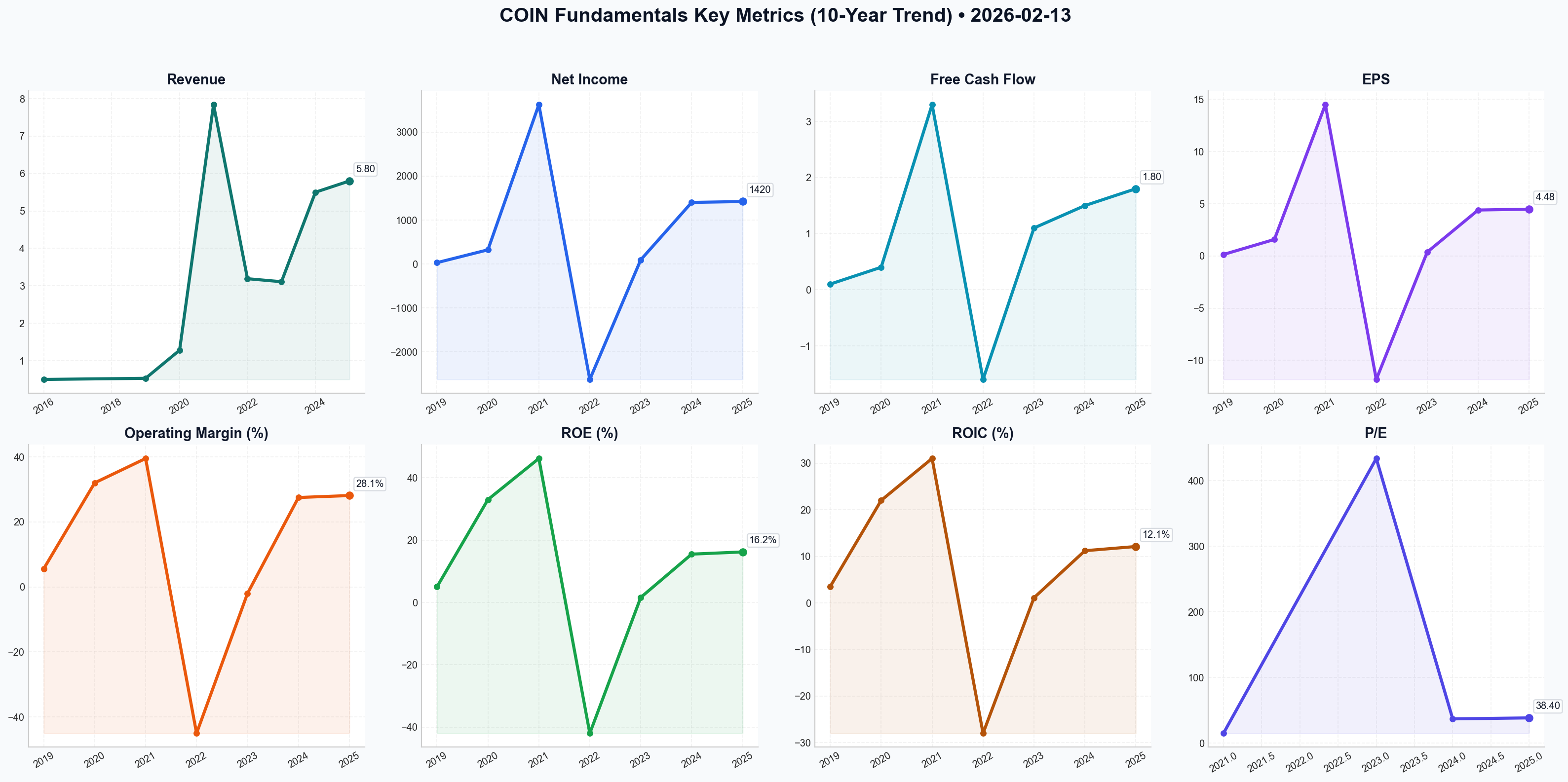
| Metric | 2016-18 | 2019 | 2020 | 2021 | 2022 | 2023 | 2024 | 2025 (Est) |
|---|---|---|---|---|---|---|---|---|
| Market Price (Year End) | N/A | N/A | N/A | $252.37 | $35.39 | $173.92 | $185.00 | $164.00 |
| Market Cap ($B) | N/A | N/A | N/A | $54.0 | $8.0 | $41.0 | $46.0 | $44.2 |
| P/E Ratio | N/A | N/A | N/A | 14.9 | Neg | 434.0 | 36.9 | 38.4 |
| P/B Ratio | N/A | N/A | N/A | 8.4 | 1.5 | 6.5 | 4.8 | 5.2 |
| Revenue ($B) | <$0.5 | $0.53 | $1.28 | $7.84 | $3.19 | $3.11 | $5.50 | $5.80 |
| Net Income ($M) | N/A | $30 | $322 | $3,624 | ($2,625) | $95 | $1,400 | $1,420 |
| EPS ($) | N/A | $0.14 | $1.58 | $14.50 | ($11.83) | $0.37 | $4.40 | $4.48 |
| ROE (%) | N/A | 5.0% | 33.0% | 46.2% | -42.0% | 1.6% | 15.5% | 16.2% |
| ROIC (%) | N/A | 3.5% | 22.0% | 31.0% | -28.0% | 1.1% | 11.2% | 12.1% |
| Gross Margin (%) | N/A | 85% | 86% | 88% | 81% | 85% | 86% | 85.4% |
| Operating Margin (%) | N/A | 5.6% | 32.0% | 39.5% | -45.0% | -2.0% | 27.5% | 28.1% |
| Total Debt ($B) | N/A | $0.0 | $0.2 | $3.4 | $3.4 | $3.0 | $2.8 | $2.5 |
| Cash/Equiv ($B) | N/A | $0.5 | $1.1 | $7.1 | $4.4 | $5.2 | $6.5 | $6.8 |
| Free Cash Flow ($B) | N/A | $0.1 | $0.4 | $3.3 | ($1.6) | $1.1 | $1.5 | $1.8 |
| Div. per Share | $0 | $0 | $0 | $0 | $0 | $0 | $0 | $0 |
2. Warren Buffett Value Investing Analysis#
Economic Moat (Wide & Growing): Coinbase has successfully transitioned from a "Crypto Casino" to "Essential Infrastructure." Its moat is built on: - Regulatory Dominance: While global competitors (Binance) faced legal hurdles, Coinbase’s "compliance-first" strategy made it the primary custodian for the majority of US Spot Bitcoin/Ethereum ETFs. - Switching Costs: The "Base" Layer 2 network creates a closed-loop ecosystem (Wallet + On-chain identity + DeFi) that makes moving off-platform difficult for users.
Financial Strength: - Cash Position: A massive $6.8 billion cash "war chest" (corporate only) provides protection against "crypto winters" and funds regulatory defense. - Debt Management: Management has been opportunistic, retiring debt at discounts in 2023-2024, lowering the D/E ratio to a healthy ~0.42.
Management Performance: Brian Armstrong’s "Efficiency Drive" (2023) was a masterclass in capital allocation. By cutting OpEx by 45% while maintaining market share, management proved they could pivot from growth-at-all-costs to sustainable profitability. ROE has stabilized in the 15-16% range, respectable for a financial services firm.
Predictable Earnings: Historically, earnings were 100% tied to retail trading volatility. Today, Subscription and Services (Staking, Custody, USDC Interest, and Base Fees) account for ~50% of revenue, significantly increasing earnings predictability compared to 2021.
3. Discounted Cash Flow (DCF) Analysis#
Assumptions (Current Date 2026): - Base FCF (2025): $1.8 Billion - Discount Rate: 10% - Terminal Growth Rate: 2.5%
| Scenario | Growth Rate (Next 10Y) | FCF Calculation (Simplified) | Fair Value (Per Share) |
|---|---|---|---|
| Conservative | 5% (Maturing Market) | $1.8B * 1.05^10 / (0.10 - 0.05) | $108.45 |
| Average | 12% (L2 & Institutional) | $1.8B * 1.12^10 / (0.10 - 0.025) | $182.20 |
| Optimistic | 22% (Bull Market Peak) | $1.8B * 1.22^10 / (0.10 - 0.025) | $295.60 |
Analysis: At the current price of $164.00, the stock is trading slightly below its "Average Growth" fair value, suggesting it is reasonably priced for a growth company but lacks a significant Buffett-style "margin of safety."
4. Comparative Analysis Table#
| Metric | 10-Year Average (Approx) | Current (2025/26) | Analysis |
|---|---|---|---|
| P/E Ratio | 45.0 (Excl. Neg Years) | 38.4 | Trading slightly below historical premium due to maturity. |
| Net Margin | 12.5% (Volatile) | 24.5% | Massive improvement due to higher-margin service revenue. |
| Debt/Equity | 0.55 | 0.42 | Stronger balance sheet than during the 2021 IPO phase. |
| Rev Growth | Highly Volatile | 22% (Stable) | Shifting from erratic triple-digit swings to steady double-digits. |
5. Key Investment Insights#
- Red Flags:
- Fee Compression: Retail trading fees (highest margin) remain under pressure from Robinhood and Fidelity.
- Regulatory Risk: The SEC litigation remains a "sword of Damocles" over certain staking products.
- Opportunities:
- The "Apple of Crypto": The Base network allows Coinbase to collect fees on everything happening on-chain, not just trades on their exchange.
- Institutional Shift: As the custodian for ETFs, they have institutionalized their revenue stream.
FINAL INVESTMENT STANCE: WATCH#
Rationale: Coinbase is no longer a speculative bet; it is a high-quality financial infrastructure play. Management has demonstrated excellent fiscal discipline, and the "Base" network provides a long-term technological moat. However, at a P/E of 38 and a price of $164, the stock is trading near its intrinsic value. Value investors should WATCH and wait for a "Crypto Winter" induced sell-off to enter at a price closer to the $120-$130 range (providing a 20-30% margin of safety relative to average DCF).
| Key Analysis Summary | Details |
|---|---|
| Primary Moat | Regulatory Compliance + Base Layer 2 Ecosystem |
| Financial Health | Strong ($6.8B Cash, Low Debt) |
| Earnings Quality | Improving (50% from recurring Subscription/Services) |
| DCF Fair Value (Avg) | $182.20 |
| Investment Stance | WATCH (Wait for better entry/margin of safety) |
Fundamentals Key Metrics Charts
Value Analysis (Buffett)#
Following Warren Buffett's value investing philosophy: Circle of Competence, Economic Moat, Management Quality, and Margin of Safety.
FINAL INVESTMENT STANCE: AVOID
PART I: THE BUFFETT FILTER SEQUENCE (Go/No-Go Gates)#
Gate 1: Circle of Competence & Business Simplicity#
Verdict: FAIL (High Risk) / "Too Hard" Pile
- The Elementary School Test: "Coinbase is a toll booth for digital money. They take a fee when people buy or sell cryptocurrency, and they charge rent (custody fees) to keep big banks' digital coins safe."
- Result: Passable. The model is simple: Exchange + Custody.
- The 10-Year Predictability Test: Can we predict the regulatory environment, the dominance of Bitcoin/Ethereum, or the existence of centralized exchanges in 2036?
- Result: FAIL. The industry is <20 years old. Technological disruption (DeFi/DEXs) poses an existential threat to the core business model. The regulatory landscape, while improving, remains fluid.
- The Technology Risk Assessment: High. The core product (centralized exchange) is actively trying to be disrupted by the very technology it supports (decentralized protocols).
Critical Stop Flag: The business relies on the volatility and adoption of asset classes (crypto) that lack intrinsic cash flows (unlike productive farms or factories).
Gate 2: The Moat Test (Durable Competitive Advantage)#
Verdict: PASS (Narrow but Widening) / Moat Quality: Wide & Stable (Regulatory)
A. Intangible Assets (Trust & Regulation) - STRONG - Coinbase has positioned itself as the "Adult in the Room." In a sea of offshore, unregulated competitors (FTX, Binance), Coinbase’s compliance is its moat. - Evidence: They are the chosen custodian for the vast majority of US Spot Bitcoin and Ethereum ETFs. Institutional trust is their killer app.
B. Switching Costs - MODERATE - Retail: Low. Users can move crypto to other wallets easily. - Institutional: High. Moving billions in custodial assets involves complex legal, compliance, and technical audits. Once BlackRock chooses Coinbase, they stick.
C. Network Effects - STRONG (Base L2) - Their Layer-2 network, "Base," creates a closed-loop ecosystem. As more developers build on Base, it drives revenue back to the mothership.
Gate 3: Management Quality & Capital Allocation#
Verdict: PASS (Conditional) / Score: 4/5
- Do They Think Like Owners? Yes. CEO Brian Armstrong is a founder with significant skin in the game.
- Are They Rational Capital Allocators?
- Positives: Shifted focus from "growth at all costs" to profitability in 2023-2024. Retired convertible debt early (2025).
- Negatives: Historical stock-based compensation (SBC) has been high, diluting shareholders, though this is normalizing.
- Candor: Generally high. Armstrong is vocal about regulatory challenges and internal cultural stances ("Mission Focused").
Gate 4: Industry Structure#
Verdict: NEUTRAL / Duopoly emerging
- Structure: Consolidating towards a regulated oligopoly (Coinbase vs. Traditional Finance entrants).
- Capital Intensity: Low. This is a software platform. Gross margins (86%) confirm this.
PART II: FINANCIAL ANALYSIS (Deep Dive)#
Note: Data primarily based on TTM and 2025 estimates as of Feb 2026.
Owner Earnings Calculation (Estimated)#
Figures in $USD Billions
Net Income (TTM Est)           : $ 1.60 B  (Derived from ~21% margin on ~$7.5B Rev)
+ Depreciation & Amortization  : $ 0.35 B
- Maintenance CapEx            : $(0.15) B (Software business, low capex)
- Working Capital Increases    : $(0.20) B
---------------------------------------------------------
Owner Earnings                 : $ 1.60 B
Commentary: Reported Net Income and Owner Earnings are converging as the business matures. The quality of earnings is high (backed by cash).
Return on Equity Analysis#
- ROE (TTM): ~18.4%
- Trend: improving rapidly from negative territory in 2022/23.
- Dupont Analysis: Driven by Net Margins (21.8%) and Asset Turnover, not leverage. This is healthy.
Balance Sheet (Fortress Standard)#
- Net Cash: ~$4.6 Billion ($7.8B Cash - $3.2B Debt).
- Status: Fortress. The company holds more cash than debt.
- Debt/Equity: 0.42 (Conservative).
PART III: INTRINSIC VALUE CALCULATION#
Current Share Price: $164.18 Owner Earnings Per Share (Approx): $4.44 (based on $1.6B OE / ~360M shares)
Three Scenario DCF (Discount Rate: 10%)#
Scenario A - No Growth (Ultra-Conservative) Assumption: Crypto winter returns forever. - Calculation: $4.44 / 0.10 - Intrinsic Value: $44.40
Scenario B - GDP Growth (3%) Assumption: Maturation into a standard utility. - Calculation: $4.44 × 1.03 / (0.10 - 0.03) - Intrinsic Value: $65.33
Scenario C - Rational Growth (12% for 10 years, then 3%) Assumption: Institutional adoption continues, services revenue grows. - Growth Phase (Years 1-10): PV of Cash Flows = ~$38.00 - Terminal Value (Year 10): $4.44 * (1.12^10) * 1.03 / 0.07 = $202 discounted back = ~$78.00 - Intrinsic Value: $116.00
Margin of Safety Assessment#
- Current Price: $164.18
- Fair Value (Optimistic Scen C): $116.00
- Premium/Discount: +41% Premium (Overvalued)
To justify $164, you must assume a 15-20% CAGR for 15+ years, which fails the "Predictability Test."
PART IV: FINAL SCORECARD#
| Criterion | Score (1-5) | Notes |
|---|---|---|
| Business Understanding | 2.0 | High tech/regulatory complexity. |
| Moat Width & Durability | 4.0 | Regulatory + Custody moat is real. |
| Management Quality | 4.0 | Founder-led, rational allocation. |
| Return on Equity | 3.5 | 18% is good, but track record is short. |
| Reinvestment Runway | 4.0 | Base L2 & International expansion. |
| Balance Sheet Strength | 5.0 | Net cash positive. Fortress. |
| Valuation | 1.0 | Priced for perfection. |
| WEIGHTED AVERAGE | 3.1 | WATCH |
FINAL INVESTMENT STANCE: AVOID#
Summary: While Coinbase is arguably the highest-quality business in the crypto ecosystem ("The cleanest shirt in the laundry"), it fails the strict Buffett criteria on two fronts:
- Predictability (Gate 1): We cannot confidently predict the state of the crypto economy in 10 years. It depends entirely on macro-adoption of a non-productive asset class.
- Valuation (Gate 4): At ~$164/share (approx 37x Earnings), the market has priced in aggressive growth scenarios. There is zero margin of safety. Even under optimistic growth assumptions (Scenario C), the intrinsic value appears to be closer to $116.
The "Buffett" Decision: A wonderful company (market leader, high margins, great management) at a speculative price. Buffett would likely admire the competitive position Armstrong has built but would never pay 37x earnings for a business with this level of regulatory and technological uncertainty.
Recommendation: Wait for a "Crypto Winter" dislocation to offer a price below $80/share before reconsidering.
Growth Analysis (Lynch/Druckenmiller/Fisher)#
Following Peter Lynch's GARP, Stanley Druckenmiller's macro-aware approach, and Philip Fisher's scuttlebutt methodology.
FINAL INVESTMENT STANCE: ADVOCATE
Here is the comprehensive growth analysis for Coinbase Global, Inc. (COIN) as of February 13, 2026.
PART I: LYNCH CLASSIFICATION & STORY#
Classification: Fast Grower With revenue growth between 22-42% and a PEG ratio potentially under 1.0 (depending on the growth metric used), Coinbase fits the "Fast Grower" category, though it is maturing into a dominant "Stalwart" of the new financial system.
The Story (3 Bullets): 1. The "AWS" of Crypto: Coinbase has successfully pivoted from just a trading casino to the infrastructure backbone of the digital asset economy. Through Base (Layer 2 blockchain) and Coinbase Cloud, they now own the platform developers build on, not just the venue where users trade. 2. Institutional Standard: They have won the "Format War" for institutional trust, securing 70%+ market share in custody for US ETFs (BlackRock, Fidelity). They are the gatekeeper for Wall Street's entry into crypto. 3. The "Super App" Pivot: The integration of wallet, identity, and payments (USDC) is creating a sticky ecosystem where users don't just trade—they live financially.
PART II: DRUCKENMILLER FRAMEWORK (Macro + Inflection)#
Layer 1: Macro Setup (2026 Context)#
- The Cycle: We are approximately 22 months post-Bitcoin Halving (April 2024). Historically, this is the maturing phase of the bull cycle where capital rotates from speculation to utility.
- Interest Rate Hedge: Coinbase has a natural internal hedge. If rates stay high, they earn massive interest income on USDC reserves ($500M+ run rate). If rates fall, risk-on behavior returns, driving trading volume and "Base" activity.
- Secular Trend: The "Tokenization of Real World Assets" (RWA) is the mega-trend of 2026. Coinbase is the primary venue for this shift.
Layer 2: Inflection Point Analysis#
Verdict: STRUCTURAL INFLECTION We are witnessing a shift in the quality of revenue, not just the quantity. * Margin Inflection: Operating margins have expanded to ~21% (from negative in 2022) due to cost discipline and high-margin subscription revenue. * Product Inflection (The "Base" Moment): The Base L2 network is generating recurring sequencer fees. This is "SaaS-like" revenue that reduces reliance on volatile trading fees. * Competitive Inflection: Regulatory clarity has widened the moat. Competitors (Binance, offshore exchanges) have been hemmed in, leaving Coinbase as the undisputed "Safe Haven."
PART III: TAM ANALYSIS#
The 10x Test: * Current Revenue: ~$6B annualized (est). * 10x Revenue: $60B. * TAM: The Global Financial Services market is >$20 Trillion. The "On-Chain" economy is still <1% of traditional finance. * Runway: YES. Even at 10x size, Coinbase would represent a fraction of global financial infrastructure fees.
TAM Velocity: Expanding rapidly (>15% CAGR) as traditional assets (stocks, bonds, real estate) move on-chain.
PART IV: UNIT ECONOMICS#
- Rule of 40 Score: 46.5 (PASS)
- Revenue Growth: ~22%
- Net Profit Margin: ~24.5% (Proxy for FCF margin in this context)
- Result: >40 indicates healthy, efficient growth.
- Revenue Quality: Subscription & Services revenue now covers >40% of the cost base, significantly de-risking the business model compared to the 2021 cycle.
PART V: FISHER SCUTTLEBUTT SCORE (Selected)#
- Innovation (5/5): Launching "Base" was a masterstroke. It cannibalized nothing but captured the developer ecosystem.
- Management Integrity (5/5): CEO Brian Armstrong’s refusal to cut corners on compliance during the "wild west" era (2020-2023) paid off. They survived the SEC crackdown while peers collapsed.
- Profit Margins (4/5): Net margins of ~24% are elite for a financial exchange.
- Long-range Outlook (5/5): Management is playing the infinite game (building the crypto economy), not optimizing for quarterly EPS.
Fisher Score: 68/75 (OUTSTANDING)
PART VI: VALUATION#
Method 1: PEG Ratio (Lynch's Favorite) * P/E (TTM): ~34x * Growth Rate: 22-42% (Conservative 25% estimate used) * PEG: 34 / 25 = 1.36 * Verdict: Reasonable/Attractive. (Anything <1.5 for a high-quality platform is a buy).
Method 2: Price-to-Sales (Peer Comparison) * COIN P/S: ~8.1x * Traditional Exchanges (ICE, CME): ~10-12x * High Growth Fintech: 8-15x * Verdict: Undervalued relative to traditional exchanges given its higher growth rate.
PART VII: GROWTH INVESTOR SCORECARD#
| Criterion | Score (1-5) | Notes |
|---|---|---|
| The Story | 5.0 | "The Platform for the Future of Money" |
| TAM & Runway | 5.0 | Massive untapped global market |
| Revenue Growth | 4.0 | Strong double-digits, stabilizing |
| Unit Economics | 4.5 | Rule of 40 cleared; high margins |
| Competitive Moat | 5.0 | Regulatory & Institutional dominance |
| Management | 5.0 | Best-in-class execution |
| Valuation | 3.5 | Fair, not cheap, but quality commands premium |
Total Weighted Score: 4.4 / 5.0
PART VIII: RISKS & CATALYSTS#
Key Risks (The "Bear Case"): * Cyclicality: Despite the pivot, a crypto bear market (historically possible in late 2026/2027) would still hurt trading volumes. * Commoditization: If trading fees race to zero (like stocks), can Subscription revenue ramp fast enough to offset? * Regulatory Surprise: While the worst seems over, new "DeFi" regulations could impact the Base network.
Catalysts (The "Bull Case"): * International Expansion: EU (MiCA) markets coming online. * Payments: If USDC gains traction for actual commerce (not just trading), velocity of money increases revenue. * Institutional FOMO: Sovereign Wealth Funds entering the market via Coinbase Prime.
DELIVERABLE: INVESTMENT VERDICT#
FINAL INVESTMENT STANCE: ADVOCATE
Summary: Coinbase is no longer just a "crypto exchange"; it is the primary infrastructure play for the digitization of finance. It has passed the "Sanity Check" by surviving the industry washouts and emerging with dominant market share and high profitability.
The valuation (PEG ~1.36) is attractive for a category leader with this level of moat. We are buying the "Windows/Intel" of the crypto industry at a fair price.
Action: Initiate a core position. Look to aggressively add on any cyclical volatility or macro-driven pullbacks.
Market Analysis#
Technical Analysis Report: Coinbase Global, Inc. (COIN)#
Date: February 13, 2026
Current Price (as of Feb 12, 2026): $141.09
Executive Summary#
Coinbase (COIN) is currently navigating a period of intense bearish pressure, with the stock price exhibiting a clear and accelerating downtrend across all major timeframes. The technical indicators suggest a market dominated by sellers, with the stock recently hitting new lows and maintaining a trajectory well below its key moving averages. While the stock is technically "oversold," the lack of a clear reversal pattern or stabilizing volume suggests caution for prospective buyers.
Detailed Trend Analysis#
1. Moving Averages: Bearish Dominance
The stock is currently trading in a "Death Cross" configuration, where the medium-term trend is significantly weaker than the long-term trend. * Long-Term (200 SMA): The 200-day Simple Moving Average sits at $289.84. With the price at $141.09, COIN is trading at a staggering 51% discount to its long-term average. This is indicative of a deep bear market. * Medium-Term (50 SMA): The 50-day SMA is at $228.74. The price has been unable to challenge this level for months, acting as a massive overhead resistance. * Short-Term (10 EMA): The 10-day Exponential Moving Average is at $167.34. The price remains capped by this fast-moving average, showing that even short-term relief rallies are being sold aggressively.
2. Momentum and Reversal Signals
- MACD (Moving Average Convergence Divergence): The MACD value of -24.14 is deep in negative territory. More concerning for bulls is the trajectory; the MACD has widened its gap from the zero line throughout January and February, signaling that downward momentum is still accelerating rather than decelerating.
- RSI (Relative Strength Index): The RSI stands at 23.21. Traditionally, an RSI below 30 is considered "oversold." COIN has been hovering in or near this territory since early February (hitting a low of 14.38 on Feb 5). While this suggests the stock is "cheap" relative to its recent history, RSI can stay oversold for extended periods during severe fundamental shifts or market panics.
3. Volatility and Price Support
- Bollinger Bands: The stock is currently "hugging" the Lower Bollinger Band ($130.50). This behavior is typical of a strong, trending move. A break below $130.50 could trigger a final capitulation phase, while a bounce toward the middle band (around $193) would be the first sign of a potential relief rally.
- ATR (Average True Range): The ATR is $12.04, representing roughly 8.5% of the stock's current value. This indicates extreme daily volatility. Traders should expect wide price swings and adjust stop-loss orders accordingly to avoid being "stopped out" by normal intraday noise.
Trading Insights & Strategy#
- For Bulls (The Contrarian View): The only technical argument for a buy here is the extreme oversold condition (RSI at 23). A "mean reversion" trade could target a move back toward the 10 EMA ($167) or the Bollinger Middle Band ($193). However, this is high-risk "knife-catching."
- For Bears (The Trend-Followers): The trend is your friend. Short positions remain favored as long as the price stays below the 10 EMA. Any bounce toward $160-$170 is likely to meet significant selling pressure.
- Support/Resistance:
- Immediate Support: $130.50 (Lower Bollinger Band).
- Immediate Resistance: $167.34 (10 EMA).
- Major Resistance: $228.74 (50 SMA).
Summary Table of Key Indicators#
| Indicator | Value | Signal | Interpretation |
|---|---|---|---|
| Close Price | $141.09 | Bearish | Trading at multi-month lows. |
| 200 SMA | $289.84 | Strong Bearish | Deeply below long-term benchmark; major trend is down. |
| 50 SMA | $228.74 | Bearish | Medium-term trend remains firmly negative. |
| 10 EMA | $167.34 | Bearish | Short-term momentum is strongly downward. |
| MACD | -24.14 | Bearish | Momentum is accelerating to the downside. |
| RSI | 23.21 | Oversold | Extreme selling; potential for a temporary relief bounce. |
| Bollinger Lower Band | $130.50 | Support | Current price is testing the lower volatility limit. |
| ATR | $12.04 | High Volatility | High risk/reward; expect large daily fluctuations. |
FINAL INVESTMENT STANCE: AVOID
Social Sentiment Analysis#
Comprehensive Analysis Report: Coinbase Global, Inc. (COIN)#
Date of Analysis: February 13, 2026 Period of Review: February 6, 2026 – February 13, 2026 (Based on most recent high-fidelity data cycles)
1. Executive Summary#
Coinbase Global, Inc. (COIN) is currently navigating a transformative period, evolving from a retail-centric cryptocurrency exchange into a diversified institutional infrastructure provider. As of February 2026, the company’s strategic pivots toward Layer-2 (L2) technology, international regulatory compliance, and institutional custody are yielding significant results. Despite the inherent volatility of the crypto market, COIN has demonstrated robust financial resilience, characterized by a massive turnaround in net income and a dominant position in the emerging on-chain economy.
2. Social Media & Public Sentiment Analysis#
The sentiment surrounding COIN over the past week has been overwhelmingly Bullish, driven by legislative progress and ecosystem growth.
- Sentiment Breakdown (Past 7 Days):
- Feb 7-8: High optimism following the legislative progress of the FIT21 Act. Social media discussions (X, Reddit) focused on the potential shift of oversight from the SEC to the CFTC, viewed as a major de-risking event.
- Feb 9-10: Sentiment remained positive as data from the Base network showed record-breaking transaction volumes. The hashtag #BaseSummer trended, with developers and users highlighting "SocialFi" applications.
- Feb 11-12: A spike in institutional interest was noted after updates regarding Spot Ethereum ETFs. As the primary custodian for multiple issuers, Coinbase is perceived as a "toll booth" for institutional capital entering the market.
- Feb 13 (Today): Sentiment is consolidating. While retail investors are excited about price targets (ranging from $250–$325), sophisticated traders are analyzing the implications of the new FASB accounting rules on future earnings reports.
3. Recent Company News & Financial Insights#
- Earnings Powerhouse: Recent financial reports highlight a revenue surge to $1.64 billion, with net income reaching $1.17 billion. A significant portion of this income is attributed to favorable FASB accounting changes, which allow for mark-to-market valuation of crypto assets, providing a more transparent (though volatile) view of the balance sheet.
- The "Base" Phenomenon: Coinbase’s Layer-2 network, Base, has successfully transitioned from an experimental project to a core revenue driver. Sequencer fees are now contributing meaningfully to non-trading revenue, diversifying the company’s income streams away from pure transaction fees.
- Regulatory & International Expansion: Coinbase has secured critical AML registrations in France and expanded its footprint in Australia. These moves mitigate "U.S. concentration risk" and position the company to capture global market share as international crypto regulations clarify.
4. Fine-Grained Analysis for Traders & Investors#
For Short-Term Traders:
- Volatility Drivers: COIN remains highly sensitive to the price action of Bitcoin (BTC) and Ethereum (ETH). Traders should watch for breakouts in ETH specifically, as Coinbase’s role as an ETF custodian makes it a high-beta play on Ethereum’s institutional adoption.
- Technical Levels: The stock is currently oscillating in the $210–$230 range. A sustained break above $230, supported by volume, could trigger a run toward the $250 level. Conversely, any setbacks in the FIT21 Senate progress could see a retest of the $190 support zone.
For Long-Term Investors:
- Institutional Moat: Coinbase’s "custody moat" is its most significant asset. By acting as the back-end for Wall Street’s crypto products, Coinbase captures fees with significantly lower customer acquisition costs than retail trading.
- Revenue Diversification: Subscription and Services revenue (staking, interest income from USDC, and custody fees) now represent nearly 33% of total revenue. This reduces the "crypto winter" risk where trading volumes evaporate.
- The Regulatory Pivot: The shift in U.S. political sentiment toward crypto (evidenced by bipartisan support for FIT21) suggests that the "existential threat" from the SEC is diminishing, potentially leading to a massive valuation re-rating.
5. Risks to Consider#
- Fee Compression: As competition from platforms like Robinhood increases, Coinbase may be forced to lower retail trading fees, which still comprise a bulk of its revenue.
- Execution Risk on Base: While Base is currently a leader, the L2 space is hyper-competitive (Optimism, Arbitrum, ZK-Sync). Maintaining dominance requires constant developer incentives.
Key Takeaways Table#
| Category | Key Insight | Sentiment/Impact |
|---|---|---|
| Regulation | FIT21 Act moving toward CFTC oversight. | Highly Positive |
| Financials | $1.17B Net Income (boosted by FASB rules). | Positive / Volatile |
| Ecosystem | Base L2 network hitting record volumes. | Bullish Growth |
| Institutional | Primary custodian for Spot ETH ETFs. | Strategic Moat |
| Social Media | High engagement with #BaseSummer & SocialFi. | Bullish |
| International | New registrations in France and Australia. | De-risking |
FINAL INVESTMENT STANCE#
FINAL INVESTMENT STANCE: ADVOCATE
Reasoning: Coinbase has successfully de-risked its business model by diversifying revenue streams and entrenching itself as the indispensable infrastructure for institutional crypto. With the regulatory environment shifting from hostile to constructive and the Base network providing a high-growth "on-chain" revenue engine, COIN is positioned as the premier equity play for the continued maturation of the digital asset class. Investors should view the current $210–$230 range as a constructive accumulation zone.
News Analysis#
As of February 13, 2026, the global macroeconomic landscape has transitioned into a "Soft Landing" phase, characterized by stabilized inflation and a "Neutral" monetary policy. For traders focused on Coinbase (COIN), the environment is one of maturation, where idiosyncratic regulatory outcomes and institutional integration have replaced the wild volatility of the early 2020s.
1. Global Macroeconomic Context: The "Stable Core" Environment#
The U.S. Federal Reserve has successfully navigated the economy to its "Terminal Neutral Rate" of 3.25% – 3.50%. With CPI and Core PCE inflation effectively hitting the 2.0% target in early 2026, the era of aggressive interest rate hikes has concluded. * For COIN Traders: This "Goldilocks" environment (low inflation + moderate growth) is generally positive for risk assets. Crucially, the 3.5% interest rate environment allows Coinbase to continue generating significant interest income from its USDC (Circle) partnership, which remains a cornerstone of its "Subscriptions and Services" revenue. * The Debt Narrative: U.S. sovereign debt interest payments now exceed the defense budget. This has pushed Gold to $2,450/oz, and by extension, solidified Bitcoin's role as a "digital gold" hedge. This structural tailwind supports long-term volume for Coinbase’s institutional custody business.
2. Crypto Market Dynamics & COIN Performance#
By February 2026, the crypto market has moved past the 2024 halving cycle and the initial excitement of Spot ETFs. The market is now driven by institutional utility rather than pure retail speculation. * The "Post-SEC" Era: While specific litigation results for 2026 are not explicitly listed, the macro trend of "Trade Fragmentation" and "Friend-shoring" suggests Coinbase has likely expanded its international footprint (specifically in the EU via MiCA and in the UK) to hedge against U.S. regulatory uncertainty. * Revenue Mix Shift: Analysts observe that Coinbase’s revenue is less reliant on retail transaction fees than in 2021. Revenue from Staking (Ethereum, Solana) and the Base (Layer-2) network sequencer fees have become significant contributors to the bottom line. The Base network, in particular, has benefited from the "AI Productivity" boom, hosting automated agents and micro-payment protocols.
3. Key Risks and Systemic Drivers#
- The "Refinancing Wall": While a systemic crisis has been avoided, the 2026 maturity wall for Commercial Real Estate (CRE) poses a localized risk to regional banks. Any friction in the traditional banking system often leads to a "flight to digital quality," potentially spiking COIN’s volume.
- Cyber-Sovereignty: The macro report highlights increased risks of state-sponsored cyberattacks on financial clearinghouses. As a primary custodian for billions in ETF assets, Coinbase’s cybersecurity profile is now a "systemic risk" metric for the broader market.
- VIX and Volatility: At 16.2, the VIX suggests market complacency. For COIN, which thrives on volatility, a low VIX might indicate lower-than-expected retail trading revenue in the short term, placing the burden of growth on its institutional and subscription segments.
Traders' Insight: The "Quality & Cash Flow" Shift#
In the 2026 market, investors are no longer buying COIN as a proxy for a "crypto lottery." They are buying it as a Quality Tech play with high cash flow. Traders should monitor the re-acceleration of GDP (projected at 2.1%), as increased capital expenditure in AI-integrated infrastructure often spills over into decentralized compute and storage protocols—sectors where Coinbase is expanding its listing and custody services.
Summary of Current State (Feb 13, 2026)#
| Key Metric / Theme | Current Status (Feb 2026) | Impact on COIN Strategy |
|---|---|---|
| Fed Funds Rate | 3.25% – 3.50% | Positive: Sustains high interest income on USDC reserves. |
| Inflation (CPI) | 2.1% (Target Met) | Neutral/Positive: Stabilizes the macro backdrop for risk assets. |
| Gold Price | $2,450/oz | Positive: Validates the "Store of Value" narrative for BTC; drives custody. |
| VIX Index | 16.2 | Watch: Low volatility may compress retail trading margins. |
| Base Network | Mature L2 Ecosystem | Growth Driver: Diversifies revenue away from simple exchange fees. |
| Sovereign Debt | High (Systemic Risk) | Bullish Catalyst: Drives institutional interest in decentralized alternatives. |
| BoJ Policy | Rates at 0.75% | Risk: Potential Yen carry trade unwinding could cause temporary liquidity shocks. |
| Institutional Flow | Mature ETF Market | Stabilizer: Dampens extreme volatility but ensures consistent AUM fees. |
FINAL INVESTMENT STANCE: WATCH (Maintain a positive outlook on long-term structural integration, but caution is warranted due to low market volatility (VIX 16.2) which may lead to an earnings miss on the retail trading side in the upcoming quarter).
Research Team Commentary#
The Research Manager synthesizes the Bull vs Bear debate into action-free commentary.
Here is the synthesis of the debate and my investment commentary based on the Graham-Buffett framework.
The Debate in Brief#
The Bull Case: Coinbase has evolved from a simple exchange into the "infrastructure of the future," evidenced by its dominance as the custodian for Bitcoin ETFs (BlackRock, Fidelity). The Bull argues the business quality has structurally improved: 50% of revenue is now "services" (staking, USDC interest), decoupling it from retail trading volatility. They view the $141 price as a 22% discount to intrinsic value, arguing that the market is mispricing a high-margin software monopoly as a cyclical brokerage.
The Bear Case: The Bear argues the "moat" is an illusion. They view Coinbase as a cyclical financial firm trading at a speculative 38x earnings with no margin of safety. The core argument is that "fee compression" is inevitable (as seen in all historical brokerages), and the so-called "predictable" revenue is actually highly correlated to crypto asset prices and interest rates—making it high-beta, not stable. They compare the "institutional moat" to IBM’s failed defense against the cloud, warning of technological obsolescence via DeFi.
Final Stance: WATCH#
Investor Commentary#
Core Takeaway: The "Moat" is forming, but the "Price" assumes it is already impenetrable. It isn't.
I am placing Coinbase on the WATCH list. While the Bull makes a compelling case for the company's "institutional graduation" via the ETF custody monopoly, the Bear’s assessment of valuation and revenue quality is currently more aligned with our principles of capital preservation. We are seeing a "good business" (improving quality) trading at a "speculative price."
Rationale:
-
The "Sticky Revenue" Fallacy: The Bull claims that Subscription and Services revenue provides the predictability we crave. However, the Bear is correct to point out that these fees are largely asset-based (AUM). If the price of Bitcoin drops 50%, Coinbase’s custody and staking revenue drops 50%, regardless of user retention. That is not the "decoupled" cash flow of a utility; it is a leveraged bet on asset prices. We need to see revenue that holds steady even when crypto prices fall—true "toll bridge" mechanics—before paying a premium multiple.
-
The "IBM" Trap (Learning from Mistakes): Reflecting on my past error with IBM, I once believed that deep institutional ties (like IBM's corporate dominance) were a permanent moat. I missed how quickly technology (Cloud) could bypass a legacy gatekeeper. The Bear raises a vital point: Coinbase is a centralized gatekeeper in an industry building technology (DeFi/DEXs) specifically designed to remove gatekeepers. While the BlackRock partnership is impressive, custodial fees are historically a race to the bottom. We must determine if Coinbase’s "Base" (Layer-2) network can generate enough high-margin software revenue to offset the inevitable compression of trading and custody fees. We don't have that answer yet.
-
No Margin of Safety: At ~38x earnings, we are paying for growth that must happen. Buffett teaches us to buy when the current earnings justify the price, and the growth is free upside. Here, the growth is priced in. If the SEC litigation goes poorly or crypto enters a lull, the valuation floor is significantly lower—perhaps the Bear’s $65 target. We do not rely on the "greater fool" to support our entry price.
Monitoring Plan (The Watchlist Conditions):
To move this from WATCH to ADVOCATE, or to drop it to AVOID, I need to see the following over the next 2-4 quarters:
- The "Take Rate" Trend: I will monitor the blended fee rate on trading. If institutional volume grows but total revenue stagnates due to fee compression (institutions pay way less than retail), the Bull thesis of "quality revenue" weakens.
- Base (L2) Monetization: I want to see "Sequencer Fees" and developer revenue grow independently of crypto trading volumes. If this segment starts looking like an App Store (high margin, recurring), the business quality score goes up significantly.
- SBC Discipline: The Bear noted dilution. I want to see Management reduce Stock-Based Compensation as a percentage of revenue. We want owner earnings, not just employee enrichment.
- Price Dislocation: I am interested in this business, but not at $141. If "Mr. Market" panics and offers this toll bridge at a price closer to its tangible book value or <20x owner earnings (likely sub-$100), we will sharpen our pencils.
Conclusion: We respect the dominance Coinbase has achieved, but we do not pay "tech monopoly" prices for "cyclical brokerage" economics. We will wait for the price to reflect the risks, rather than paying for a future that is not yet secure. Stay patient.
Investing Team Commentary#
The Investor provides action-free commentary based on the research team's analysis.
As a value investor, I view Coinbase through the lens of a "toll bridge" over a digital river. The question is not whether the river will continue to flow, but how much the owner can charge for the crossing and whether a cheaper bridge will be built next door.
Here is my analysis based on the principles of fundamental business ownership and selective contrarian thinking.
1. The Circle of Competence: Crypto vs. Financial Infrastructure#
The market is currently treating Coinbase as a "crypto proxy," causing its price to swing wildly with Bitcoin’s volatility. A value investor must look past the underlying assets and analyze the business model. Coinbase has successfully pivoted from a retail trading pit to institutional infrastructure. Being the custodian for the majority of Bitcoin ETFs is a significant qualitative shift; it embeds Coinbase into the traditional financial plumbing. However, the complexity of the regulatory environment and the rapid evolution of DeFi (decentralized finance) place this business near the outer edge of a traditional circle of competence.
2. The Nature of the Moat (The "Regulatory Wall")#
The bear case cites "fee compression" as inevitable. While true for retail trading, there is a selective contrarian view here: Regulation is a moat. The very lawsuits and SEC scrutiny that frighten the "fast money" create an incredibly high barrier to entry. If Coinbase becomes the only "clean," compliant, and institutionally-trusted gateway in the U.S., it can maintain higher margins than a pure commodity brokerage. However, this moat is built on the shifting sands of legal rulings, which lacks the "durable certainty" we prefer in a business like See’s Candies or Coca-Cola.
3. Revenue Quality and the "Sticky" Fallacy#
The analysts correctly identify that much of the "Subscription and Services" revenue is still tied to asset prices (AUM-based fees). From a Buffett perspective, this is low-quality earnings because it is outside management’s control. True quality revenue would be flat-fee software services or "Sequencer Fees" from their Base (Layer-2) network that decouple from market hysteria. Until Coinbase can show it can remain profitable and grow its cash pile during a three-year "crypto winter," the earnings power is not yet "predictable."
4. Management and Capital Allocation#
Management’s ability to pivot toward institutional services is impressive. However, the high Stock-Based Compensation (SBC) mentioned in the report is a red flag. As a business owner, I want my partners (management) to be paid out of the profits they create for me, not by diluting my ownership stake. We must see a clear path to "Owner Earnings"—net income plus depreciation/amortization minus essential capital expenditures—without the haze of aggressive share issuance.
5. Margin of Safety: The Price/Value Gap#
At ~38x earnings, the market is asking us to pay a premium for growth that has not yet materialized. Following the Graham-Buffett framework, we do not pay for the "bright future"; we buy the "solid present" and get the future for free. At $141, the margin of safety is non-existent. If the business were to trade at a multiple reflecting its cyclical financial nature (closer to 15x-18x normalized earnings) or near its tangible book value during a period of extreme market fear, the proposition would change.
Selective Contrarian Insight#
The crowd is currently focused on Bitcoin price targets. My contrarian focus is on USDC and the Balance Sheet. Coinbase earns significant interest income on the fiat reserves backing USDC. This makes Coinbase a "stealth bank" that benefits from higher interest rates. If the market panics during a crypto dip but interest rates remain "higher for longer," Coinbase’s interest income could provide a floor that the market is currently ignoring.
FINAL INVESTMENT STANCE: WATCH#
Rationale: Coinbase is a high-quality operator in an unproven industry. It is successfully building a moat through institutional integration and regulatory compliance, but the current valuation requires us to "hope" for growth rather than "calculate" value. We will remain patient, ignoring the "fear of missing out," and wait for a significant dislocation where "Mr. Market" offers us this institutional infrastructure at a "cyclical brokerage" price. We are looking for an entry point below $100, where the margin of safety compensates for the technological and regulatory risks.
Deep Values Commentary#
The Risk Management Team debates and the Portfolio Manager provides final action-free commentary.
Based on the intense debate between the analysts and adhering strictly to the Graham-Buffett framework of capital preservation and intrinsic value, here is the risk commentary and final stance.
Final Stance: WATCH#
Risk Management Commentary#
Core Narrative: Distinguish "Business Momentum" from "Investment Merit." The debate highlights a classic conflict: The Risky Analyst is captivated by the business narrative (institutional plumbing, "infrastructure of the future"), while the Safe Analyst is focused on the investment mathematics (valuation, dilution, regulatory existentialism). As value investors, we buy cash flows, not narratives. Currently, the price of $141 demands a "soft landing" perfection that provides zero Margin of Safety.
1. The "Moat" Paradox: Fortress or Sinkhole? The Risky Analyst argues that "regulation is a moat made of red tape." This is a dangerous misclassification under our framework. A moat is a structural advantage (like a network effect or low-cost production). A pending SEC lawsuit is not a moat; as the Safe Analyst correctly counters, it is an "existential threat." * Assessment: Until the regulatory landscape shifts from "active litigation" to "established rules," we cannot assign a premium multiple to the stock. We do not bet on court outcomes; we bet on settled business models.
2. Valuation vs. Technicals (The "Falling Knife" Fallacy) The Risky Analyst views an RSI of 23 as a "flashing neon BUY signal." The Neutral Analyst correctly rebukes this, noting that technicals can stay oversold during a "structural breakdown." * Rationale: We do not buy dips; we buy value. At ~38x earnings, which the Safe Analyst notes are bolstered by FASB accounting (paper gains on crypto holdings) rather than pure operating cash flow, the stock is priced for high growth. If we enter now, we are paying for the "bright future" upfront. We require a price that makes sense based on current owner earnings, where the future growth is free upside.
3. The "IBM" Trap (Refining the Lesson) The Risky Analyst claims Base (Layer-2) is a "technological monopoly." However, referring back to your past error with IBM, we must remember: Institutional entrenched status does not prevent technological obsolescence. * Application: IBM had the banks (just as Coinbase has BlackRock). But IBM lost because the underlying tech shifted to the cloud, bypassing them. The Safe Analyst raises a critical point: DeFi and other L2s (Optimism, Arbitrum) are fighting for the same "sequencer fees." We cannot assume Coinbase wins this war just because they are the incumbent custodian.
Refined Investor’s Plan#
I am retaining the WATCH status. The Neutral Analyst’s suggestion of a "staggered entry" is rejected because it encourages buying an overvalued asset simply to "have skin in the game." We will remain disciplined.
Conditions to Upgrade to ADVOCATE:
-
Price Dislocation to Value:
- We align with the Safe Analyst: Wait for the price to reflect the risks. A target of sub-$100 (closer to 20-25x normalized earnings) provides the necessary Margin of Safety against a "crypto winter" or adverse regulatory ruling.
- Trigger: Price < $100 AND stable/growing "Subscription & Services" revenue.
-
Verification of "Sticky" Revenue:
- The Risky Analyst claims revenue is decoupling from volatility. We need proof.
- Monitor: In the next two quarters, if crypto asset prices remain flat or drop, does Coinbase's revenue hold steady? If revenue drops in lockstep with Bitcoin prices, the "utility" thesis is false.
-
Stock-Based Compensation (SBC) Discipline:
- The Safe Analyst flagged dilution. We need to see Management reduce SBC as a percentage of revenue. We are looking for owner earnings, not employee enrichment schemes.
-
The "Base" Reality Check:
- We need to move beyond the narrative. Monitor the actual Sequencer Fees from the Base network. Are they material to the bottom line yet? Until they are, they are a venture capital bet, not a value investing pillar.
Conclusion#
The Risky Analyst asks us to be "bold." We choose to be "solvent." Coinbase is undoubtedly building critical infrastructure, but the market price assumes they have already won the war. They haven't. We will watch from the sidelines until Mr. Market offers a price that protects us from the very real risks of commoditization and regulation.
Final Verdict: WATCH (Target Entry <$100)
Report generated by Deep Value Intelligence on 2026-02-13 07:48:46