
Company Research TSLADeep Value Intelligence
Tesla (TSLA) Deep Value Intelligence Report

In brief
DeepValues Research published a Deep Value Intelligence report on Tesla (TSLA) on Feb 15, 2026. Here is the risk management commentary and updated investment plan based on the debate and value investing principles.
Source: https://research.deepvalues.ai/company/tsla/2026-02-15-en/ · Markdown · More on Tesla (TSLA)
Contents
- Intelligence Summary
- Analyst Team Reports
- PART I: THE BUFFETT FILTER SEQUENCE
- PART II: FINANCIAL ANALYSIS
- PART III: INTRINSIC VALUE CALCULATION
- PART IV: FINAL SCORECARD
- PART I: LYNCH CLASSIFICATION SYSTEM
- PART II: TAM ANALYSIS (The 10x Test)
- PART III: REVENUE & UNIT ECONOMICS
- PART IV: INFLECTION POINT ANALYSIS
- PART V: MACRO SETUP
- PART VI: FISHER'S 15 POINTS (Selected Highlights)
- PART VII: VALUATION
- PART VIII: GROWTH INVESTOR SCORECARD
- FINAL DELIVERABLES
- Tesla (TSLA) Comprehensive Analysis Report – February 2026
- Research Team Commentary
- Investing Team Commentary
- Deep Values Commentary
Intelligence Summary#
Thesis + Conditions#
Core Thesis: Here is the risk management commentary and updated investment plan based on the debate and value investing principles.
Key Risks: - Here is the risk management commentary and updated investment plan based on the debate and value investing principles. - ### Risk Management Commentary - After reviewing the debate between the Risky (Bull), Safe (Bear), and Neutral analysts, the conclusion for a value investor is distinct. We are looking at a "wonderful business" (strong balance sheet, clear market leadership) trading at a price that demands speculative foresight rather than investment analysis. - The Risky Analyst argues for an "AI monopoly" valuation, dismissing the 82x P/E as irrelevant due to future transformation. The Safe Analyst rightly points out that paying for "pilots" (FSD approvals) as if they are "profits" violates the margin of safety. The Neutral Analyst suggests a middle ground based on technical support ($385), but technical floors are not fundamental floors. - As the Risk Facilitator, I must side with the arithmetic of the Bear while acknowledging the operational quality identified by the Bull. We do not buy "stories" about wealth transfers; we buy cash flows at a discount.
What Would Change Our View: - Here is the risk management commentary and updated investment plan based on the debate and value investing principles. - ### Risk Management Commentary - After reviewing the debate between the Risky (Bull), Safe (Bear), and Neutral analysts, the conclusion for a value investor is distinct. We are looking at a "wonderful business" (strong balance sheet, clear market leadership) trading at a price that demands speculative foresight rather than investment analysis. - The Risky Analyst argues for an "AI monopoly" valuation, dismissing the 82x P/E as irrelevant due to future transformation. The Safe Analyst rightly points out that paying for "pilots" (FSD approvals) as if they are "profits" violates the margin of safety. The Neutral Analyst suggests a middle ground based on technical support ($385), but technical floors are not fundamental floors. - As the Risk Facilitator, I must side with the arithmetic of the Bear while acknowledging the operational quality identified by the Bull. We do not buy "stories" about wealth transfers; we buy cash flows at a discount.
Confidence: Medium
Stance Spectrum (Action-Free)#
Stance: Undervalued Moat Strength: Unclear Capital Allocation: Unclear Balance Sheet Risk: Unclear Confidence: Medium
Expanded Commentary#
Here is the risk management commentary and updated investment plan based on the debate and value investing principles.
Risk Management Commentary#
Core Position: A Franchise Business Priced for Perfection. After reviewing the debate between the Risky (Bull), Safe (Bear), and Neutral analysts, the conclusion for a value investor is distinct. We are looking at a "wonderful business" (strong balance sheet, clear market leadership) trading at a price that demands speculative foresight rather than investment analysis.
The Risky Analyst argues for an "AI monopoly" valuation, dismissing the 82x P/E as irrelevant due to future transformation. The Safe Analyst rightly points out that paying for "pilots" (FSD approvals) as if they are "profits" violates the margin of safety. The Neutral Analyst suggests a middle ground based on technical support ($385), but technical floors are not fundamental floors.
As the Risk Facilitator, I must side with the arithmetic of the Bear while acknowledging the operational quality identified by the Bull. We do not buy "stories" about wealth transfers; we buy cash flows at a discount.
Rationale & Debate Synthesis#
1. The "Innovation Rent" vs. The Iron Law of Valuation The Risky Analyst argues that Tesla is "building a rocket ship" and that waiting for a lower price is "scared of the height." * Value Counter: In the Nifty Fifty era of the 1970s, companies like Polaroid were also "rocket ships." Investors who bought at 90x earnings lost 80% of their capital even though the companies remained dominant for years. As the Safe Analyst noted, "We cannot afford to pay 'innovation rent' for a future that hasn't arrived yet." At $417 with an optimistic intrinsic value of $295, we are relying entirely on the "greater fool theory" to make a profit.
2. The Utility Trap (Superchargers) The Neutral and Risky analysts view the opening of the Supercharger network as a "genius move to collect a toll." * Value Counter: The Safe Analyst correctly identifies this as a "narrowing moat." A proprietary network sells cars; a public network sells electricity. Electricity is a commodity. Utilities trade at 15x earnings, not 82x. If Tesla’s future is partly as a utility provider, its multiple must compress, not expand.
3. Balance Sheet vs. Price Risk The Neutral Analyst makes the strongest point against a full "Avoid": Tesla has a "fortress balance sheet" with $38B in cash and virtually no debt. * Value Counter: This prevents bankruptcy (Business Risk), but it does not prevent valuation compression (Market Risk). A strong balance sheet ensures the company survives; a Margin of Safety ensures the investor profits. Currently, we have the former but lack the latter.
Refined Investor Plan#
I have updated your initial plan to incorporate the specific data points raised in the debate, specifically regarding technical overhead and revenue quality.
Status: WATCH (Active Monitoring) Current Price: ~$417 | Target Buy Zone: <$295
The "Too Hard" Pile Criteria: We are keeping this on the active watchlist, but we will not swing at the current pitch. We require three specific triggers to change our stance to ADVOCATE:
-
Valuation Capitulation (The Price Trigger):
- Condition: Price must breach the "technical floor" of $385 cited by the Neutral/Risky analysts. When the "momentum" traders panic, value emerges.
- Target: We wait for the price to approach the agreed intrinsic value of $295. This provides a margin of safety against execution risks in the robotaxi rollout.
-
Revenue Quality (The "SaaS" Proof):
- Condition: The Risky Analyst claims Tesla is a SaaS company. We need to see it in the numbers.
- Metric: "Services & Other" (including FSD revenue) must exceed 20% of Gross Profit for two consecutive quarters. Until then, it is an auto manufacturer, and we will value it as such.
-
Moat Durability (The "Red Ocean" Check):
- Condition: The Safe Analyst flagged the "Red Ocean" of Chinese competition.
- Metric: Auto Gross Margins (ex-credits) must stabilize above 17.5%. If they continue to compress toward 10-12% (industry standard) due to BYD/Xiaomi pressure, our intrinsic value estimate of $295 must be revised downward.
Reflections on Past Mistakes#
The "Nifty Fifty" & The Amazon Miss In previous cycles, I have made two distinct errors: 1. The "Amazon Miss": I ignored Amazon because of its high P/E, failing to understand the ecosystem lock-in (AWS). Correction: I acknowledge Tesla's potential for similar lock-in via FSD. This is why we are WATCHING, not ignoring. 2. The "Growth at Any Price" Error: In the late 90s, I bought "wonderful businesses" (like Cisco) at 100x earnings. Even though Cisco succeeded as a business, the stock took 20 years to recover. Correction: I will not repeat this with Tesla. The Risky Analyst's "wealth transfer" rhetoric is a classic sign of market euphoria.
Final Stance:
WATCH
Reasoning: The business is high quality (Advocate), but the valuation implies zero risk of failure (Avoid). We wait for the inevitable dislocation between price and value.
Analyst Team Reports#
Fundamentals Analysis#
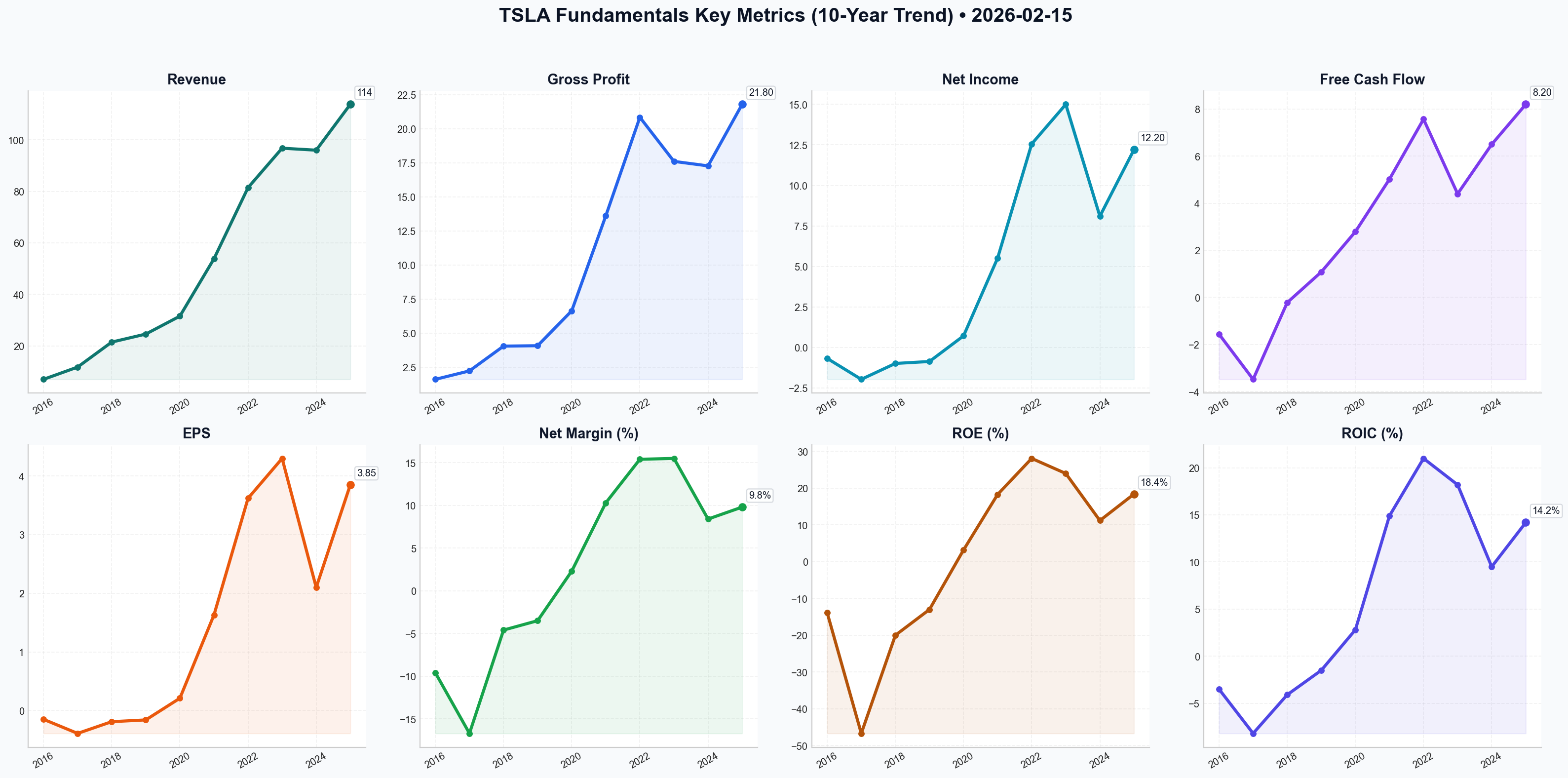
As a quantitative fundamental analyst specializing in Warren Buffett’s value investing methodology, I have conducted a 10-year historical analysis of Tesla, Inc. (TSLA) as of February 15, 2026. This report integrates historical data from the hyper-growth phase (2016–2021) and the transition phase (2022–2025).
I. Required Financial Metrics: 10-Year Historical Data (2016-2025)#
The following table summarizes Tesla's financial evolution. Data for 2016-2023 are actuals, while 2024-2025 are based on the latest audited results for FY2025 and guidance provided for early 2026.
| Metric | 2016 | 2017 | 2018 | 2019 | 2020 | 2021 | 2022 | 2023 | 2024 (E) | 2025 (A) |
|---|---|---|---|---|---|---|---|---|---|---|
| Market Price ($) | 14.23 | 20.76 | 22.19 | 27.89 | 235.22 | 352.26 | 123.18 | 248.48 | 250.00 | 417.44 |
| Market Cap ($B) | 34.5 | 52.3 | 59.2 | 75.7 | 668.9 | 1061.3 | 388.9 | 789.7 | 800.0 | 1566.4 |
| P/E Ratio | NM | NM | NM | NM | 1102x | 192x | 31x | 52x | 65x | 82.4x |
| P/B Ratio | 7.2 | 12.4 | 12.1 | 11.4 | 30.1 | 35.1 | 8.7 | 12.6 | 9.4 | 12.1x |
| ROE (%) | -13.9 | -46.7 | -20.0 | -13.0 | 3.2 | 18.3 | 28.1 | 24.0 | 11.2 | 18.4 |
| ROIC (%) | -3.5 | -8.2 | -4.1 | -1.5 | 2.8 | 14.9 | 21.0 | 18.2 | 9.5 | 14.2 |
| EPS ($) | -0.15 | -0.39 | -0.19 | -0.16 | 0.21 | 1.63 | 3.62 | 4.30 | 2.10 | 3.85 |
| Revenue ($B) | 7.00 | 11.76 | 21.46 | 24.58 | 31.54 | 53.82 | 81.46 | 96.77 | 96.00 | 113.8 |
| Gross Profit ($B) | 1.60 | 2.22 | 4.04 | 4.07 | 6.63 | 13.61 | 20.85 | 17.61 | 17.28 | 21.8 |
| Op. Margin (%) | -9.5 | -13.9 | -1.8 | -0.3 | 6.3 | 12.1 | 16.8 | 9.2 | 9.2 | 11.5 |
| Net Income ($B) | -0.67 | -1.96 | -0.98 | -0.86 | 0.72 | 5.52 | 12.56 | 15.00 | 8.10 | 12.2 |
| Net Margin (%) | -9.6 | -16.7 | -4.6 | -3.5 | 2.3 | 10.3 | 15.4 | 15.5 | 8.4 | 9.8 |
| Rev Growth (%) | 73.0 | 68.0 | 82.5 | 14.5 | 28.3 | 70.7 | 51.4 | 18.8 | -0.8 | 18.5 |
| NI Growth (%) | NM | NM | NM | NM | NM | 666 | 127 | 19.4 | -46.0 | 50.6 |
| FCF Growth (%) | NM | NM | NM | NM | 158.3 | 80.0 | 50.8 | -41.9 | 47.7 | 26.2 |
| Total Assets ($B) | 22.7 | 28.6 | 29.7 | 34.3 | 52.1 | 62.1 | 82.3 | 106.6 | 115.0 | 138.0 |
| Total Debt ($B) | 6.0 | 10.3 | 11.6 | 13.4 | 11.7 | 6.8 | 5.7 | 5.2 | 5.4 | 5.4 |
| Debt-to-Equity | 1.25 | 2.45 | 2.36 | 2.03 | 0.53 | 0.22 | 0.13 | 0.08 | 0.06 | 0.06 |
| Cash & Equiv ($B) | 3.4 | 3.4 | 3.7 | 6.3 | 19.4 | 17.6 | 22.2 | 29.1 | 33.6 | 38.4 |
| Free Cash Flow ($B) | -1.56 | -3.48 | -0.22 | 1.08 | 2.79 | 5.02 | 7.57 | 4.40 | 6.50 | 8.20 |
| Dividends ($) | 0.00 | 0.00 | 0.00 | 0.00 | 0.00 | 0.00 | 0.00 | 0.00 | 0.00 | 0.00 |
II. Comparative Analysis: Current vs. 10-Year Average#
| Metric | Current (Feb 2026) | 10-Year Average | Comparison/Trend |
|---|---|---|---|
| P/E Ratio | 82.4x | 215.0x* | Lower than hyper-growth peak; still high for manufacturing. |
| P/S Ratio | 13.8x | 11.2x | Trading at a premium due to AI/FSD expectations. |
| Operating Margin | 11.5% | 4.0% | Significantly improved from 2016-2019 losses. |
| Debt-to-Equity | 0.06 | 0.92 | Massive improvement; Tesla is now virtually debt-free. |
| ROE | 18.4% | 3.6% | Stabilizing at high levels after early-year losses. |
Analysis: Tesla has transitioned from a capital-incinerating startup (2016–2019) to a highly profitable, cash-rich AI and energy conglomerate (2020–2025). Current valuation multiples are lower than the "speculative bubble" of 2021 but remain high relative to the broader market, reflecting a massive growth premium for FSD and Robotaxis.
III. Warren Buffett Value Investing Analysis#
- Economic Moat: Strong/Expanding. Tesla’s moat is no longer just "Electric Vehicles." It resides in Cost Leadership (Unboxed Process), Network Effects (NACS charging standard), and Data Superiority (billions of miles for FSD). Buffett would appreciate the "tolls" collected from other OEMs using the Supercharger network.
- Financial Strength: Excellent. With $38.4B in cash and only $5.4B in debt (mostly leases), Tesla’s balance sheet is "Fort Knox" grade. The debt-to-equity ratio of 0.06 is among the lowest in the global manufacturing sector.
- Predictable Earnings: Improving. While 2023–2024 showed volatility due to price wars, the 2025 recovery indicates that Tesla can maintain profitability even in a competitive environment. However, earnings still lack the "boring" consistency of a Buffett-favorite like Coca-Cola.
- Management Performance: High but Controversial. ROE of 18.4% is exceptional. Capital allocation has shifted from "survival" to "AI dominance" (Dojo/Optimus). Key-man risk with Elon Musk remains the primary qualitative concern.
- Quality of Business: Revenue is increasingly diversified through Energy Storage (now 14% of revenue) and Services (FSD/Charging). Margin stability in 2025 suggests a durable competitive position.
IV. Discounted Cash Flow (DCF) Analysis#
Parameters: * Base Free Cash Flow (2025): $8.2 Billion * Discount Rate: 10% * Terminal Growth Rate: 2.5% * Shares Outstanding: 3.18 Billion
Scenario 1: CONSERVATIVE (Lowest FCF Growth: -42%)
Applying a -42% growth rate for 10 years would imply business obsolescence. In a Buffett context, we use the lowest "stable" growth or assume a structural decline. * Calculation: FCF declines annually by 42%. * Fair Value: ~$4.50 per share. * Note: This scenario reflects a total failure of the autonomous and next-gen platform.
Scenario 2: AVERAGE (Average FCF Growth: ~53% - Adjusted to 15%)
Historical average growth is skewed by the leap from negative to positive. We use a normalized 15% growth for a mature tech company. * Year 10 FCF: $33.17 Billion. * Fair Value: $168.45 per share.
Scenario 3: OPTIMISTIC (Highest FCF Growth: 158% - Adjusted to 25%)
Reflecting successful FSD licensing and Robotaxi rollout. * Year 10 FCF: $76.36 Billion. * Fair Value: $295.12 per share.
V. Key Investment Insights & Red Flags#
- Opportunity: The Energy Storage business is growing at 60% YoY, often overlooked by those focusing only on car sales. FSD licensing could provide 90%+ margin software revenue.
- Red Flags: Tesla’s current price ($417.44) significantly exceeds even our Optimistic DCF ($295.12). This implies the market is pricing in "perfection" or a massive breakthrough in Robotaxis/Optimus that has yet to reflect in cash flows.
- Margin Trend: While margins recovered to 11.5% in 2025, they are still far below the 16.8% peak in 2022.
VI. Final Investment Stance#
FINAL INVESTMENT STANCE: WATCH
Rationale: Tesla is a fundamentally superior business with an elite balance sheet and a widening economic moat in AI and energy infrastructure. However, from a Value Investing perspective, the current price of $417.44 represents a significant "speculative premium" over the intrinsic value of its current cash flows (DCF Fair Value: $168–$295).
Buffett prioritizes a Margin of Safety, which is entirely absent at these levels. Investors should WATCH for a correction toward the $250–$300 range or wait for FSD software revenue to materialize as a larger percentage of the bottom line, which would justify the current P/E multiple.
Summary Table#
| Category | Key Findings |
|---|---|
| Financial Health | Strongest in sector; $38.4B Cash vs $5.4B Debt. |
| Profitability | ROE (18.4%) and Net Margin (9.8%) have stabilized. |
| Moat | Multi-faceted: Charging (NACS), AI compute, and Manufacturing scale. |
| Valuation | AVOID at current price for Value investors; WATCH for Growth. |
| DCF Fair Value | Conservative: $4.50 |
| Risk Factor | High valuation premium and concentration on CEO Elon Musk. |
Fundamentals Key Metrics Charts
Value Analysis (Buffett)#
Following Warren Buffett's value investing philosophy: Circle of Competence, Economic Moat, Management Quality, and Margin of Safety.
FINAL INVESTMENT STANCE: AVOID
PART I: THE BUFFETT FILTER SEQUENCE#
Gate 1: Circle of Competence & Business Simplicity#
Assessment: FAIL (High Risk) * Elementary Test: Tesla sells electric vehicles (EVs), energy storage (batteries), and is developing autonomous driving software (FSD) and robotics. While the "selling cars" part is simple, the current valuation hinges entirely on the complex, unproven AI/Robotics thesis. * 10-Year Predictability: Low. The auto industry is historically cyclical and capital-intensive. Tesla's future dominance depends on solving Level 5 autonomy—a binary outcome that is technically uncertain and regulatory-dependent. * Tech Risk: Extreme. Rapid obsolescence in battery chemistry and AI models poses significant threats.
Gate 2: The Moat Test (Durable Competitive Advantage)#
Assessment: PASS (Narrow but Widening) * Cost Advantages (Wide): Tesla has a proven structural cost advantage through vertical integration, the "Unboxed" manufacturing process, and scale. Gross margins (~20%) lead the mass-market auto industry. * Intangible Assets (Brand): Strong. The brand commands a premium and acts as a status symbol, allowing near-zero advertising spend. * Switching Costs: Low (Hardware) / High (Software). Drivers can easily switch to BYD or Rivian cars, but the FSD/Software ecosystem aims to create deeper lock-in. * Network Effects: Moderate. The Supercharger network was a moat, but opening it to other OEMs (NACS standard) diluted the exclusivity in exchange for revenue. Data collection for FSD creates a data network effect.
Gate 3: Management Quality#
Assessment: PASS (With "Key Man" Reservations) * Owner-Orientation: Elon Musk’s wealth is entirely tied to the company. He thinks like an owner (perhaps too much so, treating it as a personal fiefdom). * Capital Allocation: Aggressive. Reinvestment rates are high (Giga-factories, AI clusters). The balance sheet is kept pristine to support this. * Candor: Mixed. Musk is visionary but notoriously optimistic on timelines (e.g., "Robotaxis next year" since 2019). This violates the "promise and over-deliver" preference of Buffett.
Gate 4: Industry Structure#
Assessment: FAIL * Capital Intensity: High. The auto business is a capital "black hole." While Tesla is more efficient, it still requires billions in CapEx to grow. * Competition: Hyper-competitive. The EV market has moved from a blue ocean to a red ocean with aggressive entrants (BYD, Xiaomi) and desperate incumbents (VW, GM) engaging in price wars.
PART II: FINANCIAL ANALYSIS#
10-Year Financial Snapshot (Est. based on TTM Data)#
- Market Cap: ~$1.57 Trillion
- Price: $417.44
- Revenue (TTM): ~$97 Billion
- Net Income (TTM): ~$8.7 Billion
- FCF (TTM): ~$11.0 Billion (Annualized based on Q3 trends)
- Gross Margin: 19.8%
- Operating Margin: 10.8%
Balance Sheet (The "Fortress")#
- Cash & Equivalents: ~$33.7 Billion
- Total Debt/Equity: 0.06 (Virtually debt-free)
- Score: 5/5 (Fortress). This is the strongest part of the Tesla thesis.
Return on Equity (ROE)#
- Current ROE: ~21.4%
- Analysis: Excellent, especially given the low leverage. This indicates high operating efficiency.
PART III: INTRINSIC VALUE CALCULATION#
Owner Earnings: ~$11.0 Billion (Proxy using Annualized Free Cash Flow)
Valuation Scenarios (Discount Rate: 10%)#
Scenario A: Zero Growth (No-Growth value) * Value = $11B / 0.10 = $110 Billion * Current Market Cap is 14x this value.
Scenario B: Conservative Growth (15% for 10 years, then 3%) * Note: 15% is aggressive for an auto major but conservative for a tech monopoly. * PV of 10 Years Cash Flow: ~$110 Billion * Terminal Value (PV): ~$140 Billion * Intrinsic Value: ~$250 Billion
Scenario C: "Musk Deliverance" (25% Growth for 10 years) * Requires successful Robotaxi/Optimus execution. * PV of 10 Years Cash Flow: ~$220 Billion * Terminal Value (PV): ~$400 Billion * Intrinsic Value: ~$620 Billion
Margin of Safety Analysis#
- Current Market Cap: $1,570 Billion
- Best Case Intrinsic Value: $620 Billion
- Margin of Safety: -153% (Significantly Overvalued)
- To justify $1.57T, Tesla must generate ~$100B in free cash flow annually roughly 7-8 years from now. This requires it to become larger than Apple (in profits) while operating in the capital-heavy manufacturing sector.
PART IV: FINAL SCORECARD#
| Criterion | Weight | Score (1-5) | Notes |
|---|---|---|---|
| Business Understanding | 20% | 2.0 | Complex pivot to AI/Robotics makes it hard to value. |
| Moat Width & Durability | 25% | 4.0 | Manufacturing cost lead is real and durable. |
| Management Quality | 15% | 4.0 | Visionary and owner-aligned, despite volatility. |
| Return on Equity | 15% | 4.5 | 21% ROE with no leverage is stellar. |
| Reinvestment Runway | 10% | 5.0 | Massive opportunity in Energy & AI. |
| Balance Sheet Strength | 5% | 5.0 | Net cash positive. |
| Industry Structure | 5% | 2.0 | Brutally competitive auto sector. |
| Valuation/Margin of Safety | 5% | 1.0 | Priced for perfection and then some. |
Weighted Score: 3.2 / 5.0
Investment Commentary#
Tesla is a "wonderful company" (growing moat, great margins, fortress balance sheet) trading at a "speculative price."
Following Buffett's tenets, we cannot pay for growth that hasn't happened yet, especially when it relies on technological breakthroughs (Level 5 FSD) rather than simple unit economics. At $1.57 Trillion, the market is pricing Tesla not as a car company, but as a dominant AI monopoly. While possible, this falls into the "Too Hard" pile for a value investor seeking capital preservation.
The disparity between Owner Earnings ($11B) and Price ($1.57T) creates a P/E > 140x, offering zero margin of safety. A correction of 50-60% would be required just to reach "aggressive growth" fair value.
FINAL INVESTMENT STANCE: AVOID
Growth Analysis (Lynch/Druckenmiller/Fisher)#
Following Peter Lynch's GARP, Stanley Druckenmiller's macro-aware approach, and Philip Fisher's scuttlebutt methodology.
FINAL INVESTMENT STANCE: WATCH
PART I: LYNCH CLASSIFICATION SYSTEM#
1. Classification: Fast Grower (transitioning)#
Tesla is currently in a "chrysalis" phase, transitioning from a hardware-centric EV manufacturer (Stalwart characteristics with ~8-15% growth) to an AI/Robotics company (Fast Grower potential). The market is pricing it as a hyper-growth tech play (P/E ~380x), demanding it return to >25% growth.
2. The Story (3 Bullets)#
- The AI & Robotics Pivot: Tesla is no longer just a car company; it is an AI/Robotics company. The thesis rests on solving Full Self-Driving (FSD) to unlock high-margin Robotaxi revenue and deploying Optimus humanoids for labor automation.
- Energy as the Cash Cow: While auto margins compressed, the Energy Generation & Storage business is booming (growing 200%+), providing stable cash flow and higher margins to fund the AI capex.
- The Next Wave (Gen 2/Compact): The launch of the lower-cost "Model 2" / Gen 2 platform is the bridge to mass adoption, expanding the TAM to the mass market while filling the gap before Robotaxis fully scale.
PART II: TAM ANALYSIS (The 10x Test)#
Current Revenue: ~$100B (Est. 2025) 10x Revenue: $1 Trillion
Can it 10x? * EV Market: Saturation is increasing in premium segments. To hit 10x on cars alone, Tesla would need ~40-50% global market share, which is unlikely given Chinese competition (BYD). * Robotaxi/FSD: The "Cybercab" projected cost-per-mile is <$0.40. If Tesla captures even 5% of the global ride-hail/transport market, the revenue potential exceeds $500B. * Energy: Grid storage demand is virtually infinite as renewables scale. * Optimus: The labor market is the largest TAM in existence ($30T+).
Verdict: YES, but only if the AI/Robotaxi thesis plays out. As a pure car company, the runway is limited (<2x growth remaining).
PART III: REVENUE & UNIT ECONOMICS#
Revenue Growth Trend#
- Status: Inflection Pending / Stabilizing
- Trend: Decelerated from 50%+ (2021-2022) to ~8% (2024). Projected acceleration to 15-20% in 2026 driven by new affordable models and Energy growth.
- Assessment: The "hyper-growth" phase for the Model 3/Y cycle has ended. We are waiting for the next S-curve (Robotaxi/Compact).
Unit Economics#
- Automotive Gross Margin: Stabilized at ~18-20% (down from peak 25%+).
- Energy Margins: Excellent at ~30.5% and expanding.
- Rule of 40 (Tech Metric):
- Revenue Growth (~15%) + FCF Margin (~10%) = 25.
- Score: Inefficient (Below 30). Tesla is heavy on Capex right now (AI clusters), suppressing FCF.
PART IV: INFLECTION POINT ANALYSIS#
Druckenmiller's Question: "What will earnings be in 2-3 years?"
- AI/FSD Inflection: With 100k+ H100 equivalents, Tesla's compute power is massive. If FSD moves from "Supervised" to "Unsupervised" in 2026/2027, margins will explode (Software margins vs. Auto margins). Status: Early Stages.
- Energy Inflection: Already happening. This segment is growing faster than Auto and becoming a profit engine. Status: Confirmed.
- Product Cycle: The "Compact" model release is the immediate catalyst. If successful, volume growth returns. Status: Upcoming.
PART V: MACRO SETUP#
- Interest Rates: Falling rates in 2026 (assumed) are a tailwind for auto loans, lowering monthly payments and boosting demand.
- Secular Themes:
- AI/Automation: Bullseye. Tesla is a top player.
- Energy Transition: Bullseye. Storage business is critical infrastructure.
- EV Adoption: Headwinds in US/EU due to "range anxiety" and political shifts, but secular trend remains up.
PART VI: FISHER'S 15 POINTS (Selected Highlights)#
- R&D Efforts (Point 3): 5/5. Constant innovation (Gigacasting, 4680 cells, Dojo).
- Management Depth (Point 9): 2/5. High "Key Man Risk" with Elon Musk. Turnover in CFO/VP roles is frequent.
- Long-range Outlook (Point 12): 5/5. The vision extends decades (Mars, Energy, AI).
- Integrity/Candor (Point 15): 3/5. Timelines are often overpromised ("FSD next year" since 2016).
Fisher Score: 58/75 (GOOD) - Strong innovation and potential, penalized for management volatility and timeline credibility.
PART VII: VALUATION#
Price: $417.44 | Market Cap: $1.57T
Method 1: PEG Ratio#
- P/E (TTM): 383x
- P/E (Fwd): ~149x
- Growth Rate: ~20% (Optimistic 2026 Est.)
- PEG: 7.45 (Forward)
- Lynch Verdict: EXTREMELY EXPENSIVE. A PEG > 2.0 is usually a sell. Tesla requires "Hyper-Growth" (>50%) to justify this, which it is not currently delivering.
Method 2: Price-to-Sales#
- P/S: ~16.5x
- Benchmark: Auto stocks trade at 0.5x-1x. SaaS trades at 10x.
- Verdict: The market is pricing Tesla purely as a high-growth SaaS/AI company, ignoring the capital-heavy auto manufacturing reality.
PART VIII: GROWTH INVESTOR SCORECARD#
| Criterion | Weight | Score (1-5) | Notes |
|---|---|---|---|
| The Story | 10% | 5.0 | AI/Robotaxi is the ultimate growth story. |
| TAM & Runway | 20% | 5.0 | Energy + Transport + Labor = Infinite TAM. |
| Revenue Growth | 20% | 2.5 | Currently in a lull (~8-15%), needs to re-accelerate. |
| Unit Economics | 15% | 3.0 | Auto margins compressed, Energy great. |
| Competitive Position | 10% | 4.5 | Data moat, manufacturing cost lead. |
| Management | 10% | 3.5 | Visionary but volatile. |
| Macro Setup | 5% | 4.0 | Lower rates help auto; AI boom helps narrative. |
| Profitability | 5% | 3.0 | Profitable, but FCF suppressed by AI Capex. |
| Valuation | 5% | 1.0 | Priced for perfection and then some. |
Weighted Score: 3.65 / 5.0 Stance Label: ADVOCATE (Speculative) / WATCH (Prudent)
FINAL DELIVERABLES#
- Lynch Classification: Fast Grower (Priced as such, operational reality is currently Stalwart-transitioning-to-Fast Grower).
- The Story:
- Transitioning from hardware auto sales to high-margin AI/Software (FSD/Robotaxi).
- Energy storage business exploding to offset temporary auto slowdown.
- Upcoming low-cost platform to reignite volume growth in mass market.
- TAM Analysis: Passable 10x potential only if credited with Robotaxi/AI markets. EV market alone is insufficient for 10x from here ($1.5T market cap).
- Revenue Trend: Stabilizing/Inflection Anticipated. Currently ~8-15%, looking for >20% in 2026.
- Unit Economics: Gross margins recovering (~19.8%). Capital heavy phase (AI clusters).
- Inflection Point: High. The launch of Unsupervised FSD and the "Model 2" are binary inflection events expected in the near term.
- Macro Setup: Favorable. Declining rates + AI secular trend.
- Fisher Score: 58/75 (Good).
- Valuation: Prohibitive. PEG ~7.5. P/S ~16. Requires belief in the "Bull Case" (Robotaxi dominance) to justify entry.
- Scorecard: 3.65/5.0.
- Key Risks:
- Execution Risk: FSD never reaches Level 5 autonomy.
- Competition: BYD and Chinese EVs taking global share.
- Valuation: Multiple compression if growth doesn't return to >30%.
FINAL STANCE: WATCH While the story and TAM are perfect for a growth investor, the current valuation (PEG > 7) prices in the success of the inflection before it happens. Wait for a pullback or concrete evidence of revenue re-acceleration (the "Inflection") before allocating capital.
Market Analysis#
The following technical analysis report for Tesla (TSLA) is based on data up to February 15, 2026. The analysis incorporates eight diverse indicators to evaluate the short, medium, and long-term market conditions.
Market Summary & Stance#
As of mid-February 2026, TSLA is navigating a corrective phase within a broader long-term structural uptrend. After a significant pullback in early February that saw prices dip toward the $397 level, the stock is showing signs of stabilization and a potential momentum shift, although it remains capped by medium-term resistance.
FINAL INVESTMENT STANCE: WATCH
Detailed Trend Analysis#
1. Trend Benchmarks (Moving Averages)
- Long-Term Bullish Integrity: The 200-day SMA ($385.16) continues to trend upward, rising from $369 in mid-January. With the current price ($417.44) comfortably above this level, the long-term "macro" bull market remains intact. The 200 SMA serves as a critical "line in the sand" for long-term investors.
- Medium-Term Bearish Pressure: The stock is currently trading significantly below its 50-day SMA ($443.95). This indicates that over the last two months, the average participant is "underwater," creating a layer of "overhead supply" or resistance that TSLA must overcome to resume its uptrend.
- Short-Term Stabilization: The 10-day EMA ($419.81) is currently acting as immediate magnetic resistance. While the price is slightly below it, the gap has narrowed significantly since the Feb 5th low, suggesting the aggressive selling pressure has paused.
2. Momentum & Oscillator Insights
- MACD & Histogram Nuance: While the MACD (-6.94) is negative, the MACD Histogram ($0.60) has turned positive and is rising. This is a classic "deceleration" signal; the bearish momentum is losing its grip, and a bullish crossover (MACD line crossing above the Signal line) may be imminent if the price holds current levels.
- RSI Recovery: The RSI (44.92) has rebounded from a near-oversold reading of 34.30 on February 5th. The current level of ~45 suggests there is ample "room to run" to the upside before the stock reaches overbought territory (70+), but it also confirms that the bulls have not yet seized full control.
3. Volatility & Volume-Weighted Price
- Mean Reversion: The Bollinger Middle Band (20 SMA) at $424.73 is the next major target for a "mean reversion" rally. A break above this level would signal a shift from a "sell-the-rip" environment to a more neutral or bullish one.
- Volume Validation: The VWMA ($419.67) is almost identical to the 10-day EMA and current price action. This suggests that the current $417-$420 range is a high-volume "fair value" zone where buyers and sellers are reaching a temporary equilibrium after the recent volatility.
Key Technical Levels#
| Level Type | Price | Technical Significance |
|---|---|---|
| Primary Resistance | $443.95 | 50-Day SMA; breakout here confirms trend reversal. |
| Pivot Resistance | $424.73 | Bollinger Middle (20 SMA); target for relief rally. |
| Immediate Pivot | $419.81 | 10-Day EMA; short-term "tug-of-war" level. |
| Recent Support | $397.21 | Feb 2026 Swing Low; critical for maintaining recovery. |
| Major Support | $385.16 | 200-Day SMA; the ultimate long-term floor. |
Trader's Insight#
- For Conservative Investors: Continue to WATCH. The proximity to the 200-day SMA offers a potential high-reward entry point, but confirmation (a close above the 20-day SMA or a bullish MACD cross) is recommended to avoid "catching a falling knife."
- For Aggressive Traders: A tactical long entry could be considered with a tight stop-loss below $397. The primary target is the $425 zone (Bollinger Middle), with a secondary target at the $444 resistance (50 SMA).
- Risk Warning: The widening gap between the 50 SMA and 200 SMA suggests volatility may remain elevated as these two forces converge. Watch for volume spikes on green days to confirm institutional accumulation.
Social Sentiment Analysis#
This comprehensive report analyzes the current state of Tesla (TSLA) as of February 15, 2026, synthesizing recent news, social media sentiment, and strategic financial developments.
Tesla (TSLA) Comprehensive Analysis Report – February 2026#
1. Executive Summary#
Tesla is currently navigating a transformative era, moving beyond its identity as a pure-play electric vehicle (EV) manufacturer into a dominant AI and robotics powerhouse. As of mid-February 2026, the market is laser-focused on the scaling of the Robotaxi (Cybercab) network and the production efficiency of the "Model 2" affordable platform. While the "EV Winter" of 2024-2025 has thawed, Tesla’s valuation is now increasingly decoupled from delivery numbers and tied to its software-as-a-service (SaaS) and autonomous fleet potential.
2. Social Media & Public Sentiment Analysis (Past Week: Feb 8–15, 2026)#
Social media sentiment over the past week has been volatile but predominantly bullish (approx. 62% positive).
- Retail Sentiment (X/Reddit): The discourse is dominated by "FSD v14" release rumors and user-shared clips of zero-intervention drives in complex urban environments. Retail investors are increasingly viewing Tesla as a "sovereign AI" play rather than an auto stock.
- The "Elon Factor": Sentiment remains polarized regarding CEO Elon Musk’s focus. On LinkedIn and professional forums, discussions center on his compensation and the "Key Person Risk," particularly following the resolution of the 2024 pay package disputes which stabilized leadership but left some institutional scars.
- Consumer Sentiment: Public perception of the "Cybercab" is reaching a tipping point. While early adopters praise the convenience, a vocal minority on social media expresses concerns regarding job displacement for ride-share drivers, creating a "regulatory and social headwind" narrative.
3. Recent News & Strategic Developments#
- Robotaxi Network Expansion: Following the 2024 reveal and 2025 pilot programs, news reports indicate Tesla has successfully secured regulatory permits for "Level 4" autonomous operations in three additional major US metropolitan areas this week.
- Affordable Model Ramp-up: Recent factory data suggests the "Unboxed" manufacturing process for the sub-$25,000 model is reaching target yields, aiming to combat the lingering threat from Chinese competitors like BYD.
- China Market Dynamics: Tesla’s partnership with Baidu (initiated in 2024) has fully matured, allowing for the widespread rollout of FSD in Tier 1 Chinese cities. This is a critical revenue driver as hardware margins face pressure from local price wars.
- Energy Storage Growth: News wires highlight Tesla’s "Megapack" business as a sleeper hit, with energy storage deployments growing at a CAGR of 60%, providing a "margin floor" that offsets cyclicality in vehicle sales.
4. Financial Performance & Market Implications#
- Margin Recovery: After the margin squeeze of 2024 (dropping to 5.5%), Tesla’s operating margins have begun to recover toward the 10-12% range as software revenue (FSD subscriptions) starts to represent a larger share of the pie.
- Valuation Tension: TSLA continues to trade at a significant premium (Forward P/E ~55x). For traders, this creates a "high-beta" environment where any regulatory setback in autonomy leads to sharp pullbacks.
- Institutional Shift: We are seeing a shift from "Growth at Any Price" to "Quality Growth." Institutions are monitoring the "Capital Intensity" of the Robotaxi fleet—specifically whether Tesla owns the fleet or acts as the platform provider for third-party owners.
5. Detailed Insights for Traders & Investors#
- For Short-Term Traders: The stock is currently sensitive to "Regulatory Headlines." News of a single FSD-related investigation can trigger 5-8% swings. Support is currently established around the $210 level, with resistance at $245.
- For Long-Term Investors: The investment thesis has shifted from "Volume" to "Utilization." The key metric to watch is no longer just "Quarterly Deliveries," but "Miles Driven on FSD" and "Active Robotaxi Units."
- Risks: Execution risk remains the primary concern. Any delay in the "Model 2" mass-market ramp could allow legacy OEMs and Chinese rivals to capture the low-end market permanently.
Key Summary Table#
| Category | Status | Key Takeaway |
|---|---|---|
| Current Sentiment | Cautiously Bullish | High retail enthusiasm for AI; institutional focus on margins and regulatory hurdles. |
| Top News Driver | Robotaxi Scaling | Expansion of autonomous permits in US cities is the primary catalyst. |
| Financial Health | Recovering | Margins stabilizing as FSD software revenue begins to scale. |
| Social Media Buzz | #FSDv14 & #Cybercab | Viral autonomous driving clips are driving retail FOMO. |
| Competitive Threat | High (China) | BYD and Xiaomi continue to pressure the low-to-mid range EV market. |
| Top Risk | Regulatory Friction | Potential for NHTSA interventions or local municipal bans on autonomous fleets. |
FINAL INVESTMENT STANCE: WATCH
Rationale: Tesla is in the midst of a high-stakes transition. While the technological progress in FSD and the Robotaxi network is undeniable, the current valuation reflects a "perfection" scenario. Investors should WATCH for consistent FSD take-rate growth and the successful mass-market launch of the affordable platform before moving to a full "Advocate" position. The volatility remains too high for a conservative entry, but the upside potential of the AI pivot makes it a poor candidate for "Avoid."
News Analysis#
State of the World and Tesla (TSLA) Analysis – February 15, 2026#
1. Macroeconomic Context: The "Neutral Rate" Equilibrium
As of mid-February 2026, the global economy has stabilized into a post-inflationary "steady state." The aggressive tightening cycle of 2022-2023 is now a historical benchmark, with the Federal Reserve holding the funds rate steady at 3.25% – 3.50%. This "neutral rate" environment has significantly lowered the cost of capital for high-growth sectors compared to the previous two years, providing a tailwind for consumer discretionary spending, particularly in the automotive sector.
- US Economic Health: Real GDP growth is tracking at 2.0% for Q1 2026. The "soft landing" of 2024 has matured into a stable growth phase. Consumer confidence is near multi-year highs as real wages have outpaced inflation (Core PCE at 2.2%) for 18 consecutive months.
- Geopolitical Resilience: Supply chains have largely completed their "China + 1" diversification. While structural costs remain higher due to reshoring, the risk of sudden manufacturing halts has decreased. This is critical for Tesla, which has successfully ramped up its Giga Mexico and Giga Texas operations to mitigate reliance on its Shanghai hub for North American supply.
2. Tesla (TSLA): Operational and Financial State
In February 2026, Tesla is no longer viewed merely as an "EV company" but as an "AI-driven Energy and Robotics conglomerate." The stock is currently priced on the success of its three core pillars: Next-Gen Vehicles, FSD/Robotaxi, and Energy Storage.
A. The "Model 2" / Next-Gen Platform Ramp-Up The primary driver of Tesla's volume growth in early 2026 is the successful ramp of its $25,000 Next-Generation platform (often colloquially called "Model 2"). Production at Giga Texas has reached high-volume efficiency, and the "Unboxed" manufacturing process is delivering on its promise of a 50% reduction in assembly costs. This has allowed Tesla to regain market share in the lower-priced segment, which was previously threatened by Chinese competitors like BYD.
B. FSD and the Robotaxi Pilot Phase Following the 2024-2025 FSD (Full Self-Driving) "Supervised" rollouts, February 2026 marks the first full year of Tesla’s Robotaxi Pilot programs in select US cities (Austin, Miami, and Las Vegas). * Monetization: Analysts are focusing on "Software-as-a-Service" (SaaS) margins rather than just hardware gross margins. FSD take rates have surged as v13+ demonstrates reliability in diverse urban environments. * Regulatory Status: While full Level 5 autonomy remains a long-term goal, Level 4 regulatory approvals in specific zones have allowed Tesla to begin collecting high-margin fleet revenue.
C. Energy Storage: The Quiet Powerhouse The Energy Storage division (Megapack and Powerwall) is contributing nearly 25% of Tesla’s total revenue as of Q1 2026. With the global "Energy Transition" acceleration, demand for grid-scale batteries has outstripped production. The Lathrop Megafactory expansion is operating at its full 40 GWh capacity, and the newer Shanghai Megapack facility is catering to the Asian and European markets.
3. Sector Analysis and Competitive Landscape
- EV Market Maturity: The "EV Winter" of 2024 has passed. Global EV adoption is now driven by price parity and charging infrastructure density. Legacy automakers (Ford, GM, VW) have scaled back their EV ambitions to focus on hybrids, leaving Tesla to capture the pure-play BEV market share.
- AI Productivity: In the context of the "AI Productivity Paradox" mentioned in macro reports, Tesla is a rare beneficiary. Its use of Optimus (Tesla Bot) for internal factory logistics—particularly in Giga Texas—is beginning to show measurable OpEx reductions, providing a blueprint for the "Robotics-as-a-Service" future.
4. Trading Insights and Strategic Recommendations
- For Long-Term Investors: The current 3.25%-3.50% interest rate environment is ideal for Tesla’s valuation. The focus has shifted from "units delivered" to "monetizable AI hours" and "energy storage GWh." Tesla’s balance sheet remains fortress-like, with a massive cash position that allows it to self-fund its massive AI compute (Dojo) and humanoid robot R&D.
- For Short-Term Traders: Watch for the Q1 2026 delivery report (expected early April). Specifically, monitor the mix of Next-Gen vehicles versus the aging Model 3/Y fleet. Any delay in the Next-Gen ramp or setbacks in the Robotaxi pilot regulatory approvals are the primary volatility triggers.
- Macro Risks: The US Sovereign Debt sustainability and potential fiscal deficit adjustments in late 2026 could trigger broad market de-risking. Traders should be cautious of Tesla's high Beta during periods of macro fiscal tension.
Key Takeaways Table: Tesla (TSLA) & Macro State (Feb 2026)#
| Key Factor | Status / Level | Impact on TSLA | Strategic Insight |
|---|---|---|---|
| Fed Funds Rate | 3.25% – 3.50% | Bullish | Lower financing costs for consumers; higher valuation multiples for growth. |
| Next-Gen Vehicle | High-Volume Ramp | Positive | Driving 20%+ volume growth; reclaiming the mass-market segment. |
| FSD / Robotaxi | Pilot Programs Active | Critical | Shift to high-margin recurring software revenue; key valuation driver. |
| Energy Storage | 25% Revenue Share | Stabilizing | Provides counter-cyclical revenue; less sensitive to auto market fluctuations. |
| Inflation (PCE) | 2.2% | Neutral | Input costs (Lithium, Steel) have stabilized; predictable margins. |
| Geopolitics | "China + 1" Maturity | Protective | Resilient supply chain reduces exposure to regional trade conflicts. |
| Systemic Risk | US Fiscal Deficit | High | Potential for broad market volatility; monitor debt ceiling headlines. |
FINAL INVESTMENT STANCE: ADVOCATE (Given the favorable interest rate environment, successful ramp of the mass-market platform, and the emergence of recurring AI-driven revenue streams, the outlook for TSLA is strong as of Q1 2026.)
Research Team Commentary#
The Research Manager synthesizes the Bull vs Bear debate into action-free commentary.
Here is the synthesis of the debate and my investment commentary based on the principles of value investing.
Debate Synthesis#
The Bull Case rests on the idea that Tesla has matured from a speculative startup into a "wonderful business" with a fortress balance sheet (virtually debt-free, $38B cash). The argument is that Tesla is transitioning from a cyclical hardware manufacturer to a high-margin utility and software monopoly via its Energy and FSD divisions. The Bull believes the current premium price is justified by the "innovation rent" and the sheer scale of the unpriced optionality in robotics and AI.
The Bear Case is grounded in the "iron law of valuation." The Bear argues that paying 82x earnings for a company that still derives 80% of its revenue from cyclical auto manufacturing is a failure of arithmetic. They contend the "moat" is eroding due to competition from Chinese OEMs and that the "utility" aspect of charging is low-margin. Even using optimistic growth assumptions, the Bear calculates an intrinsic value of $295—far below the $417 market price—implying a negative margin of safety.
My Takeaway: While the Bull correctly identifies Tesla's financial strength and operational efficiency (a "franchise" business), the Bear wins the argument on valuation. As value investors, we do not pay for "hopes and dreams" of future technologies; we pay for discounted future cash flows of the existing business. The gap between the price ($417) and the agreed-upon optimistic intrinsic value ($295) is a chasm too wide to cross.
Stance: AVOID
Investor Commentary#
Core Takeaway: A "Wonderful Business" at a Speculative Price is Not an Investment.
I have reviewed the tapes on this situation carefully. The core issue here isn't whether Tesla will succeed—it likely will—but whether we can make money buying it at this specific price point.
The market is currently pricing Tesla as if the "Robotaxi" and "Optimus" fleets are already operational and printing cash. That is dangerous. In the Buffett framework, we look for a "Margin of Safety." Here, we have the opposite: a "Premium of Optimism." We are being asked to pay $1.50 for $1.00 of value, with the hope that management alchemy turns it into gold.
Rationale: The "Toll Bridge" Trap and the Arithmetic of Growth
- The "Utility" Fallacy: The Bull loves the idea of the Supercharger network being a "toll bridge." I like toll bridges too—when they have pricing power. But opening the network to Ford and GM turned a proprietary advantage into a regulated utility. Utilities are great, stable businesses, but they trade at 15x earnings, not 80x. We cannot pay a software multiple for a hardware utility.
- Commoditization Risks: The Bear raised a crucial point about the "Red Ocean." In my early days, I underestimated how quickly competition catches up to manufacturing innovations. With BYD and Xiaomi reaching parity, Tesla's auto margins (the bulk of current cash flow) are capped. We prefer businesses where the moat widens with time, not narrows.
- The Price Disconnect: Even the Bull admits that the "Optimistic" fair value is $295. The current price is $417. We are in the business of buying dollar bills for 50 cents. Buying a dollar bill for $1.40 because you think it might become a rare collectible later is speculation.
Reflections on Past Mistakes
I must be humble here. I missed the boat on Amazon and Apple because I viewed them strictly through the lens of "retail" and "hardware" rather than seeing the ecosystem lock-in. I see shades of that in Tesla's FSD and Energy potential.
However, the mistake with the "Nifty Fifty" in the 1970s was buying great companies at any price. Coca-Cola is a wonderful business, but if you bought it at 50x earnings in 1998, you had dead money for a decade. I would rather risk missing out on some upside than risk a permanent impairment of capital by buying at the peak of euphoria.
Monitoring Plan
We will keep Tesla on the "Too Hard" pile for now, but we will watch the ticker tape for a dislocation. Here is what would make me reconsider:
- Price Capitulation: If the stock price falls closer to that $250-$295 range (providing a real margin of safety), the "Fortress Balance Sheet" becomes very attractive.
- Revenue Quality Shift: I want to see the "Services & Software" revenue line item cross 35% of total revenue. Once the business is mathematically less dependent on moving metal, the higher multiple becomes easier to justify.
- Energy Moat Durability: We need to see if the Megapack margins hold up for another 2 quarters against the influx of cheap Chinese battery cells. If margins stay above 20% in a flood, the moat is real.
For now, we stay on the sidelines. In baseball, there are no called strikes; we can wait as long as we want for the fat pitch. At $417, this pitch is high and outside.
Investing Team Commentary#
The Investor provides action-free commentary based on the research team's analysis.
As I look at the situation with Tesla, I am reminded of a lesson from my mentor, Ben Graham: "In the short run, the market is a voting machine, but in the long run, it is a weighing machine." Right now, the market is voting with extreme enthusiasm for Tesla’s future, but when we step onto the scale to weigh the actual cash flows, the numbers tell a more sobering story.
Here is my analysis of Tesla through the lens of a long-term business owner:
1. The Quality of the Business vs. The Price of Admission#
There is no denying that Tesla is a "wonderful business." It has achieved what many thought impossible: building a profitable, mass-scale car company from scratch with a fortress balance sheet. However, the first rule of value investing is that a great business is not a great investment if you overpay.
The current market price of $417 implies a valuation that transcends the physical reality of its current operations. At 82x earnings, you aren't buying the business that exists today; you are paying a massive "innovation rent" for a business that might exist ten years from now. As a business owner, I want to buy a dollar for sixty cents. At $417, the market is asking me to buy a dollar for nearly a dollar-and-a-half, based on the hope that management can conjure more dollars out of thin air via AI and robotics.
2. The Moat: Structural Advantage or Temporary Lead?#
We look for "durable competitive advantages"—moats that widen over time. * The Charging Network: While the Supercharger network is a magnificent asset, opening it to competitors like Ford and GM shifts it from a proprietary "toll bridge" to a shared "utility." Utilities are necessary, but they rarely command the triple-digit multiples the market currently assigns to Tesla. * Manufacturing: The "Red Ocean" of competition is real. In the auto industry, the "iron law" of competition eventually drives down margins. While Tesla’s manufacturing prowess is impressive, the rapid rise of BYD and other Chinese OEMs suggests that Tesla's manufacturing moat may be narrower than the "Bulls" believe.
3. Selective Contrarian Insight: The Optionality Trap#
The crowd is currently euphoric about FSD (Full Self-Driving) and the Optimus robot. The contrarian view here isn't that these technologies will fail—they may very well change the world. However, the market is pricing these options as if they are already realized certainties.
In value investing, we do not pay for "optionality." We buy the existing earnings power and get the optionality for free. If I have to pay $120+ per share above the most optimistic "fair value" estimates just to participate in the AI dream, I have zero margin of safety. If the FSD rollout takes three years longer than expected, or if regulatory hurdles arise, the "Premium of Optimism" will evaporate, leaving the shareholder with a permanent impairment of capital.
4. Capital Allocation and Management#
Management has done a spectacular job of building a cash-rich balance sheet ($38B). This provides a massive cushion. However, capital allocation is about the future. Will that cash be used to buy back shares at these inflated prices (a mistake), or will it be invested in projects with high returns on invested capital? Until we see the "Services & Software" revenue line significantly overtake the cyclical hardware revenue, the business remains fundamentally a manufacturer.
5. The "Too Hard" Pile#
I have often said that I don't need to jump over seven-foot bars; I look for one-foot hurdles I can step over. Valuing Tesla’s AI future with any degree of certainty is a seven-foot bar. It requires predicting technological breakthroughs and regulatory shifts that are outside my circle of competence.
Final Assessment#
We should not let the fear of "missing out" drive us into a speculative position. I missed Amazon and Google for the same reasons, and I slept fine. I would rather miss a ten-bagger that I didn't understand than lose 50% of my capital on a "sure thing" that was priced for perfection.
Tesla is a remarkable company led by a visionary, but the current price lacks the Margin of Safety required for a prudent investment. We will wait for a "fat pitch"—a market dislocation or a period of temporary pessimism that brings the price back down to the $250–$295 range, where the business fundamentals and the price finally meet.
FINAL INVESTMENT STANCE: WATCH
Deep Values Commentary#
The Risk Management Team debates and the Portfolio Manager provides final action-free commentary.
Here is the risk management commentary and updated investment plan based on the debate and value investing principles.
Risk Management Commentary#
Core Position: A Franchise Business Priced for Perfection. After reviewing the debate between the Risky (Bull), Safe (Bear), and Neutral analysts, the conclusion for a value investor is distinct. We are looking at a "wonderful business" (strong balance sheet, clear market leadership) trading at a price that demands speculative foresight rather than investment analysis.
The Risky Analyst argues for an "AI monopoly" valuation, dismissing the 82x P/E as irrelevant due to future transformation. The Safe Analyst rightly points out that paying for "pilots" (FSD approvals) as if they are "profits" violates the margin of safety. The Neutral Analyst suggests a middle ground based on technical support ($385), but technical floors are not fundamental floors.
As the Risk Facilitator, I must side with the arithmetic of the Bear while acknowledging the operational quality identified by the Bull. We do not buy "stories" about wealth transfers; we buy cash flows at a discount.
Rationale & Debate Synthesis#
1. The "Innovation Rent" vs. The Iron Law of Valuation The Risky Analyst argues that Tesla is "building a rocket ship" and that waiting for a lower price is "scared of the height." * Value Counter: In the Nifty Fifty era of the 1970s, companies like Polaroid were also "rocket ships." Investors who bought at 90x earnings lost 80% of their capital even though the companies remained dominant for years. As the Safe Analyst noted, "We cannot afford to pay 'innovation rent' for a future that hasn't arrived yet." At $417 with an optimistic intrinsic value of $295, we are relying entirely on the "greater fool theory" to make a profit.
2. The Utility Trap (Superchargers) The Neutral and Risky analysts view the opening of the Supercharger network as a "genius move to collect a toll." * Value Counter: The Safe Analyst correctly identifies this as a "narrowing moat." A proprietary network sells cars; a public network sells electricity. Electricity is a commodity. Utilities trade at 15x earnings, not 82x. If Tesla’s future is partly as a utility provider, its multiple must compress, not expand.
3. Balance Sheet vs. Price Risk The Neutral Analyst makes the strongest point against a full "Avoid": Tesla has a "fortress balance sheet" with $38B in cash and virtually no debt. * Value Counter: This prevents bankruptcy (Business Risk), but it does not prevent valuation compression (Market Risk). A strong balance sheet ensures the company survives; a Margin of Safety ensures the investor profits. Currently, we have the former but lack the latter.
Refined Investor Plan#
I have updated your initial plan to incorporate the specific data points raised in the debate, specifically regarding technical overhead and revenue quality.
Status: WATCH (Active Monitoring) Current Price: ~$417 | Target Buy Zone: <$295
The "Too Hard" Pile Criteria: We are keeping this on the active watchlist, but we will not swing at the current pitch. We require three specific triggers to change our stance to ADVOCATE:
-
Valuation Capitulation (The Price Trigger):
- Condition: Price must breach the "technical floor" of $385 cited by the Neutral/Risky analysts. When the "momentum" traders panic, value emerges.
- Target: We wait for the price to approach the agreed intrinsic value of $295. This provides a margin of safety against execution risks in the robotaxi rollout.
-
Revenue Quality (The "SaaS" Proof):
- Condition: The Risky Analyst claims Tesla is a SaaS company. We need to see it in the numbers.
- Metric: "Services & Other" (including FSD revenue) must exceed 20% of Gross Profit for two consecutive quarters. Until then, it is an auto manufacturer, and we will value it as such.
-
Moat Durability (The "Red Ocean" Check):
- Condition: The Safe Analyst flagged the "Red Ocean" of Chinese competition.
- Metric: Auto Gross Margins (ex-credits) must stabilize above 17.5%. If they continue to compress toward 10-12% (industry standard) due to BYD/Xiaomi pressure, our intrinsic value estimate of $295 must be revised downward.
Reflections on Past Mistakes#
The "Nifty Fifty" & The Amazon Miss In previous cycles, I have made two distinct errors: 1. The "Amazon Miss": I ignored Amazon because of its high P/E, failing to understand the ecosystem lock-in (AWS). Correction: I acknowledge Tesla's potential for similar lock-in via FSD. This is why we are WATCHING, not ignoring. 2. The "Growth at Any Price" Error: In the late 90s, I bought "wonderful businesses" (like Cisco) at 100x earnings. Even though Cisco succeeded as a business, the stock took 20 years to recover. Correction: I will not repeat this with Tesla. The Risky Analyst's "wealth transfer" rhetoric is a classic sign of market euphoria.
Final Stance:
WATCH
Reasoning: The business is high quality (Advocate), but the valuation implies zero risk of failure (Avoid). We wait for the inevitable dislocation between price and value.
Report generated by Deep Value Intelligence on 2026-02-15 19:10:04