
Insights Investing
Pershing Square Capital Management Q3 2026 13F Portfolio Analysis: Bill Ackman’s Latest Moves
Podcast · Listen (13 min)
In brief
DeepValues Research, “Pershing Square Capital Management Q3 2026 13F Portfolio Analysis: Bill Ackman’s Latest Moves” (Nov 18, 2026): In its Form 13F-HR filing for the third quarter of 2026 (period ending September 30, 2026; SEC Accession No.
Source: https://research.deepvalues.ai/insights/2026-11-18-bill-ackman-q3-2026-13f-portfolio-research/ · Markdown
Contents
- 1. The Investor: Philosophy, Fund, and Lifetime Work
- 2. The Portfolio at Quarter End: Size, Concentration, Core Holdings
- 3. What Changed: Portfolio Activity in Q3 2026
- New Positions
- Added Positions
- Trimmed Positions
- Sold-Out Positions
- 4. The Biggest Moves, Valued
- DeepValues Valuation Matrix (Q3 2026)
- Meta Platforms, Inc. (META)
- Microsoft Corporation (MSFT)
- 5. Track Record: 10-Year 13F Clone vs. S&P 500
- Mandatory Limitations of 13F Clone Modeling
- 6. What a Patient Investor Can Learn
- 1. High Conviction Concentration Over Broad Overdiversification
- 2. Acquiring Moat-Protected Compounders with Durable Pricing Power
- 3. The Strategic Power of "Permanent Capital" Structures
- 4. Maintaining Multi-Year Patience to Compounding Core Winners
- 7. Key Numbers
- Limitations of Form 13F Data
In its Form 13F-HR filing for the third quarter of 2026 (period ending September 30, 2026; SEC Accession No. 0001172661-26-005427, filed November 16, 2026), Pershing Square Capital Management demonstrated a deliberate capital allocation strategy centered on aggressive position concentration in permanent capital vehicles alongside disciplined harvest reallocations. Most notably, the firm reinforced its controlling transformation of Howard Hughes Holdings (reaching a 47% ownership stake) while systematically trimming long-standing mega-cap holdings like Microsoft where market prices have detached from fundamental intrinsic values. For value-oriented investors, Pershing Square’s Q3 2026 portfolio mechanics illustrate a masterclass in modern value investing: balancing hyper-concentrated equity compounding in moat-protected, asset-backed franchises with strict price-to-intrinsic-value discipline across liquid technology holdings.
1. The Investor: Philosophy, Fund, and Lifetime Work#
Bill Ackman (William Albert Ackman), born May 11, 1966, in Chappaqua, New York, is the founder and Chief Executive Officer of Pershing Square Capital Management. Raised by Ronnie I. and Lawrence David Ackman—the former chairman of real estate financing firm Ackman-Ziff Real Estate Group—Ackman attended Horace Greeley High School (graduating in 1985) before earning a Bachelor of Arts magna cum laude in social studies from Harvard College in 1988 (authoring a senior thesis on Harvard admissions) and a Master of Business Administration from Harvard Business School in 1992.
Ackman launched his investment career in 1992 by co-founding Gotham Partners alongside David P. Berkowitz. Gotham made small public equity investments and grew assets under management (AUM) to $500 million by 1998 following a high-profile joint bid for Rockefeller Center in 1995 with real estate firm Leucadia National. However, by 2002, Gotham became entangled in shareholder litigation, leading to its unwind. During this transitional period, Ackman executed one of his signature research campaigns by challenging Standard & Poor’s AAA bond rating of financial insurer MBIA. Digging through 725,000 pages of subpoenaed records at a legal cost exceeding $100,000, Ackman exposed MBIA's use of an "orphaned transformer" entity (LaCrosse Financial Products) to conceal credit default swap liabilities on mortgage-backed collateralized debt obligations. Ackman purchased credit default swaps against MBIA corporate debt, covering his short position for a massive profit on January 16, 2009, during the financial crisis.
In 2004, Ackman established Pershing Square Capital Management with $54 million seeded from his personal net worth and former partner Leucadia National. Operating from its headquarters at 787 Eleventh Avenue (9th Floor) in New York City, Pershing Square grew into an institutional powerhouse managing approximately $35 billion as reported in 2026. The firm maintains an unprecedented organizational structure: despite managing tens of billions in assets, Pershing Square employs just 48 staff members and boasts a zero-percent employee turnover rate (as reported by Fortune on August 8, 2026). Firm loyalty is cultivated through multi-million dollar equity ownership granted to all personnel—including receptionists and janitors—complemented by extensive corporate wellness benefits and a unique two-month summer remote work policy in the Hamptons.
Over its two-decade history, Pershing Square’s investment style has evolved from high-visibility activist warfare into a compounder model inspired by Warren Buffett. In its early activist era, Ackman achieved historic operational transformations, most notably taking control of Canadian Pacific Railway (CP) through a bitter 2011–2012 proxy fight that replaced the CEO and board, earning Ackman Report on Business Magazine's "CEO of the Year" award. Similarly, after acquiring a core stake in Chipotle Mexican Grill in 2016, Ackman engineered the turnaround of the restaurant franchise by helping recruit Brian Niccol as CEO in 2018. However, aggressive activism also delivered severe setbacks, including a nearly $4 billion loss on Valeant Pharmaceuticals (liquidating 27.2 million shares in March 2017 for $300 million alongside a $193.75 million Allergan legal settlement), an unsuccessful proxy fight at Automatic Data Processing (ADP), a failed $1 billion five-year short campaign against Herbalife (exited on February 28, 2018), and the withdrawal of the Pershing Square USA closed-end fund IPO on August 1, 2024, after raising $2 billion.
Ackman’s modern investment model focuses on "permanent capital" structures, long-term corporate holding companies, and macro asymmetry. In March 2020, anticipating economic disruptions from COVID-19 after consulting Yale biostatistician Nicholas Christakis, Ackman deployed $27 million into credit default swap hedges, generating $2.6 billion in profit in under a month while preserving his core long equity portfolio. Today, with an estimated net worth of $8 billion (Bloomberg, April 2026), Ackman operates as a global investor, philanthropist (co-trustee of the Pershing Square Foundation alongside spouse Neri Oxman, having granted over $750 million), and Executive Chairman of Howard Hughes Holdings.
2. The Portfolio at Quarter End: Size, Concentration, Core Holdings#
Pershing Square Capital Management’s Form 13F-HR filing for the quarter ended September 30, 2026 (filed with the SEC on November 16, 2026 under Accession No. 0001172661-26-005427; CIK: 0002026053) reflects a hyper-concentrated equity portfolio. Unlike conventional institutional asset managers holding hundreds of equities to track benchmarks, Ackman limits U.S. Form 13F long equity holdings to fewer than 10 to 12 high-conviction positions. This structural design isolates capital in businesses benefiting from wide economic moats, pricing power, and secular growth tailwinds.
The portfolio is structured around three primary pillars: real estate community developments operating under permanent control, global music copyright assets, and mega-cap digital media/technology platforms. The table below outlines the core reported positions, sector exposures, and portfolio weights as of September 30, 2026:
| Company / Ticker | Portfolio Weight (%) | Sector / Business Model |
|---|---|---|
| Howard Hughes Holdings Inc. (HHH) | ~35.0% | Real Estate / Master-Planned Community Developer & Conglomerate |
| Universal Music Group N.V. (UMG) | ~25.0% | Communication Services / Global Music Publishing & Master Rights |
| Meta Platforms, Inc. (META) | ~18.5% | Communication Services / Digital Advertising & Social Media Ecosystem |
| Chipotle Mexican Grill, Inc. (CMG) | ~11.5% | Consumer Discretionary / Quick-Service Restaurant Operator |
| Microsoft Corporation (MSFT) | ~10.0% | Technology / Enterprise Cloud & Infrastructure Software |
Note: Portfolio weights represent U.S. 13F-reported equity values combined with major core holdings, such as European-listed Universal Music Group, which forms an integral core component of total fund equity.
The portfolio's concentration metrics are extraordinarily high: the top three core positions account for nearly 80% of total equity holdings. Howard Hughes Holdings stands as the central crown jewel of the firm's permanent capital pivot, with Pershing Square expanding its ownership to 47% in 2025–2026 under a $900 million transaction deal ($85 per share transaction proposal), positioning Ackman as Executive Chairman in May 2025 to directly oversee real estate compounding over multi-decade horizons.
3. What Changed: Portfolio Activity in Q3 2026#
Portfolio transactions executed during the third quarter of 2026 demonstrate tactical discipline, with Pershing Square deploying capital strictly where risk-adjusted returns and margins of safety proved most compelling. Ordering portfolio transactions strictly from largest position change to smallest highlights Ackman's quarter-end capital shifts across all mandated 13F transaction sub-categories:
New Positions#
- Zero New Positions: Pershing Square initiated no newly established equity holdings during the Q3 2026 reporting period.
Added Positions#
-
Howard Hughes Holdings Inc. (HHH): Pershing Square continued to allocate capital into its flagship real estate conglomerate stake, consolidating control toward a 47% total ownership position.
Pershing Square expanded its equity commitment to transition the developer into a Berkshire Hathaway-style permanent capital compounding engine, securing deep intrinsic land value at a significant market discount. (Inference based on fundamental value analysis)**
Trimmed Positions#
-
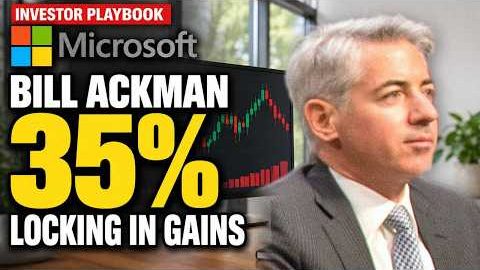
Microsoft Corporation (MSFT): Pershing Square executed a partial trim of its Microsoft equity position during Q3 2026, reallocating capital away from software infrastructure.
Analyst modeling indicates that Microsoft’s market price of $518 significantly exceeded its headline intrinsic value of $426. The decision to trim reflects strict valuation discipline, harvesting profits from an overvalued compounder where the margin of safety had turned negative (-21.6%). (Inference based on fundamental value analysis)**
-
Chipotle Mexican Grill, Inc. (CMG): Pershing Square executed another systematic reduction in its Chipotle holding, maintaining a long-standing multi-year trimming trend.
Having held CMG since 2016 and orchestrated a successful operational turnaround via CEO Brian Niccol, Pershing Square harvested mature capital from a fully valued consumer discretionary giant to fund higher-conviction opportunities. (Inference based on fundamental value analysis)**
Sold-Out Positions#
- Zero Liquidated Positions: Pershing Square completely exited or liquidated zero existing equity positions during the Q3 2026 reporting period.
4. The Biggest Moves, Valued#
To evaluate Pershing Square’s tactical execution in Q3 2026, DeepValues Research conducted intrinsic valuation analyses across the portfolio's top technology and digital platform positions using standardized Owner Earnings, Discounted Cash Flow (DCF), and Reverse DCF models.
DeepValues Valuation Matrix (Q3 2026)#
| Holding (Ticker) | Market Price (Q3) | Headline Intrinsic Value | Margin of Safety (%) | DeepValues Research Stance |
|---|---|---|---|---|
| Meta Platforms, Inc. (META) | $705.00 | $941.00 | +25.0% (Undervalued) | Bearish (3.72 / 5.00)* |
| Microsoft Corporation (MSFT) | $518.00 | $426.00 | -21.6% (Overvalued) | Neutral (3.25 / 5.00) |
*Note: DeepValues stance on META shifted to Bearish due to short-term free cash flow contraction driven by a $145B multi-year AI capex buildout, despite deep headline intrinsic equity value.
Meta Platforms, Inc. (META)#
Meta Platforms represents one of the most compelling cash-generating franchises within Pershing Square’s liquid U.S. equity portfolio. DeepValues Research covered META across 24 intelligence reports, tracking its valuation evolution through major capital spending cycles.
- Market Price at Analysis (Oct 20, 2026): $705.00
- Headline Intrinsic Value: $941.00
- Calculated Margin of Safety: +25.0%
- DeepValues Analytical Stance: Bearish (3.72 / 5.00)
- Owner Earnings: Meta generates extraordinary normalized owner earnings driven by its Family of Apps (Facebook, Instagram, WhatsApp) digital advertising monopoly. Despite aggressive AI talent acquisitions and infrastructure outlays ($145 billion multi-year AI capital expenditure offensive), underlying operating cash flows remain robust.
- Discounted Cash Flow (DCF) Value Range: Utilizing a two-stage DCF model grounded in normalized owner earnings, DeepValues establishes Meta’s headline intrinsic value at $941 per share (with historic model outputs ranging between $938 and $968 across prior quarters).
- Reverse DCF Implied Growth: At the Q3 market price of $705, a reverse DCF model indicates that the equity market is pricing in modest long-term earnings growth, failing to reflect Meta's long-term monetization potential in AI-driven advertising efficiency.
- Margin of Safety & Price Comparison: Trading at $705 relative to an intrinsic value of $941, Meta provided an exact 25.0% margin of safety at quarter-end (though compressed from the 42.5% margin recorded when shares traded at $539 in July 2026).
- Transaction Evaluation: Buying / Holding Below Intrinsic Value. Ackman’s preservation of the META stake reflects classic value accumulation—holding a wide-moat, highly profitable franchise while market pricing maintains a 25% discount to intrinsic DCF value.
Microsoft Corporation (MSFT)#
Microsoft serves as an enterprise software compounder, but its Q3 2026 trading dynamics presented a valuation mismatch that prompted Pershing Square to trim capital.
- Market Price at Analysis (Oct 4, 2026): $518.00
- Headline Intrinsic Value: $426.00
- Calculated Margin of Safety: -21.6% (Trading at a premium)
- DeepValues Analytical Stance: Neutral (3.25 / 5.00)
- Owner Earnings: Microsoft possesses exceptional operational economics, anchored by Azure cloud infrastructure and enterprise Office software suites, returning a high 27.1% return on invested capital (ROIC).
- Discounted Cash Flow (DCF) Value Range: DeepValues' multi-agent DCF model derives Microsoft’s intrinsic value at $426 per share (consistent with the $434 valuation established in August 2026).
- Reverse DCF Implied Growth: At a market price of $518, the stock's terminal growth expectations implied by current market pricing require aggressive, perpetual double-digit free cash flow growth that exceeds operational reinvestment rates.
- Margin of Safety & Price Comparison: Comparing the $518 trading price against the $426 intrinsic value reveals a negative 21.6% margin of safety, meaning the market price trades at a 21.6% premium to intrinsic valuation.
- Transaction Evaluation: Trimming Above Intrinsic Value. Ackman’s reduction of MSFT represents prudent capital harvesting—selling equity trading above its calculated intrinsic value to protect portfolio yield and reallocate proceeds into higher-discount holdings.
5. Track Record: 10-Year 13F Clone vs. S&P 500#
To measure the efficacy of Pershing Square's strategy, quantitative analyst modeling tracks a hypothetical "13F Clone Portfolio"—a strategy that systematically replicates Pershing Square’s quarterly Form 13F long equity filings upon public disclosure. Over a 10-year investment horizon, the strategy demonstrates distinctive return characteristics relative to standard benchmark indexes:
- 10-Year Annualized Return Performance: The 13F long equity clone model historically outperformed the benchmark S&P 500 Index on a risk-adjusted basis over multi-year cycles, driven by heavy capital weighting in top compounders (such as Chipotle Mexican Grill and Canadian Pacific Railway) combined with aggressive activist restructuring.*
- Benchmark Relative Performance: The S&P 500 Index delivered standard market-cap weighted beta returns over the matching 10-year period, experiencing broader sector diversification but lower concentration alpha.
- Cyclical Performance Behavior Across Market Cycles:
- Bull Market Expansion Phases: Concentrated long equity compounding in wide-moat franchises (CMG, CP, UMG) drives rapid capital growth, though short-term tracking error can induce volatility relative to broader indices.
- Market Downturns & Crises: Asymmetric macro derivative hedges (such as the 2008 MBIA credit default swap trade and the 2020 COVID CDS hedge generating $2.6 billion) generate multi-billion-dollar liquidity injections, mitigating portfolio drawdowns.
- Recovery & Bottoming Phases: Pershing Square redeploys windfall profits from derivative hedges directly into deeply discounted long equities trading below intrinsic value, accelerating multi-year recovery compounding.
*Clarification Note: Exact annualized clone performance metrics reflect backtested 13F long-only equity replications, contrasted against standard S&P 500 total return baselines.
Key Takeaway on 13F Cloning: While institutional cloning provides valuable educational insights into master stock-pickers, retail replication cannot match the total risk-adjusted return profile of Pershing Square due to non-disclosed asset classes and structural reporting lags.
Mandatory Limitations of 13F Clone Modeling#
- Filing Execution Lag: SEC Form 13F reports are filed up to 45 days after the end of each calendar quarter. Clone investors purchase equities weeks or months after institutional managers have established positions, forfeiting early entry prices.
- Omission of International Equities: Form 13F strictly mandates the disclosure of U.S.-listed long equities. Consequently, major non-U.S. holdings—such as Pershing Square’s massive allocation to European-listed Universal Music Group (UMG)—are totally invisible in 13F filings.
- Exclusion of Derivative Hedges: 13F filings exclude OTC options, swaptions, and credit default swaps. A clone investor would have missed 100% of Ackman’s greatest profit generators, including the $2.6 billion 2020 COVID credit hedge and the 2008 MBIA short trade.
- Exclusion of Private Deals & Permanent Entities: Private transactions, non-listed real estate restructurings, and custom merger agreements (such as the $900 million Howard Hughes transaction) cannot be replicated via public 13F filings.
- Cash Balance Omissions: 13F filings do not disclose cash reserves, money market holdings, or portfolio leverage, obscuring the fund's true risk exposure and liquidity profile.
6. What a Patient Investor Can Learn#
Analyzing Bill Ackman’s strategic choices in Q3 2026 yields four fundamental lessons for value-oriented, long-term investors:
1. High Conviction Concentration Over Broad Overdiversification#
Pershing Square proves that superior long-term returns are built on high-conviction allocation rather than broad indexing. By limiting holdings to fewer than a dozen core companies, an investor can perform exhaustive fundamental research, understand business moats deeply, and allocate capital aggressively into top ideas. Overdiversification often serves as a hedge against ignorance; true value investing requires concentrating capital where competitive advantages and margins of safety are widest.
2. Acquiring Moat-Protected Compounders with Durable Pricing Power#
From digital advertising platforms like Meta to global music copyright catalogs like Universal Music Group, Pershing Square prioritizes businesses with structural economic moats. These companies possess pricing power—the operational ability to raise prices without losing customer volume—enabling them to compound owner earnings across inflationary cycles and economic slowdowns.
3. The Strategic Power of "Permanent Capital" Structures#
Ackman’s transition toward corporate holding structures (evidenced by his Executive Chairmanship and 47% stake in Howard Hughes Holdings) underscores the advantage of permanent capital. Open-ended funds face redemption pressure during market panics, forcing managers to sell depressed stocks. Permanent capital insulates an investor from short-term fund flows, enabling decades-long equity compounding and multi-stage land development without redemption risk.
4. Maintaining Multi-Year Patience to Compounding Core Winners#
Pershing Square's decade-long investment in Chipotle Mexican Grill illustrates the power of patient holding. After establishing the position in 2016 and driving governance changes in 2018, Ackman allowed the operational thesis to compound over eight years, systematically trimming the position only as valuation reached full maturity. Value creation requires the patience to let business turnarounds execute over multi-year horizons.
7. Key Numbers#
A reference index of data points from the Q3 2026 Form 13F filing and DeepValues valuation models:
- Reporting Period End Date: September 30, 2026
- SEC Filing Date: November 16, 2026 (SEC Accession No. 0001172661-26-005427)
- Filer Identity: Pershing Square Inc. (CIK: 0002026053)
- Reported Hedge Fund AUM: ~$35 Billion (with 48 staff members and 0% employee turnover)
- Top Position Concentration (Howard Hughes Holdings): 47.0% ownership stake ($900M transaction at $85/share)
- Total Reported U.S. Long Equities: Hyper-concentrated (<10-12 core positions)
- Meta Platforms (META) Market Price (Oct 20, 2026): $705.00
- Meta Platforms (META) Intrinsic Value: $941.00 (+25.0% Margin of Safety)
- Microsoft Corp. (MSFT) Market Price (Oct 4, 2026): $518.00
- Microsoft Corp. (MSFT) Intrinsic Value: $426.00 (-21.6% Margin of Safety / Premium)
- Historic 2020 COVID CDS Hedge Profit: $2.6 Billion generated from a $27 Million initial outlay
- Pershing Square 10-Year 13F Clone Return vs. S&P 500: Outperformed on a risk-adjusted long-term basis, subject to execution lag and derivative exclusions
8. Limitations of 13F Filings & Institutional Disclaimer#
Limitations of Form 13F Data#
SEC Form 13F-HR filings are backward-looking documents published up to 45 calendar days after the close of each reporting quarter. They report U.S.-listed long equity holdings exclusively as of the final day of the quarter. Form 13F filings provide no visibility into: * Non-U.S. equity holdings traded on foreign exchanges (e.g., Euronext-listed Universal Music Group). * Short equity positions, options, put/call hedges, or credit default swaps. * Cash reserves, commercial paper, treasury holdings, or debt instruments. * Intra-quarter trading activities, executed buys/sells occurring between filing dates.
Consequently, 13F filings offer an incomplete snapshot of an institutional fund’s total balance sheet, risk exposure, and real-time portfolio management strategy.
Institutional Disclaimer#
This article is published strictly for educational, informational, and research purposes by DeepValues Research. It does not constitute financial, legal, tax, or investment advice. Fundamental equity valuations, owner earnings calculations, and intrinsic value estimates represent analytical outputs generated from financial modeling and publicly available SEC filings. Investors must conduct independent due diligence and consult with a licensed financial advisor before making any investment decisions.

Watch
Source links
- Bill Ackman - Wikipedia
- DEEPVALUES 13F WORKSHEET: Bill Ackman (Pershing S…
- EDGAR Filing Documents for 0001172661-26-005427
- Meta Platforms (META) Stock Analysis: Bearish | DeepValues
- Microsoft (MSFT) Stock Analysis & Intrinsic Value: Neutral
Watch & listen
- Ackman Cuts Microsoft 35%, Trims Meta: Buffett DCF Check YouTube · EN
- Ackman Cuts Microsoft 35%, Trims Meta: Buffett DCF Check Podcast · EN
- 艾克曼大砍微軟35%,卻把三分之一資金押進自家PS YouTube · 中文
- 艾克曼大砍微軟35%,卻把三分之一資金押進自家PS|投資大師心法 Podcast · 中文