
Insights Investing
Financial History as a Mirror: Edward Chancellor on the AI Boom, Historic Bubbles, and the Patient Investor
Podcast · Listen (11 min)
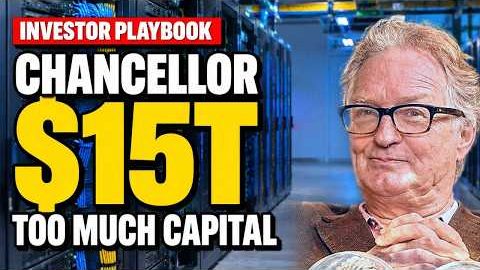
Edward Chancellor: $15 Trillion in AI and the Exit Myth | Investor Playbook
In brief
DeepValues Research, “Financial History as a Mirror: Edward Chancellor on the AI Boom, Historic Bubbles, and the Patient Investor” (Nov 23, 2026): In a recent video commentary, financial historian Edward Chancellor draws direct parallels between four centuries of speculative manias—spanning the 17th-century Tulip Mania and the 1720 South Sea Bubble to the 1840s Railway Mania and the 1990s Dot-Com crash—and today's artificial intelligence boom.
Source: https://research.deepvalues.ai/insights/2026-11-23-best-partners-tv-everyone-who-embraces-a-financial-bubble-believes/ · Markdown
Contents
- 1. Who wrote it
- 2. What was written
- The Anatomy of a Bubble
- The Greater Fool Theory and Momentum Investing
- Technological Duplication and Overcapacity
- The "Everything Bubble" and Sovereign Vulnerability
- 3. What the documents show
- 4. The Buffett reading
- Business Quality and Moat
- Capital Allocation
- Price versus Value
- Winner Identification Timing
- 5. What is not known
- 6. The lesson for a patient investor
- 7. Key numbers
In a recent video commentary, financial historian Edward Chancellor draws direct parallels between four centuries of speculative manias—spanning the 17th-century Tulip Mania and the 1720 South Sea Bubble to the 1840s Railway Mania and the 1990s Dot-Com crash—and today's artificial intelligence boom. Chancellor's central thesis asserts that contemporary AI enthusiasm displays the classic structural hallmarks of historical bubbles, including monetary easing, pervasive leverage, accelerated communication networks, and messianic corporate leadership. Consequently, long-term value investors are advised to prioritize capital preservation, exercise extreme caution regarding momentum strategies and concentrated passive market indices, and maintain patience by waiting for post-crash industry shakeouts to reveal the ultimate economic winners.
1. Who wrote it#
Edward Chancellor is a trained historian, financial author, and long-time investment practitioner whose work provides critical context for value investors seeking to navigate market cycles. He is widely recognized for his seminal 1999 book, Devil Take the Hindmost: A History of Financial Speculation, which remains an authoritative text on market manias. Chancellor frames financial speculation not as isolated numerical or quantitative anomalies, but as recurring socio-economic manias rooted in enduring human psychology. In taking this approach, he builds upon historical studies such as Charles Mackay’s 1841 work, Extraordinary Popular Delusions and the Madness of Crowds, which evaluated financial bubbles—such as Tulip Mania, the Mississippi Scheme, and the South Sea Bubble—alongside social panics like medieval witch-hunts.
For long-term investors, Chancellor’s historical perspective reinforces the fundamental boundary separating investment from speculation. This distinction was captured by Fred Schwed in his classic 1930s Wall Street volume, Where Are the Customers' Yachts?: investment represents an earnest attempt to prevent a large sum of money from turning into a small sum, relying on capital preservation, a strict margin of safety, and gradual compounding; speculation represents the high-risk attempt to turn a small sum into a fortune quickly. In speculative manias, market participants transition from disciplined investors into short-term gamblers, causing risk to be systematically mispriced across asset classes.
2. What was written#
The synthesis of Chancellor's historical analysis presented here is derived from a public video published on the YouTube channel 最佳拍档, which evaluates current market conditions against historical speculative cycles.
The Anatomy of a Bubble#
Chancellor identifies a consistent structural recipe that fuels speculative manias across centuries: artificially low interest rates, high levels of financial leverage, massive capital inflows, rapid transmission of market narratives via modern communication channels, and the emergence of messianic corporate leaders. In historical manias, figures like John Blunt of the South Sea Company projected an aura of omnipotence to drive investor fervor. Today, a similar dynamic surrounds prominent technology leaders, including NVIDIA's Jensen Huang, OpenAI's Sam Altman, Anthropic's Dario Amodei, and SpaceX's Elon Musk, whose vision for Artificial General Intelligence (AGI) requires near-religious investor belief to secure continuous, massive capital outlays.
The Greater Fool Theory and Momentum Investing#
Speculative frenzies rely heavily on the "Greater Fool Theory"—the willingness to purchase assets far above their intrinsic value under the assumption that another buyer will pay a higher price before a crash occurs. Modern "momentum investing" operates as a rebranded form of this theory. While quantitative backtests extending to the 1920s show that the momentum factor has historically generated excess returns, empirical research demonstrates that momentum strategies generated zero net returns between 1995 and 2015. Recent momentum dominance has been heavily amplified by the structural shift from active to passive indexing—where mechanical capital flows systematically push overvalued megacaps higher—and by high retail trading activity, where retail brokerages process trading volumes up to twice those of professional institutions.
Technological Duplication and Overcapacity#
Technological manias invariably generate massive structural overcapacity. Current capital outlays in AI infrastructure reflect historical episodes such as the 1840s Railway Mania and the late-1990s fiber-optic boom. In each instance, competing market entrants deployed vast sums of capital to build virtually identical, redundant infrastructure, underestimating the speed with which specialized technology becomes commoditized.
The "Everything Bubble" and Sovereign Vulnerability#
Contemporary markets demonstrate widespread speculative leverage, highlighted by retail adoption of perpetual futures offering 100x to 200x leverage, 3x leveraged single-stock ETFs, and record-high equity trading volumes. Chancellor explicitly highlights SpaceX's massive IPO as an emblem of this mania, characterizing it as the largest "meme stock" in financial history. Furthermore, state-level moral hazard has surfaced globally; for instance, South Korean retail investors ("Ants") have taken massive leveraged positions in semiconductor stocks with explicit endorsement from the South Korean Prime Minister.
Crucially, Chancellor contrasts current conditions with past manias: during the 1920s and 1990s, the U.S. government operated with fiscal surpluses or low debt levels, providing sovereign balance sheet capacity to backstop market failures. Today, major Western nations (including the U.S., UK, and France) exhibit severe net negative international investment positions, severely constraining government capacity to absorb systemic shocks. Chancellor also links perceptions of political corruption—such as high-profile political figures and their families promoting personal cryptocurrency and AI ventures—to heightened public outrage. Should market failure occur, analysts infer that post-crash political backlashes could prove far more punitive than during previous asset liquidations.
3. What the documents show#
Historical records strongly corroborate Chancellor's analysis of structural bubble formation, market behavior, and sovereign intervention.
- 17th-Century Tulip Mania and 1690s Diving Bell Mania: Primary documentation from the 1630s Dutch Republic records that single rare tulip bulbs were priced equivalent to an Amsterdam townhouse. As derivative futures markets emerged, pricing decoupled from underlying physical assets until the contract system collapsed, requiring regulatory intervention to void defaulted contracts. Similarly, the 1690s English diving bell craze—the first documented technology bubble—was catalyzed by a massive treasure recovery from a shipwreck off the coast of Massachusetts. The concurrent rise of early financial reporting in newspapers accelerated speculative contagion. Notably, writer Richard Steele articulated classic counter-cyclical principles ("buy when others sell"), yet later succumbed to financial ruin by speculating in a South Sea fish-transportation company.
- 1720 South Sea Bubble: Historical documents detail extensive corporate governance failures by South Sea directors, led by John Blunt, who utilized executive bribery and leveraged stock purchases through Sword Blade Bank to sustain prices. Following the collapse, Parliament enacted retroactive legislation confiscating investor assets and estates, including that of Chancellor of the Exchequer John Aislabie and the family of historian Edward Gibbon, illustrating the intense political backlash that follows major financial panics.
- 1840s Railway Mania: Infrastructure records confirm severe capital duplication driven by narrative-led investment, including the construction of three redundant, competing rail lines between London and Peterborough, and another three between Leeds and Manchester. Historical press accounts show that while the public and media were fully aware that a railway bubble existed, momentum sustained the speculative cycle until capital was exhausted.
- 1980s Japan and 2020 China Housing: Policy and market records highlight the persistent danger of moral hazard—the assumption that central authorities will not permit market declines. In 1980s Japan, real estate and equity bubbles expanded under the belief that financial institutions were "too big to fail," collapsing only when Bank of Japan Governor Yasushi Mieno initiated aggressive interest rate hikes. Similarly, China's real estate market accumulated over 50 million vacant apartments until regulatory credit restrictions ("Three Red Lines") forced an overdue industry deleveraging.
4. The Buffett reading#
Evaluating the current AI landscape through classical value investing and business valuation principles yields specific warnings regarding capital deployment and intrinsic value.
Business Quality and Moat#
Based on historical clearing cycles, analysts infer that frontier AI models face severe commoditization risks, mirroring the telecommunications infrastructure providers of the late 1990s. For example, Vodafone held a 17% market share in the UK during the 1999–2000 peak, yet telecom access quickly devolved into an undifferentiated service. Today, capital-intensive frontier models face aggressive competition from low-cost, open-source alternatives capable of delivering 95% of frontier performance at roughly 2% of the operating cost, severely eroding economic moats.
Capital Allocation#
The projected $15 trillion in global AI and data infrastructure spending over a five-year horizon represents an extraordinary, high-risk allocation of corporate capital. Capital allocation discipline is further compromised by hardware vendors engaging in vendor financing structures to support financially fragile data center operators, mirroring dangerous practices observed at the height of the dot-com telecom buildout.
Price versus Value#
Value investing demands an adequate Equity Risk Premium (ERP) to compensate for equity ownership risk over risk-free assets. When real yields on Treasury Inflation-Protected Securities (TIPS) reached 4.5% during the 1999–2000 market peak—and remain highly attractive today—while equity risk premiums compress toward zero, asset allocation pricing offers no margin of safety. Under fundamental valuation principles, demanding a substantial margin of safety in such environments is not merely a conservative posture; it is a mathematical imperative for long-term capital preservation.
Winner Identification Timing#
Historical precedent confirms that market dominance during a technological bubble peak rarely translates into long-term investment success. Dominant technological platforms emerge after a bubble pops and an industry shakeout occurs. For example, Amazon survived a ~95% drawdown in its stock price during the dot-com crash before solidifying its market position, while dominant digital enterprises such as Google and Facebook only emerged as public companies long after the dot-com collapse had cleared out unsustainable business models.
5. What is not known#
An analytical evaluation of current macroeconomic and corporate market conditions requires identifying key unobservable variables. The following uncertainties remain unknown, and any forward-looking assumptions regarding them must be treated strictly as analytical inferences:
- Monetary Tightening Catalysts: Based on historical cycles, analysts infer that capital cost increases trigger bubble collapses, but the precise timing and operational catalyst that will restrict monetary liquidity or force systemic deleveraging remain unobservable.
- Hardware and Architectural Winners: Analysts infer that market leadership may shift, but it remains uncertain whether GPU-heavy hardware architectures will maintain dominance over specialized custom TPUs, or whether computational demand will remain concentrated in centralized data centers rather than shifting to localized edge computing models.
- Sovereign Fiscal Capacity: The extent and severity of political and social backlashes remain uncertain when sovereign balance sheets—burdened by high net negative international investment positions—are stress-tested during a major market liquidation.
6. The lesson for a patient investor#
Based on Chancellor’s historical synthesis, long-term capital allocators should maintain a disciplined, defensive posture focused on capital preservation and margin of safety:
- Reject Momentum and Passive Concentration: Avoid reliance on broad, market-cap-weighted passive index strategies. Passive funds have become highly concentrated in top-heavy, speculative megacaps whose valuations are sustained by mechanical capital inflows rather than underlying balance-sheet strength and earnings quality.
- Prioritize True Active Value Allocation: Partner with or allocate capital to active managers who adhere strictly to fundamental valuation methodologies, disciplined balance sheet analysis, and absolute margin-of-safety requirements.
- Practice Patience Through Shakeouts: Step aside during intense technological manias. Patient capital should allow speculative financial cycles to run their course and collapse, deploying capital only after an industry shakeout establishes proven business models and rational asset valuations.
7. Key numbers#
The quantitative figures and historical metrics documented in Chancellor's synthesis include the following:
- 16 minutes: Duration of the Best Partners TV (最佳拍档) YouTube commentary video published on November 23, 2026.
- 1 bulb = 1 townhouse: Valuation peak of a single rare tulip bulb relative to prime Amsterdam real estate in the 1630s.
- 1920s to present: Historical timeframe over which momentum factor backtests demonstrate statistical excess returns.
- 1995 to 2015: Twenty-year empirical period during which momentum strategies generated zero net returns.
- 2x: Retail investor trading volume relative to professional institutional volume on modern trading platforms.
- 3 redundant lines: Rail infrastructure duplication laid between London-Peterborough and Leeds-Manchester during the 1840s Railway Mania.
- $15 trillion: Projected aggregate capital expenditure targeted for global AI and data infrastructure over a 5-year period.
- 95%: Peak-to-trough equity drawdown experienced by Amazon stock during the dot-com bubble collapse.
- 17%: Vodafone’s UK mobile telecommunications market share during the 1999–2000 peak.
- 95% performance at 2% cost: Operational efficiency ratio of emerging open-source AI models relative to frontier proprietary models.
- 100x to 200x: Peak leverage tiers accessible on speculative perpetual futures and derivative platforms.
- 3x: Single-stock leveraged ETF exposure vehicles offered on semiconductor equities such as NVIDIA and SK Hynix.
- 50 million: Total number of vacant residential apartments recorded in China prior to the 2020 "Three Red Lines" credit tightening.
- 4.5%: Peak real yield generated by U.S. Treasury Inflation-Protected Securities (TIPS) during the 1999–2000 market cycle.

Watch
Source links
- DEEPVALUES MONITOR BRIEF
- 每个拥抱金融泡沫的人,都坚信自己能全身而退 | 爱德华·钱塞勒 | 金融泡沫 | AI泡沫 | 金融投机史 | 金融狂热 | 互联网泡沫 | 道德风险 | 动量投资 | 被动投资 | 迷因股
Watch & listen
- Edward Chancellor: $15 Trillion in AI and the Exit Myth YouTube · EN
- Edward Chancellor: $15 Trillion in AI and the Exit Myth | Investor Playbook Podcast · EN
- AI投資估達15兆美元:連寫泡沫守則的人都賠光 YouTube · 中文
- AI投資估達15兆美元:連寫泡沫守則的人都賠光|投資大師心法 Podcast · 中文