
Insights Investing
Vice Chair for Supervision Michelle Bowman on Modernizing U.S. Banking Supervision
Podcast · Listen (10 min)
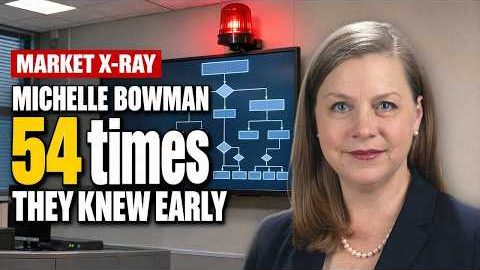
The Fed Flagged SVB 54 Times but Never Forced the Fix | Investor Playbook
In brief
DeepValues Research, “Vice Chair for Supervision Michelle Bowman on Modernizing U.S. Banking Supervision” (Nov 27, 2026): In a pre-recorded address delivered on November 25, 2026, Federal Reserve Vice Chair for Supervision Michelle Bowman presented a strategic framework for modernizing U.S. banking regulatory and supervisory structures.
Source: https://research.deepvalues.ai/insights/2026-11-27-federal-reserve-speech-by-vice-chair-for-supervision-bowman-on/ · Markdown
Contents
In a pre-recorded address delivered on November 25, 2026, Federal Reserve Vice Chair for Supervision Michelle Bowman presented a strategic framework for modernizing U.S. banking regulatory and supervisory structures. Bowman argued that the mere identification of financial risks within banking institutions is insufficient to preserve systemic stability. Instead, effective supervision requires equipping regulators with the proactive authority, accountability, and independent judgment necessary to intervene before firm-specific or contagion risks fully materialize.
Who wrote it#
Michelle Bowman serves as Vice Chair for Supervision on the Federal Reserve Board of Governors, a position she assumed on June 9, 2025, following her initial appointment as Governor on November 26, 2018. Within the federal banking oversight architecture, the Federal Reserve Board and the 12 regional Reserve Banks directly supervise approximately 900 state member banks and 5,000 bank holding companies. This jurisdiction operates alongside the Office of the Comptroller of the Currency (OCC), which serves as the primary federal regulator for national banks, and the Federal Deposit Insurance Corporation (FDIC), which oversees state-chartered non-member institutions. For equity analysts at DeepValues Research and patient bank investors, the Vice Chair for Supervision’s policy stance represents a critical variable. Supervisory rigor and examination priorities directly dictate bank asset quality evaluations, compliance overhead, capital buffer maintenance, and ultimately the institution's capacity for shareholder capital deployment.
What was written#
In pre-recorded remarks published on the YouTube channel Federal Reserve on November 25, 2026, Bowman set forth a strategic posture for oversight during a macro environment characterized by a target federal funds rate range of 3.50–3.75%, an interest on reserve balances (IORB) rate of 3.65%, and a primary credit bank rate of 3.75%. Her remarks established three core pillars for modernizing supervisory operations:
- Learning from Supervisory Failures: Advancing beyond passive risk identification by empowering supervisors with the explicit authority, accountability, and independent judgment required to take decisive action before financial risks are realized.
- Keeping Pace with Financial Evolution: Frequently updating regulatory and supervisory frameworks to focus resources on material risks, facilitate timely decision-making, and adapt to shifting market structures and technology, in active coordination with international standard-setting bodies such as the Financial Stability Board (FSB) and the Basel Committee on Banking Supervision (BCBS).
- Regional and International Cooperation: Strengthening cross-border supervisory alignment throughout the Americas alongside key host institutions—including Banco Central do Brasil, the Association of Supervisors of Banks of the Americas (ASBA), the BCBS, and the Financial Stability Institute (FSI)—to reflect deeply interconnected trade and financial networks.
What the documents show#
Bowman's call for forward-looking supervisory intervention aligns with the statutory foundations of central bank governance and mirrors historical precedents where regulatory mandates expanded following major financial disruptions.
| Bowman's Supervisory Recommendations | Statutory & Historical Document Evidence |
|---|---|
| Proactive Supervisory Authority & Judgment: Empowering examiners to intervene before risk materializes on bank balance sheets. | Statutory Credit Oversight (12 U.S.C. § 301): Mandates that Reserve Bank directors monitor member bank loan and investment activity to prevent the "undue use of bank credit" for speculative trading in securities, real estate, or commodities. Grants the Board explicit statutory authority to suspend credit facilities for non-compliant institutions. |
| Adapting Frameworks to Market Evolution: Continuous modernization to address financial engineering, technological shifts, and international linkages. | Statutory Framework Architecture (Federal Reserve Act Section 12 & Banking Act of 1935): Section 12 (12 U.S.C. § 261) established the Federal Advisory Council for industry feedback, while the Banking Act of 1935 centralized monetary and supervisory policy within the Board of Governors to insulate regulatory enforcement from localized banking pressures. |
| Crisis-Driven Regulatory Expansion: Upgrading supervisory toolkits and oversight powers to manage systemic vulnerabilities. | Historical Shock Precedents: Structural regulatory expansion consistently follows supervisory failures. The Panic of 1907 led to the Federal Reserve Act of 1913; the Great Depression generated the Glass-Steagall Act of 1933 and Banking Act of 1935; and recent liquidity shocks expanded central bank oversight and operational mechanics. |
| Institutional & International Liquidity Coordination: Aligning regional oversight and standing liquidity facilities to maintain broader stability. | Emergency Liquidity & Swap Frameworks: Historical crises expanded the Fed's lender-of-last-resort tools beyond traditional discount window credit, including 2008 facilities like the Term Auction Facility (TAF) and Primary Dealer Credit Facility (PDCF), 2020 pandemic credit programs, and international central bank swap lines. |
The Buffett reading#
At DeepValues Research, evaluating Vice Chair Bowman’s supervisory vision through a classic value-investing lens provides essential clarity on the structural dynamics governing financial equities:
Business Quality#
Rigorous, forward-looking supervision preserves total banking system integrity and mitigates systemic run risks, protecting high-quality financial franchises. However, in an elevated interest rate regime—with a 3.50–3.75% target federal funds rate and a 3.65% IORB—banks face heightened duration risk and unrealized asset losses. Proactive supervisory examinations increase compliance friction and operational expenditures, which can compress return on equity (ROE) for institutions lacking operating efficiency.
Economic Moat#
Escalating regulatory complexity and proactive examination burdens widen the competitive moat for money-center banks and large bank holding companies. These large institutions leverage compliance scale advantages to efficiently absorb regulatory overhead across vast asset bases, creating formidable structural barriers to entry for smaller regional and community competitors.
Capital Allocation#
Because the Federal Reserve set reserve requirements to 0% for all depository institutions in March 2020, supervisory focus has pivoted from mechanical reserve ratios to qualitative examinations of credit underwriting, asset-liability management, and capital strength. Stricter supervisory scrutiny under this framework directly restricts management's discretion in returning capital to shareholders via dividends or share buybacks if examiners identify unmitigated risks, preferring capital retention over shareholder distributions.
Price vs. Value#
For equity analysts at DeepValues Research, market mispricings arise when supervisory laxity obscures duration risk and credit degradation on bank balance sheets. When latent supervisory gaps are exposed or sudden regulatory interventions occur, market panics force equity prices to trade at severe discounts to intrinsic asset value—particularly when institutions are forced to access emergency liquidity via the discount window at the 3.75% bank rate.
What is not known#
- The precise operational metrics, quantitative benchmarks, or examination rubrics the Federal Reserve intends to adopt to operationalize "supervisory judgment."
- An explicit timeline or implementation roadmap for deploying modernized regulatory frameworks uniformly across all 12 Federal Reserve Districts.
- The ultimate path of monetary policy, given that Federal Reserve Governor Michael Barr stated on November 18, 2026, that further interest rate increases may be required if inflation remains elevated and economic growth persists.
The lesson for a patient investor#
For patient value investors evaluating banking equities, Vice Chair Bowman’s address highlights that published book values and static capital ratios offer incomplete protection. Sustainable equity outperformance depends on management’s internal risk culture and the capacity of supervisors to curb reckless lending before balance sheet impairment occurs. Because regulatory enforcement actions often lag the accumulation of risk exposures over extended credit cycles, maintaining a strict margin of safety remains mandatory when pricing bank stocks.
Key numbers#
- 3.50–3.75%: Target federal funds rate range.
- 3.65%: Interest on reserve balances (IORB).
- 3.75%: Bank rate (discount window primary credit rate).
- ~900: State member banks supervised by the Board and Reserve Banks.
- ~5,000: Bank holding companies under Federal Reserve supervision.
- $7.139 trillion: Total Federal Reserve balance sheet assets as of August 2024.
- $172.7 trillion: Total net worth of U.S. households and nonprofit organizations (Q4 2024).
- $114.3 billion: Federal Reserve net negative income reported in 2023.
- $133.3 billion: Deferred asset liability booked by the Fed for Treasury remittances.

Watch
Source links
Watch & listen
- The Fed Flagged SVB 54 Times but Never Forced the Fix YouTube · EN
- The Fed Flagged SVB 54 Times but Never Forced the Fix | Investor Playbook Podcast · EN
- 矽谷銀行收到54次警告仍倒閉:監管機構漏了什麼 YouTube · 中文
- 矽谷銀行收到54次警告仍倒閉:監管機構漏了什麼|投資大師心法 Podcast · 中文