
Insights Investing
Mapping AI Value Capture: What Duan Yongping's Recent Moves Reveal About Ecosystem Moats, Capital Allocation, and Margin of Safety
Podcast · Listen (19 min)
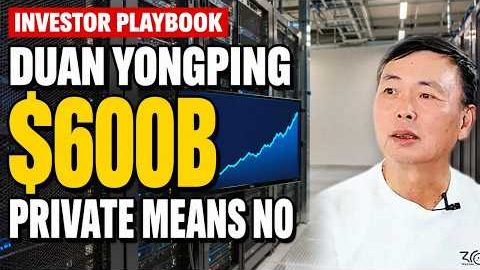
ByteDance at $600B: Why Duan Yongping Still Passes | Investor Playbook
In brief
DeepValues Research, “Mapping AI Value Capture: What Duan Yongping's Recent Moves Reveal About Ecosystem Moats, Capital Allocation, and Margin of Safety” (Nov 27, 2026): This article analyzes public commentaries made by investor Duan Yongping in November 2026 regarding major technology market participants, including Apple, Tencent, ByteDance, and Anthropic.
Source: https://research.deepvalues.ai/insights/2026-11-27-anthropic-ai/ · Markdown
Contents
- 1. The Big Picture: Filtering AI Hype Through the Buffett-Graham Lens
- 2. Ecosystem Power vs. R&D Capital Intensity: Apple vs. Tencent
- 3. The Liquidity Filter: Valuation vs. Execution in Private Markets (ByteDance & Anthropic)
- 4. Economic Moats and Value Capture Across the AI Value Chain
- 5. Practical Takeaways for Long-Term Value Investors
- Key numbers
- What would change our view
- Sources
This article analyzes public commentaries made by investor Duan Yongping in November 2026 regarding major technology market participants, including Apple, Tencent, ByteDance, and Anthropic. An evaluation of these disclosures leads to a central conclusion: technological capability in artificial intelligence does not automatically translate into an economic moat, meaning capital allocation strategy must depend on a firm's ecosystem bargaining power, partner dynamics, and liquidity conditions rather than raw technological enthusiasm. For long-term investors evaluating intrinsic value and margin of safety in the AI era, understanding these distinctions is critical to separating sustainable owner earnings from capital-intensive corporate arms races.
1. The Big Picture: Filtering AI Hype Through the Buffett-Graham Lens#
The massive surge of capital deployment into artificial intelligence has prompted broad market speculation regarding which enterprises will dominate the next generation of computing. However, evaluating the sector through the disciplined lens of classical value investing—anchored in the principles of Benjamin Graham and Warren Buffett—requires stripping away technological novelty to analyze return on invested capital (ROIC), durable economic moats, and margin of safety. Investor Duan Yongping's public commentaries provide a structured framework for applying these timeless value criteria to modern technology ecosystems.
From a fundamental value perspective, rapid technological innovation does not inherently guarantee economic value creation for equity shareholders. A critical analytical distinction must be made between defensive capital expenditure and moat-widening capital expenditure: * Defensive Capital Expenditure: Unplanned or mandatory outlays incurred simply to keep pace with technological shifts or prevent product obsolescence. These investments do not enhance pricing power or expand structural competitive advantages; instead, they serve as a capital tax that directly erodes free cash flow and long-term owner earnings. * Moat-Widening Capital Expenditure: Strategic reinvestments that deepen existing customer lock-in, expand distribution scale, enhance unit economics, or reinforce structural pricing power, thereby expanding the enterprise's long-term return on invested capital.
High capital expenditure allocated toward training frontier AI models risks turning into a defensive arms race if the underlying model capabilities become commoditized or if the enterprise lacks direct distributional leverage over end-users. Technological capability is secondary to whether an enterprise can capture persistent economic value from AI without over-expanding its capital base. As technology firms navigate this evolving landscape, the core strategic inquiry across both established incumbents and emerging pure-play developers remains constant: does AI integration strengthen an enterprise's structural economic moat, or does it force the enterprise into a low-return capital treadmill?
2. Ecosystem Power vs. R&D Capital Intensity: Apple vs. Tencent#
In late November 2026, Duan Yongping offered contrasting strategic judgments regarding the AI roadmaps of Apple Inc. (AAPL) and Tencent Holdings Ltd. (0700.HK). Significantly, these two contrasting statements were made within minutes of each other in the exact same public discussion thread on Xueqiu on November 26, 2026, demonstrating how a unified value investing framework yields distinct strategic conclusions when applied to different corporate ecosystem structures.
On November 26, 2026 (12:59:02 Beijing Time / November 25, 20:59:02 PST), responding to a user query on Xueqiu regarding whether Apple would commit tens of billions of dollars to internal large-model R&D, Duan stated: "我觉的苹果不会做大模型,他们没道理去做的" ("I think Apple won't make large models, they have no reason to").
The underlying economic rationale rests on the structural leverage Apple derives from controlling consumer hardware and operating system entry points. Apple commands the primary physical and digital gateway for an installed base of over two billion active devices. Because of this distribution bottleneck, frontier AI model providers require access to Apple's user ecosystem far more than Apple requires proprietary ownership of foundational AI models. Consequently, Apple maintains high bargaining power over third-party AI suppliers. This position allows Apple to integrate advanced AI functionality into its user experience through third-party licensing and strategic partnerships, thereby capturing high-margin ecosystem value while avoiding the immense capital expenditures associated with foundational model training.
Conversely, Duan expressed an opposing strategic requirement for Tencent in a subsequent Xueqiu commentary posted in the same discussion thread on November 26, 2026 (13:56:10 Beijing Time / November 25, 21:56:10 PST). Responding to a participant who argued that Tencent could simply leverage WeChat as a distribution front-end to integrate external third-party models without developing its own, Duan asserted that Tencent must develop its own proprietary large models.
The analytical rationale behind this distinction stems from ecosystem vulnerability and partner dynamics. Unlike Apple's hardware-gated environment, Tencent’s internet service and social network ecosystem operates in a software landscape where external AI ecosystems pose direct competitive threats to its core service suite. Furthermore, Tencent's available partner landscape differs fundamentally from Apple's, meaning relying exclusively on external third-party AI suppliers exposes Tencent to severe strategic conflicts of interest. Developing proprietary foundational models represents a necessary defensive capital outlay to protect its WeChat platform, defend its user engagement, and preserve its core economic moat.
| Company | Duan Yongping Strategic Judgment | Underlying Economic & Ecosystem Rationale |
|---|---|---|
| Apple (AAPL) | Unnecessary to build proprietary foundational large models. | Controls hardware and OS entry points; possesses high bargaining power over external AI providers; can capture value via third-party partnerships without heavy training capital expenditures. |
| Tencent (0700.HK) | Essential to develop proprietary foundational large models. | Operates an internet service ecosystem vulnerable to AI disruption; partner dynamics differ from Apple; owned models are required to prevent competitive conflicts and defend core business operations. |
Note: The above business logic is analytical inference, not verbatim quotes from Duan Yongping.
3. The Liquidity Filter: Valuation vs. Execution in Private Markets (ByteDance & Anthropic)#
A foundational principle of disciplined security analysis is maintaining a strict operational boundary between assessing an enterprise's business quality and executing an investment trade. Duan Yongping’s commentary in November 2026 clearly illustrates this distinction across unlisted market opportunities, specifically regarding ByteDance and Anthropic.
On November 21, 2026 (16:07 Beijing Time / November 21, 00:07 PST), as reported by Jiemian News, IT Times, and Sina Finance, Duan issued a public clarification regarding his remarks from the prior day concerning ByteDance’s estimated $600 billion valuation. While reaffirming that ByteDance is an exceptionally strong enterprise whose valuation near $600 billion held analytical interest, he explicitly defined his execution parameters: "但潜台词是上市后哈。除非极为特殊的情况,我是不碰非上市公司的。" ("But the implicit premise is after IPO. Unless under extremely special circumstances, I do not touch unlisted companies.")
Duan explained that after his initial comments, several private parties had contacted him privately attempting to sell pre-IPO ByteDance shares, prompting the explicit clarification. He emphasized that his strict preference for public equities stems from transactional efficiency and administrative simplicity. Specifically, trading public equities is straightforward ("省事") because it completely eliminates the need to engage in private off-market negotiations or deal directly with individuals seeking to offload unlisted shares ("不需要私下与他人打交道"). This distinction highlights a critical rule for long-term investors: recognizing a private company's operational excellence or attractive valuation does not justify taking on illiquidity, legal complexity, counterparty risks, and administrative friction.
Similarly, on November 27, 2026 (02:47:41 Beijing Time / November 26, 10:47:41 PST), Xueqiu records indicate that a user suggested Duan evaluate AI pure-play Anthropic, praising Anthropic's business model and corporate culture for its focus, restraint, honesty, and adherence to principles. Duan responded concisely: "一直看着呢" ("I've been watching it all along").
It is vital to recognize that the positive characterization of Anthropic's business culture and model originated entirely from the netizen's prompt rather than Duan himself. Duan’s concise statement confirms ongoing research tracking, but does not constitute an investment endorsement, a valuation judgment, or an executed capital commitment. Monitoring an unlisted firm allows an analyst to track structural industry shifts, but value discipline requires withholding capital until liquid market trading and audited financial disclosures are accessible.
4. Economic Moats and Value Capture Across the AI Value Chain#
Understanding value capture across the AI ecosystem requires evaluating how economic rents flow between hardware manufacturers, cloud infrastructure hyperscalers, foundational model developers, and consumer platform gatekeepers.
At the foundational compute layer, specialized hardware vendors such as NVIDIA capture upfront, high-margin cash flows by supplying the necessary processing infrastructure. However, the capital intensity of purchasing this hardware falls heavily onto cloud providers and pure-play model developers. For pure-play AI developers monetizing exclusively through APIs, enterprise subscriptions, or software plugins, maintaining state-of-the-art capability requires continuous, massive capital outlays for model retraining and ongoing inference. Unless a pure-play provider establishes high customer retention, structural enterprise workflow integration, or proprietary developer network effects, gross margins face ongoing compression from inference delivery costs and commoditization by rival open-source or proprietary models.
To mitigate these economic pressures, cloud hyperscalers like Amazon and Alphabet (Google) utilize strategic alliances and structured capital deployments. By providing equity financing and cloud compute credits to developers like Anthropic, hyperscalers secure long-term utilization for their data center infrastructure while retaining equity upside in frontier AI research. This structure allows cloud providers to monetize the hardware layer and cloud hosting traffic regardless of which specific frontier model provider wins incremental market share.
Integrated technology incumbents occupy an even stronger economic position. Alphabet (Google), for instance, maintains a dual structural advantage: it develops frontier proprietary models (Gemini) while simultaneously controlling owned consumer entry points (Google Search, Android, YouTube). This contrasts sharply with pure-play model developers that lack owned consumer touchpoints and must pay distribution tolls or yield margin to third-party platforms to reach end-users. Ultimately, enterprise value capture will be dictated by distribution control and capital efficiency rather than model parameters alone, determining whether AI expenditures generate sustainable owner earnings or simply fund ongoing infrastructure costs.
5. Practical Takeaways for Long-Term Value Investors#
Analyzing these capital allocation dynamics yields key principles for value investors navigating the technology sector:
- Distinguish Distribution Gatekeepers from Capital-Intensive Creators: Prioritize enterprises that control durable user entry points and maintain high bargaining power over suppliers. Operating system and hardware platform owners can capture AI benefits via third-party integration without absorbing high foundational model training expenses.
- Enforce Liquidity and Execution Discipline: Segregate fundamental business appraisal from trade execution. Identifying an attractive valuation in a private company should not override the liquidity protections, corporate governance safeguards, and low transaction friction provided by public capital markets.
- Audit Capital Allocation for Defensive Spent: Evaluate whether an enterprise's AI capital expenditure widens its competitive moat and increases long-term return on invested capital, or merely represents a defensive cost of doing business that reduces free cash flow.
To further explore open-source company research or check a stock's intrinsic value, visit the DeepValues Research site or check the DeepValues app.
Key numbers#
- ByteDance Estimated Attractiveness Valuation: ~$600 billion USD (Clarified as a post-IPO condition on November 21, 2026 / November 21 00:07 PST).
- Duan Yongping ByteDance Clarification Date: November 21, 2026 (16:07 Beijing Time / UTC+8).
- Duan Yongping Apple & Tencent AI Strategy Statements Date: November 26, 2026 (Post times: Apple at 12:59:02 UTC+8 / Nov 25 20:59:02 PST; Tencent at 13:56:10 UTC+8 / Nov 25 21:56:10 PST).
- Duan Yongping Anthropic Confirmation Date: November 27, 2026 (02:47:41 Beijing Time / UTC+8; November 26 10:47:41 PST).
What would change our view#
- Apple shifting its capital allocation strategy to initiate tens of billions of dollars in self-developed foundational large model training rather than leveraging third-party provider licensing and strategic partnerships.
- Tencent publicly abandoning its proprietary AI model development efforts to rely exclusively on external third-party model APIs across its WeChat and internet service platforms.
- Duan Yongping publicly disclosing a direct private equity transaction acquiring non-public shares in ByteDance prior to an official initial public offering filing.
- Anthropic demonstrating multi-year positive owner earnings and sustainable free cash flow after fully accounting for model training capital expenditures and ongoing inference infrastructure costs.
Sources#
- Excerpts from "段永平关注AI" (Xueqiu Post Records, November 27, 2026)
- Excerpts from "段永平投资AI战略" (Xueqiu Post Records, November 26, 2026)
- Excerpts from "段永平投资字节跳动澄清" (Jiemian News, IT Times, Sina Finance, November 21, 2026)

Watch
Source links
- 段永平关注AI
- 段永平投资AI战略
- 段永平投资字节跳动澄清
Watch & listen
- ByteDance at $600B: Why Duan Yongping Still Passes YouTube · EN
- ByteDance at $600B: Why Duan Yongping Still Passes | Investor Playbook Podcast · EN
- 段永平拒絕6000億美元估值的字節跳動:蘋果騰訊AI為何相反 YouTube · 中文
- 段永平拒絕6000億美元估值的字節跳動:蘋果騰訊AI為何相反|投資大師心法 Podcast · 中文