
Insights Investing
The Economics of Physical AI: Analyzing Chamath Palihapitiya’s Perspective on Robotics and Capital Allocation
Podcast · Listen (23 min)
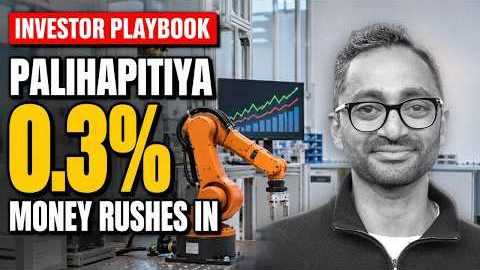
Chamath's Robot Math: $33B In, Cheaper for 0.3% of Work | Investor Playbook
In brief
DeepValues Research, “The Economics of Physical AI: Analyzing Chamath Palihapitiya’s Perspective on Robotics and Capital Allocation” (Nov 27, 2026): On November 25, 2026, investor Chamath Palihapitiya published an analytical post titled "Physical AI: The Economics of Putting Robots to Work" on his Learn With Me platform (research.socialcapital.com).
Source: https://research.deepvalues.ai/insights/2026-11-27-chamath-palihapitiya-physical-ai-the-economics-of-putting-robots-to/ · Markdown
Contents
- Who wrote it
- What was written
- Divergent Physical AI Approaches
- Current Economic Realities (Anthropic Data)
- Technical Bottlenecks and Progress Signals
- Commercial Traction and Capital Flows
- Preview of the Paywalled 80-Slide Deep Dive
- What the documents show
- Specialized vs. General-Purpose Financial Reality
- Capital Deployment vs. Economic Returns
- The Amazon Throughput Paradox and Labor Dynamics
- The Buffett reading
- What is not known
- The lesson for a patient investor
- Key numbers
On November 25, 2026, investor Chamath Palihapitiya published an analytical post titled "Physical AI: The Economics of Putting Robots to Work" on his Learn With Me platform (research.socialcapital.com). The article explores the economic divide between general-purpose humanoid robots and specialized, single-task industrial machines. While massive venture capital infusions are currently driving physical AI development, research from Anthropic indicates a stark gap between capital deployment and operational reality: robots are cost-effective for only 0.3% of U.S. work hours today. Achieving cost superiority for even 10% of U.S. labor hours requires an estimated 70% reduction in the cost per unit of work, highlighting a structural tension between aggressive speculative capital allocation and underlying economic fundamentals.
Who wrote it#
Chamath Palihapitiya is a Canadian-American venture capitalist, entrepreneur, and private investor. Born in Galle, Sri Lanka, in 1976, he moved to Canada at age five when his father joined the High Commission of Sri Lanka in Ottawa. In 1986, his family sought political asylum in Canada after his father criticized violence against Tamils during the Sri Lankan Civil War. Raised in financially precarious circumstances—with his mother working housekeeping jobs and his father facing unemployment—Palihapitiya took a job at Burger King at age fourteen to help support his household. He attended Lisgar Collegiate Institute and graduated from the University of Waterloo in 1999 with a Bachelor of Applied Science in electrical engineering.
Palihapitiya began his career as a derivatives trader at BMO Nesbitt Burns before relocating to California in 2001 to join Winamp. At AOL, he became the company's youngest vice president in 2004, leading its instant messaging division. Following a brief period at Mayfield Fund, he joined Facebook in 2007 as a senior executive. His tenure at Facebook began with leading the rollout of Facebook Beacon, an advertising platform discontinued in 2009 following privacy lawsuits. Subsequently, he transitioned to lead Facebook's user growth team, helping guide the platform toward one billion users by 2012, while also managing the Facebook Phone and Facebook Home initiatives prior to his exit in 2011. Corporate histories, including Steven Levy’s Facebook: The Inside Story, document his aggressive management style during this period.
In 2011, Palihapitiya co-founded Social Capital with Brigette Lau, expanding its assets under management to over $1.1 billion by 2015 through early investments in enterprise software and financial technology (including Yammer, Slack, Box, and Groq). In 2018, Palihapitiya restructured Social Capital from an outside investor management firm into a family office dedicated to deploying his personal balance sheet across public equities, artificial intelligence, biotechnology, climate tech, crypto, and space technology. In June 2025, his 2024 annual letter reported that Social Capital managed $2.147 billion derived from $1.4 billion in paid-in capital. He disseminates his research via the Learn With Me newsletter on research.socialcapital.com—which reaches over 3,000 investors and founders—and co-hosts the weekly business and technology podcast All-In.
For patient, value-minded investors, examining Palihapitiya’s writing provides insight into where early-stage venture capital is concentrating, allowing analysts to evaluate macro technological disruption narratives against established business models. However, his market commentary must be evaluated alongside his historical capital allocation track record:
- SPAC Sponsorship Record: Beginning in 2019, Palihapitiya sponsored a series of special-purpose acquisition companies under the Social Capital Hedosophia brand, taking public Virgin Galactic (IPOA), Opendoor (IPOB), Clover Health (IPOC), and SoFi (IPOE).
- Asset Drawdowns and Liquidations: Following their public market debuts, these equities experienced severe valuation declines during 2021–2022. Virgin Galactic fell from $46 to $5; Clover Health from $28 to $4; Opendoor from $30 to $5; and SoFi from $25 to $3. Additionally, two of his blank-check vehicles—Social Capital Hedosophia Holdings Corp. IV (IPOD) and VI (IPOF)—failed to execute business combinations and liquidated public shares in September 2022.
- Recent Capital Ventures: In September 2025, Palihapitiya launched American Exceptionalism Acquisition Corp. A, raising $345 million via an initial public offering and private placement to target acquisitions across energy, AI, decentralized finance, and defense. Previously, in January 2024, he announced 8090, a venture incubator promoting its "Software Factory" product in July 2025 as a replacement for corporate AI proof-of-concept projects.
Value research analysts monitor Palihapitiya's publications not to adopt speculative venture trends, but to systematically cross-examine high-growth narrative arcs against verified balance sheets, unit economics, and operational cash flows.
What was written#
In his November 25, 2026 post, Palihapitiya outlined the technical bottlenecks, competing architectural paradigms, and capital flows governing physical AI deployment.
Divergent Physical AI Approaches#
Palihapitiya detailed two contrasting commercial and technical strategies currently vying for dominance in physical automation:
- General-Purpose Humanoid Strategy: Championed by Elon Musk, who announced on October 21 that Tesla had initiated early production on a Fremont line targeting an annual capacity of 1 million Optimus humanoid units. At full scale, this single facility would match total global 2025 full-size humanoid sales in under three days.
- Specialized Industrial Machine Strategy: Championed by Travis Kalanick at industrial AI startup Atoms, which secured a $1.7 billion investment check led by Marc Andreessen’s venture firm. Kalanick posted that humanoids are suited primarily for low-scale tasks in human-designed environments, whereas high-volume industrial operations require single-purpose machines engineered for specific tasks.
Current Economic Realities (Anthropic Data)#
Palihapitiya cited empirical data from Anthropic to demonstrate the disconnect between technical capability and unit-level economic viability:
- Robots are currently more cost-effective than human labor for only 0.3% of U.S. work hours.
- Achieving cost superiority across 10% of U.S. work hours requires a 70% reduction in cost per unit of work.
- Under historical productivity improvement rates, achieving a 70% cost reduction would take approximately 40 years (placing broad adoption around 2066).
- Under Anthropic’s accelerated AI scenario—where cost reductions occur up to four times faster—the 10% labor threshold is reached around 2040.
- While physical AI hardware currently possesses technical capabilities covering 34% of U.S. work time in specific settings, approximately two-thirds of that 34% exists in environments engineered specifically for specialized machines.
Technical Bottlenecks and Progress Signals#
Bridging this economic gap requires major advancements in dexterity, operational reliability, and training data efficiency. Palihapitiya cited performance benchmarks from Figure, where incorporating human video data into robot training pipelines increased fully finished task completion across 30 unfamiliar homes from 9% to 56%.
Commercial Traction and Capital Flows#
Palihapitiya highlighted that substantial recurring revenues are already being captured by specialized single-job automation companies, contrasting with massive venture capital flowing into humanoid developers:
- Established Revenue Models: Intuitive Surgical generated approximately $10 billion last year in surgical robotics; Symbotic generated approximately $2.8 billion through September in warehouse automation; and Anduril generated approximately $2.2 billion in defense hardware.
- Venture Capital Inflows: PitchBook figures show robotics startups raised a record $33 billion in H1 2026, while Dealroom data indicates humanoid startups specifically captured $11.9 billion in 2026 through the post date.
Preview of the Paywalled 80-Slide Deep Dive#
Palihapitiya previewed restricted research contained within his paid 80-slide deep dive, including: 1. Benchmark scores and per-attempt inference costs for general AI foundation models like GPT-6.2 Astra running on physical hardware. 2. The single economic metric dictating humanoid payback periods, alongside analytical deductions drawn from Agility Robotics’ regulatory filings. 3. Operational findings from Amazon showing that next-generation robotic facilities required 30% more human personnel in specific warehouse roles. 4. Formal warnings issued by a Chinese entity regarding potential capital bubbles in embodied intelligence.
What the documents show#
A rigorous cross-examination of Palihapitiya’s post against primary corporate filings, historical financial data, and market records yields three primary economic insights.
Specialized vs. General-Purpose Financial Reality#
Primary corporate filings validate the thesis that single-task automation currently maintains a dominant operational lead over general-purpose humanoids. Multi-billion-dollar recurring revenues from Intuitive Surgical ($10 billion), Symbotic ($2.8 billion through September), and Anduril ($2.2 billion) demonstrate that industrial and institutional enterprise buyers pay high premiums for high-reliability, specialized systems integrated directly into custom workflows. Conversely, general-purpose humanoid initiatives remain largely in early-stage testing, relying on speculative venture capital rather than self-sustaining operating cash flows.
Capital Deployment vs. Economic Returns#
Analyzing Palihapitiya’s capital allocation history reinforces the analytical necessity of separating high-growth technological narratives from long-term equity return profiles. During the 2019–2021 blank-check boom, Palihapitiya promoted transformative technological narratives across space commerce, digital healthcare, real estate, and consumer fintech. Subsequent SEC filings reveal that these equity vehicles suffered post-merger drawdowns ranging from 80% to 90%, alongside the complete liquidation of two SPAC entities in September 2022.
Our analytical deduction is that high venture funding rounds ($33 billion in H1 2026; $11.9 billion into humanoids) reflect speculative capital abundance rather than near-term unit economic viability. Capital volume alone does not compress the structural cost-reduction curve.
The Amazon Throughput Paradox and Labor Dynamics#
The popular narrative that physical AI immediately eliminates human labor is contradicted by real-world deployment data. Amazon’s operational finding—that implementing next-generation warehouse robotics increased required human headcount by 30% in specific roles—illustrates a fundamental economic phenomenon: physical automation dramatically increases facility throughput. This surge in total operational volume creates downstream operational bottlenecks in custom sorting, exceptional item handling, and system maintenance. Consequently, facilities must deploy additional human workers to manage the increased volume, proving that physical automation often reshapes and expands labor requirements rather than simply eliminating them.
The Buffett reading#
Evaluating physical AI through a classical value investing framework (the discipline of Warren Buffett and Charlie Munger) requires isolating durable economic characteristics from speculative market sentiment.
- Economic Moats & Competitive Advantage: Standardized hardware manufacturing for general-purpose humanoids risks rapid commoditization as global manufacturing capacity scales. Durable economic moats do not accrue to basic hardware bodies, but to specialized software ecosystems integrated deeply into enterprise infrastructure (such as surgical suites or proprietary logistics hubs). High switching costs, operational integration, and non-replicable physical datasets build defensible pricing power.
- Business Quality & Predictability: Physical AI businesses present low earnings predictability for value-minded investors. High capital intensity, extended sales cycles, severe reliability bottlenecks, and a 70% cost gap relative to human labor limit near-term visibility. Without predictable free cash flows, allocating capital at elevated initial valuations violates basic principles of business quality.
- Capital Allocation & Investment Hype: The deployment of $33 billion into robotics startups during H1 2026—against an economic reality where robots are cost-competitive for only 0.3% of U.S. work hours—indicates speculative venture behavior rather than disciplined, margin-of-safety capital allocation.
- Price vs. Value: Price is what you pay; value is what you get. High venture funding rounds represent price. Intrinsic value is strictly bounded by the discounted free cash flows a enterprise generates when its unit labor costs undercut human benchmarks on an unsubsidized basis. Value investors must wait for unit economics—measured by fully burdened cost per unit of work completed—to justify equity valuations.
What is not known#
An analysis of the available source context reveals several unresolved analytical gaps and restricted data points:
- The Single Payback Metric: The precise mathematical formula and specific economic metric identified by Palihapitiya as determining the humanoid payback period remain unverified, as they are restricted to his paywalled 80-slide presentation.
- Agility Robotics Filing Details: The specific financial and operational metrics contained within Agility Robotics' regulatory filing were not publicly disclosed in the post preview.
- Inference and Compute Costs: The exact computational inference cost per attempt and ongoing operational expense required to run foundation models (such as GPT-6.2 Astra) on physical robot hardware were omitted.
- Identity of the Chinese Entity: The specific identity, data models, and analytical arguments of the Chinese entity issuing warnings regarding capital bubbles in embodied intelligence remain unstated.
- Cost Compression Velocity: It remains unverified whether artificial intelligence models can realistically compress a historical 40-year productivity curve into a 14-year accelerated timeline by 2040.
The lesson for a patient investor#
For long-term, patient investors, Palihapitiya’s synthesis of physical AI economics yields four critical strategic takeaways:
- Distinguish Technical Capability from Economic Superiority: A robot’s technical capacity to perform tasks covering 34% of U.S. work hours does not translate to economic adoption. Investors must separate engineering capability from unit-level cost superiority (currently at just 0.3%).
- Evaluate Cost Per Unit of Work Completed: The core metric governing adoption is the fully burdened cost per unit of work completed. This metric drops not merely through cheaper hardware manufacturing, but through faster task completion rates, lower error rates, and reduced human supervisory intervention.
- Recognize Throughput Complexity: Automation elevates overall operational throughput, which frequently creates secondary operational bottlenecks. As demonstrated by Amazon's 30% auxiliary headcount expansion, physical automation can increase total labor expenditures in supporting roles.
- Prioritize Proven Cash Flows over General Narrative: Sustainable cash generation remains anchored in specialized, environment-adapted machinery (such as surgical and defense hardware) possessing high switching costs, rather than in general-purpose humanoid promises.
Key numbers#
- Nov 25, 2026: Publication date of Chamath Palihapitiya's post "Physical AI: The Economics of Putting Robots to Work".
- 1,000,000: Annual Optimus humanoid production capacity targeted for Tesla's Fremont line (announced Oct 21).
- 3 Days: Time required for Tesla's planned production line to match total 2025 global full-size humanoid sales.
- $1.7 Billion: Check led by Marc Andreessen’s venture firm into Travis Kalanick’s industrial AI company, Atoms.
- 0.3%: Share of U.S. work time today where robots are cheaper than human labor (Anthropic data).
- 70%: Required cost reduction for robots to achieve cost superiority across 10% of U.S. work time.
- 40 Years vs. 2040: Timeline required to reach 10% labor cost parity under historic productivity rates (~40 years) versus Anthropic’s accelerated AI scenario (by ~2040).
- 34%: Share of U.S. work time containing tasks robots can perform today in certain settings (~2/3 located in environments designed for specialized robots).
- 9% to 56%: Task completion rate improvement achieved by Figure after incorporating human video data into training across 30 unfamiliar homes.
- $10 Billion: Approximate annual revenue generated by Intuitive Surgical’s surgical robots last year.
- $2.8 Billion: Revenue generated by Symbotic’s warehouse systems through September.
- $2.2 Billion: Revenue generated by Anduril’s defense machines.
- $33 Billion: Record capital raised by robotics startups in H1 2026 (PitchBook data).
- $11.9 Billion: Capital raised specifically by humanoid-robot startups in 2026 through the post date (Dealroom data).
- 30%: Increase in human personnel required in certain warehouse roles for Amazon's next-generation robotic facility.
- 3,000+: Investors and founders subscribing to Social Capital Research.
- $2.147 Billion: Assets managed by Social Capital in 2024 (from $1.4 billion paid-in capital).
- $345 Million: Capital raised by Palihapitiya's American Exceptionalism Acquisition Corp. A in September 2025.

Watch
Source links
- Chamath Palihapitiya - Wikipedia
- DEEPVALUES MONITOR BRIEF
- https://research.socialcapital.com/p/physical-ai
Watch & listen
- Chamath's Robot Math: $33B In, Cheaper for 0.3% of Work YouTube · EN
- Chamath's Robot Math: $33B In, Cheaper for 0.3% of Work | Investor Playbook Podcast · EN
- Chamath拆解機器人經濟學:技術能做34%,划算只有0.3% YouTube · 中文
- Chamath拆解機器人經濟學:技術能做34%,划算只有0.3%|投資大師心法 Podcast · 中文