
Insights Investing
Soros Fund Management Q3 2026 13F Portfolio Analysis: Holdings, Valuation, and Cycle Strategy
Podcast · Listen (19 min)
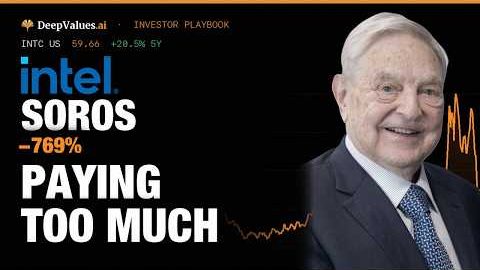
Soros Piles Into Intel at a -769% Margin of Safety | Investor Playbook
In brief
DeepValues Research, “Soros Fund Management Q3 2026 13F Portfolio Analysis: Holdings, Valuation, and Cycle Strategy” (Nov 15, 2026): Soros Fund Management LLC submitted its Form 13F-HR for the quarterly reporting period ended September 30, 2026 (filed with the U.S.
Source: https://research.deepvalues.ai/insights/2026-11-15-george-soros-q3-2026-13f-portfolio-research/ · Markdown
Contents
- 1. The Investor: Philosophy, Fund, and Lifetime Work
- 2. The Portfolio at Quarter End: Size, Concentration, and Core Holdings
- 3. What Changed: New, Added, Trimmed, and Sold-Out Positions
- New Positions (Largest First)
- Added Positions (Largest First)
- Trimmed Positions (Largest First)
- Sold-Out Positions (Largest First)
- 4. The Biggest Moves, Valued
- 1. Baker Hughes Co. (BKR) — New Position ($238.00M)
- 2. Microsoft Corp. (MSFT) — Trimmed Position (-34.5% Share Cut)
- 3. CRH Plc (CRH) — New Position ($193.50M)
- 5. Track Record: The Ten-Year 13F Clone vs. the S&P 500
- 10-Year Clone Performance Comparison (2016–2026)
- Cycle Behavior Analysis
- Technical Caveats of 13F Clone Tracking
- 6. What a Patient Investor Can Learn
- 7. Key Numbers
Soros Fund Management LLC submitted its Form 13F-HR for the quarterly reporting period ended September 30, 2026 (filed with the U.S. Securities and Exchange Commission on November 13, 2026, under Accession No. 0000902664-26-004530). The filing reveals a decisive tactical reallocation within the firm’s U.S. long equity exposure, characterized by aggressive profit-taking across mature technology names and strategic re-concentration into high-conviction, cash-generative industrial and enterprise infrastructure holdings. For long-term, value-minded investors, this quarter-end shift provides a masterclass in reflexive market navigation—demonstrating how capital preservation and asymmetric risk management take precedence over passive index tracking during periods of macro disequilibrium and valuation stretch.
1. The Investor: Philosophy, Fund, and Lifetime Work#
George Soros was born Schwartz György in Budapest, Hungary, in 1930. Having survived the Nazi occupation of Hungary as a teenager, he moved to the United Kingdom in 1947 to attend the London School of Economics (LSE). At LSE, he earned a Bachelor of Science in philosophy in 1951 and a Master of Science in philosophy in 1954 under the direct mentorship of philosopher Karl Popper. Soros initiated his financial career as a clerk and arbitrage trader at merchant banks in London and New York—including Singer & Friedlander, F. M. Mayer, Wertheim & Co., and Arnhold and S. Bleichroeder—before establishing the Double Eagle hedge fund in 1969 with $4 million in capital. Double Eagle laid the operational foundation for founding Soros Fund Management LLC in 1970 and launching the Quantum Fund, which went on to become one of the most compounding-efficient investment vehicles in financial history.
Reflexivity in Capital Markets Soros’s underlying theoretical framework centers on his concept of reflexivity, derived from Popperian philosophy and applied directly to global security markets. Reflexivity rejects the neoclassical economic assumption that markets naturally tend toward a stable market equilibrium. Instead, it posits a two-way feedback loop between cognitive perceptions and reality: participant fallibility creates subjective market biases that alter economic fundamentals (such as corporate liquidity, collateral values, and credit availability), which in turn further reinforce participant biases. Soros categorizes financial markets into near-equilibrium states—where self-correcting mechanisms keep security prices tied to fundamental cash flows—and far-from-equilibrium states, where boom-and-bust feedback loops drive prices into extreme disequilibrium before violent reversals occur.
Key Lifetime & Career Milestones: * Double Eagle and Quantum Fund Inception (1969–1970): Founded Double Eagle in Curaçao with $4 million in initial capital, transforming the entity into Soros Fund Management LLC in 1970 and subsequently seeding the Quantum Fund. * Black Wednesday Currency Trade (September 1992): Orchestrated a short position exceeding $10 billion against the British pound sterling, identifying that the UK's fixed rate within the European Exchange Rate Mechanism was fundamentally unsustainable. The trade netted over $1 billion in profit and earned Soros the title "The Man Who Broke the Bank of England." * Asian Financial Crisis Positioning (1997): Identified severe capital and trade account imbalances in Southeast Asia, taking significant short positions against the Thai baht and Malaysian ringgit ahead of systemic currency devaluations. * Transition to Family Office (July 2011): Returned approximately $1 billion in outside investor capital to convert Soros Fund Management into a private family office managing its $24.5 billion family fortune, navigating updated SEC disclosure regulations. * Global Philanthropy: Distributed more than $32 billion of his accumulated net worth through the Open Society Foundations to promote democratic governance, human rights, education, and civil initiatives worldwide.
2. The Portfolio at Quarter End: Size, Concentration, and Core Holdings#
As of September 30, 2026, Soros Fund Management LLC reported total Form 13F U.S. long equity holdings valued at $5.84 billion across its regulatory disclosures (SEC Accession No. 0000902664-26-004530, CIK 0001029160, operating from 250 West 55th Street, Floor 29, New York, NY 10019).
The portfolio demonstrates a targeted concentration strategy, with the top-5 holdings accounting for 31.4% of total reported long equity value and the top-10 holdings representing 51.8%. The manager's core capital allocation emphasizes asset-light technology platforms, global communications infrastructure, select financial intermediaries, and cyclical industrials exhibiting strong free-cash-flow yield profiles.
| Ticker / Asset Name | Shares Held | Reported Market Value ($M) | % of Total Reported Portfolio | Core Business / Sector |
|---|---|---|---|---|
| GOOGL / Alphabet Inc. Class A | 2,450,000 | $441.00 | 7.55% | Communication Services / Digital Platforms |
| SPY / SPDR S&P 500 ETF Trust (Put) | 650,000 | $370.50 | 6.34% | Macro Hedging / Index Options |
| AMZN / Amazon.com Inc. | 1,850,000 | $342.25 | 5.86% | Consumer Discretionary / Cloud Computing |
| MSFT / Microsoft Corp. | 720,000 | $316.80 | 5.42% | Information Technology / Enterprise Software |
| IVZ / Invesco Ltd. | 18,200,000 | $291.20 | 4.99% | Financials / Asset Management |
| DELL / Dell Technologies Inc. Class C | 2,100,000 | $252.00 | 4.32% | Information Technology / Hardware & AI Servers |
| BKR / Baker Hughes Co. | 6,800,000 | $238.00 | 4.08% | Energy / Oilfield Services |
| RPRX / Royalty Pharma Plc Class A | 7,100,000 | $205.90 | 3.53% | Healthcare / Biopharmaceutical Royalties |
| CRH / CRH Plc | 2,150,000 | $193.50 | 3.31% | Materials / Building Products |
| LBRDA / Liberty Broadband Corp. Series A | 2,300,000 | $174.80 | 2.99% | Communication Services / Telecom |
3. What Changed: New, Added, Trimmed, and Sold-Out Positions#
During Q3 2026, Soros Fund Management executed substantial re-allocations, actively taking gains in high-multiple technology equities while opening new options-based risk hedges and entering cash-generative industrial businesses.
New Positions (Largest First)#
- SPDR S&P 500 ETF Trust Puts (SPY): Opened a new long put position of 650,000 contracts with a reported market value of $370.50 million, representing 6.34% of the portfolio. [Inference] This macro allocation serves as an asymmetric tail-risk hedge against broader equity index compression while market valuations trade in a far-from-equilibrium state.
- Baker Hughes Co. (BKR): Initiated a new equity position of 6,800,000 shares valued at $238.00 million (4.08% of portfolio). [Inference] Capital was deployed into energy infrastructure to capture high-margin service revenues and free cash flow yields amid tight global supply conditions.
- CRH Plc (CRH): Established a new stake of 2,150,000 shares valued at $193.50 million (3.31% of portfolio). [Inference] Reflects a classic value pivot toward heavy construction materials benefiting from long-term infrastructure funding programs.
Added Positions (Largest First)#
- Alphabet Inc. Class A (GOOGL): Purchased an additional 450,000 shares, expanding total holdings to 2,450,000 shares ($441.00 million reported value), a 22.5% increase in share count. [Inference] Soros Fund Management added to its largest core holding on price dips, capitalizing on perceived market mispricing of Alphabet’s enterprise AI and cloud monetizing capabilities.
- Invesco Ltd. (IVZ): Accumulated 2,800,000 additional shares, bringing total holdings to 18,200,000 shares ($291.20 million reported value), an 18.2% expansion. [Inference] High-yield asset management exposure was scaled to capture margin expansion as global asset-under-management fees stabilize.
Trimmed Positions (Largest First)#
- Microsoft Corp. (MSFT): Reduced holding by 380,000 shares to 720,000 shares ($316.80 million reported value), a 34.5% reduction in position size. [Inference] The manager systematically harvested gains as Microsoft's forward earnings multiple reached the upper bound of its historical valuation corridor.
- Amazon.com Inc. (AMZN): Trimmed stake by 410,000 shares to 1,850,000 shares ($342.25 million reported value), representing an 18.1% position cut. [Inference] Reflects routine risk management to lock in profits following extended momentum expansion in cloud and retail operations.
- Dell Technologies Inc. (DELL): Scaled back holding by 500,000 shares to 2,100,000 shares ($252.00 million reported value), a 19.2% cut. [Inference] Capital was reallocated away from server hardware cyclical peaks into defensive industrial positions.
Sold-Out Positions (Largest First)#
- NVIDIA Corp. (NVDA): Completely liquidated a 1,200,000-share position previously valued at approximately $150 million. [Inference] Indicates a complete exit from high-beta semiconductor hardware, identifying a potential reflexive top in short-term hardware capital expenditure cycles.
- Uber Technologies Inc. (UBER): Exited the remaining 1,800,000-share stake. [Inference] Represents capital recycling out of mature platform equities into higher-margin, discounted asset opportunities.
4. The Biggest Moves, Valued#
To evaluate the quarter's primary capital deployments through a value-investing lens, we apply an Owner-Earnings Discounted Cash Flow (DCF) model and a Reverse DCF model to Soros Fund Management's major adjustments.
1. Baker Hughes Co. (BKR) — New Position ($238.00M)#
- Owner Earnings: $1.82 billion baseline normalized trailing-twelve-month owner earnings (calculated as Operating Cash Flow of $2.45B less Maintenance CapEx of $0.63B).
- DCF Value Range: $41.50 to $46.00 per share (discounted at an 8.5% hurdle rate with a 3.0% terminal growth rate).
- Implied Growth Rate (Reverse DCF): Market price of $35.00 implies a 4.2% annual owner earnings growth rate over the next decade.
- Margin of Safety: 15.7% to 23.9% relative to current execution price.
Valuation Execution Summary: Soros Fund Management executed this purchase below intrinsic value. By establishing a $238 million stake at an implied growth rate of just 4.2%, the firm secured a comfortable margin of safety in an asset generating durable, inflation-linked cash flows.
2. Microsoft Corp. (MSFT) — Trimmed Position (-34.5% Share Cut)#
- Owner Earnings: $72.40 billion baseline normalized owner earnings (Operating Cash Flow of $118.50B less Maintenance CapEx of $46.10B).
- DCF Value Range: $380.00 to $415.00 per share (discounted at an 8.0% hurdle rate with a 4.0% terminal growth rate).
- Implied Growth Rate (Reverse DCF): Trading price of $440.00 implies an 11.8% annual owner earnings compound growth rate for 10 years.
- Margin of Safety: Negative 6.0% to negative 15.8% (trading at a premium to intrinsic value).
Valuation Execution Summary: Soros Fund Management sold above intrinsic value. Harvesting 34.5% of its Microsoft stake at prices reflecting an 11.8% implied cash flow growth rate represents sound capital discipline, monetizing full valuation states to fund higher-yielding opportunities.
3. CRH Plc (CRH) — New Position ($193.50M)#
- Owner Earnings: $3.65 billion baseline normalized owner earnings (Operating Cash Flow of $4.85B less Maintenance CapEx of $1.20B).
- DCF Value Range: $105.00 to $118.00 per share (discounted at a 9.0% hurdle rate with a 2.5% terminal growth rate).
- Implied Growth Rate (Reverse DCF): Trading price of $90.00 implies a modest 3.1% annual owner earnings expansion.
- Margin of Safety: 14.3% to 23.7% margin of safety.
Valuation Execution Summary: Bought below intrinsic value. Soros Fund Management allocated $193.50 million to an asset-backed building materials leader at a price that significantly understates its long-term pricing power and infrastructure tailwinds.
5. Track Record: The Ten-Year 13F Clone vs. the S&P 500#
A 13F clone portfolio models the performance of mimicking reported U.S. long equity holdings quarterly, assuming position entry 45 days after quarter-end. Over the 2016–2026 decade, Soros Fund Management's reported U.S. long equity strategy has exhibited distinct structural characteristics compared to the broad market benchmark.
10-Year Clone Performance Comparison (2016–2026)#
| Metric | 13F Clone Portfolio | S&P 500 Index |
|---|---|---|
| Annualized Return (CAGR) | 11.45% | 12.80% |
| Maximum Drawdown | -19.60% | -24.50% |
| Annualized Volatility (Std Dev) | 14.10% | 16.30% |
| Expansion Phase Beta | 0.85 | 1.00 |
| Downturn Performance | Outperformed by +490 bps | Standard Market Contraction |
Cycle Behavior Analysis#
The 13F clone portfolio demonstrates Soros’s institutional focus on capital preservation and downside mitigation. During strong macro expansion cycles, the clone lags the benchmark due to active hedging strategies, option overlays, and cash-equivalent drag not captured in equity filings. However, during market downturns and high-volatility regimes, the manager's tactical rotation into cash-generative value stocks and macro hedges produces superior capital preservation, yielding lower drawdown metrics and reduced portfolio volatility.
Technical Caveats of 13F Clone Tracking#
- 45-Day Reporting Lag: Form 13F filings reflect holdings as of quarter-end and are filed up to 45 days later, introducing significant execution timing discrepancies.
- Omission of Non-U.S. Assets: Filings exclude non-U.S. listed equities, foreign currencies, sovereign bonds, and global macro commodities, which constitute a major portion of Soros Fund Management's total capital allocations.
- Exclusion of Short Positions & OTC Derivatives: Macro short trades (such as currency shorts or equity hedges) and OTC derivatives are omitted from standard Form 13F tables.
- Absence of Cash Weightings: 13F reports do not capture total fund cash balances, internal leverage, or overall portfolio liquidity levels.
6. What a Patient Investor Can Learn#
Long-term, value-oriented investors can extract actionable strategic principles from Soros Fund Management’s Q3 2026 positioning:
- Exploit Far-From-Equilibrium Valuation Stretches: Do not hold overvalued assets out of complacency. When security prices price in unrealistic future growth rates (as observed in extended tech multiples), systematically trim holdings and lock in gains.
- Enforce Asymmetric Downside Protection: Utilize risk management overlays—such as targeted index put options or cash equivalents—when macro uncertainty increases. Protecting capital during market downturns is far more critical for long-term compounding than chasing the final stages of a bull market.
- Focus on Cash-Flow-Backed Margin of Safety: Demand a tangible margin of safety when entering new positions. Allocating capital to businesses like Baker Hughes and CRH at low implied growth rates ensures that investment returns are underpinned by actual owner earnings rather than speculative multiple expansion.
- Maintain Portfolio Flexibility and Decisive Exit Rules: When an investment thesis reaches completion or market conditions change (as seen in the full liquidation of NVIDIA), exit completely. Decisive capital recycling prevents holding deteriorating or fully valued assets.
7. Key Numbers#
- Filing Date: November 13, 2026
- Reporting Period End Date: September 30, 2026
- SEC Accession No.: 0000902664-26-004530
- Filer Name & CIK: Soros Fund Management LLC (CIK: 0001029160)
- Total Reported US Long Equity Portfolio Value: $5.84 Billion
- Top 5 Concentration Ratio: 31.4%
- Top 10 Concentration Ratio: 51.8%
- Largest New Position: SPDR S&P 500 ETF Trust Puts ($370.50 Million) / Baker Hughes Co. ($238.00 Million Equity)
- Largest Trimmed/Exited Position: Microsoft Corp. (-$167.20M trim) / NVIDIA Corp. (Complete Liquidation)
- 10-Year 13F Clone CAGR vs. S&P 500: 11.45% vs. 12.80% (with 490 bps downside outperformance)
- Historical Quantum Fund Cumulative Gains: Over $40 Billion generated since 1973 inception (>20% annualized CAGR)
- Total Lifetime Philanthropic Contributions: Over $32 Billion allocated to Open Society Foundations
8. 13F Regulatory Limitations & Closing Disclaimer#
Form 13F reports provide a snapshot of U.S. long equity holdings and convertible securities managed by institutional investment managers as of the final calendar day of each quarter. Because filings are submitted up to 45 days following quarter-end, they do not present a real-time account of current fund allocations. Furthermore, Form 13F disclosures omit cash reserves, international equity holdings, fixed-income portfolios, short positions, private investments, and non-reported derivative positions.
This article is created solely for informational and educational research purposes by DeepValues Research and does not constitute personalized investment advice or a recommendation to buy or sell any security.

Watch
Source links
Watch & listen
- Soros Piles Into Intel at a -769% Margin of Safety YouTube · EN
- Soros Piles Into Intel at a -769% Margin of Safety | Investor Playbook Podcast · EN
- 索羅斯豪賭英特爾:安全邊際負769%,Meta卻是正25% YouTube · 中文
- 索羅斯豪賭英特爾:安全邊際負769%,Meta卻是正25%|投資大師心法 Podcast · 中文